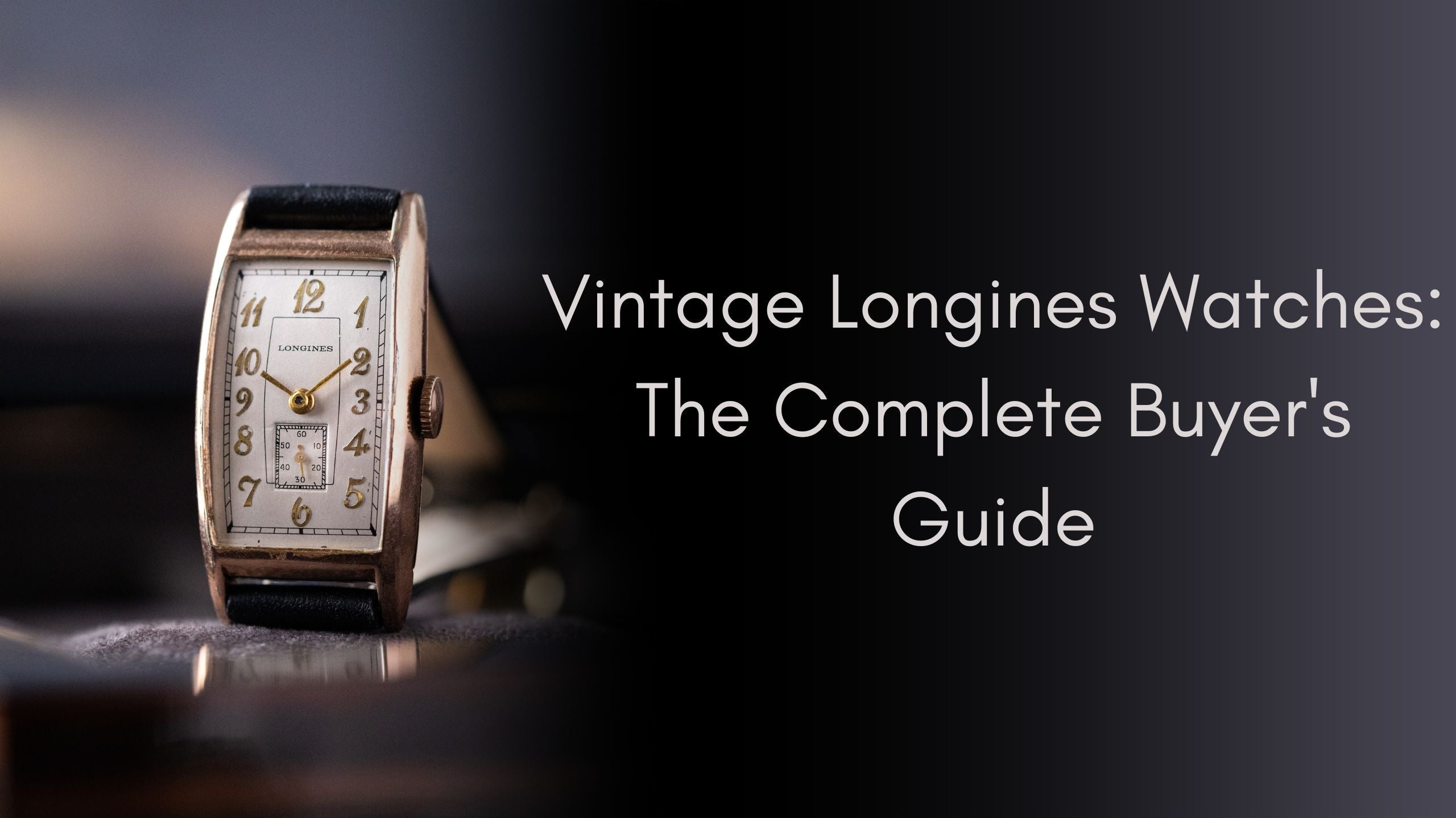

Collectors learn dial fonts, case shapes, and calibre numbers — yet the hands are often the first thing a trained eye actually reads. They date a watch, define its character, and expose a bad restoration faster than almost any other component. This is the complete guide to the eighteen hand styles every vintage collector should know by sight.
Watch hands are more than a design detail. They are period markers: a dauphine hand tells you post-war optimism, a cathedral hand tells you trench warfare, a snowflake tells you 1969 and nothing else. They are also an authentication tool — because when a dial has been redone or hands replaced during a careless service, the style mismatch is usually visible before you ever open the caseback. Below, we cover each style, where it came from, and which watches wear it.
The Four Families of Watch Hands
Eighteen named styles sounds like a lot to memorise. In practice, nearly every hand ever fitted to a wristwatch belongs to one of four families — and once you see the logic behind each family, individual styles become easy to place.
Descended from pocket watch tradition. Slim, elegant, often heat-blued or polished gold. These hands prioritise refinement over legibility — and define the great dress watches of the 1930s–1950s.
Built for legibility in bad conditions — trenches, cockpits, and open water. Broad surfaces designed to carry luminous material, readable at a glance in the dark.
The clean-lined styles of post-war design. Straight, geometric, unornamented — hands that let the dial architecture do the talking. Dominant from the 1950s through the 1970s.
Hands that abandon the pointer entirely. Rare, polarising, and instantly memorable — including one of the most unusual designs ever to leave a Soviet factory.
All 18 Styles Compared
Use this table as a field reference. "Era of origin" refers to when the style became established on wristwatches — most were worn for decades afterwards, and several never left production.
| Hand Style | Era of Origin | Character | Typically Seen On |
|---|---|---|---|
| Breguet | 1780s (pocket watches) | Refined, historical | Classical dress watches |
| Spade | 19th century | Traditional, formal | Early wristwatches, chronographs |
| Cathedral | 1910s | Robust, luminous | Trench & military watches |
| Sword | 1910s–20s | Sharp, architectural | Cartier Tank, dress watches |
| Spear | 1930s | Elegant, pointed | Art Deco rectangular watches |
| Leaf | 1930s–40s | Soft, organic | Calendar & dress watches |
| Obelisque | 1930s–40s | Angular, Deco | Rectangular tank-style cases |
| Syringe | 1930s–40s | Precise, clinical | Military & medical watches |
| Teardrop | 1940s | Graceful, tapered | Mid-century chronographs |
| Alpha | 1940s–50s | Balanced, versatile | Post-war Swiss dress watches |
| Dauphine | 1950s | Faceted, luxurious | Post-war dress watches |
| Pencil | 1950s | Clean, functional | Everyday watches, field styles |
| Mercedes | 1950s | Sporting, iconic | Rolex sports models |
| Arrow | 1950s–60s | Bold, directional | Sports & military watches |
| Baton | 1960s | Minimal, modern | Slim dress & quartz-era watches |
| Snowflake | 1969 | Distinctive, maximal lume | Tudor dive watches |
| Plongeur | 1970s | Oversized, utilitarian | Professional dive watches |
| Beaubleu (Circle) | 1980s (Raketa) / modern revival | Radical, sculptural | Raketa Kopernik, modern Beaubleu |


Dress & Classical Hands
These are the hands of the pocket watch tradition, carried over onto the wrist and refined through the golden age of Swiss dress watchmaking. If your collecting centres on vintage Swiss watches from the 1930s through the 1950s, these six styles will account for the overwhelming majority of what crosses your desk.
Breguet
The oldest named style in this guide, and arguably in all of watchmaking. Abraham-Louis Breguet introduced these hands on his pocket watches in the 1780s: a slim stem terminating in a hollow ring with an offset pointed tip — the shape often described as a "hollow apple" (pomme évidée). Traditionally executed in heat-blued steel, Breguet hands signal classical seriousness. On a wristwatch, they are almost always a deliberate statement of heritage. Finding them on a vintage Omega rectangular dress watch, as in our reference collage, marks a piece that was aiming upmarket from the day it was made.

Spade
Named for the playing-card suit it resembles: a stem swelling into a pointed, heart-like head. Spade hands (the French term is poire, "pear") dominated 19th-century pocket watches and carried into early wristwatches — you find them on trench-era pieces and on pre-war chronographs from makers like Minerva, where a blued spade hour hand pairs handsomely with a busy telemeter dial. On a wristwatch, spade hands are a strong signal of pre-1945 production.

Leaf
Two slender, curved blades that swell gently at the middle and taper to fine points — organic where the dauphine is geometric. Leaf hands (feuille) are the signature of 1930s and 1940s calendar and dress watches, and no maker used them more gracefully than Jaeger-LeCoultre: the blued leaf hands on a 1940s LeCoultre triple calendar are among the most recognisable pairings in vintage collecting. Because they are thin and usually heat-blued, they are also among the most frequently damaged and replaced — check the bluing tone matches between hour and minute hand.

Alpha
The alpha hand is a slim triangle: narrow at the centre post, widening slightly along its length, then closing to a sharp tip, often with a short tail behind the post. It sits stylistically between the leaf and the dauphine — less romantic than the former, less severe than the latter — which is exactly why post-war Swiss makers used it everywhere. The gilt alpha hands on a Buren Grand Prix are a textbook example: dressy, legible, and unmistakably 1950s.

Dauphine
If one hand style defines post-war luxury, it is the dauphine: a broad, faceted triangle, usually with a polished ridge running down the centreline so the two halves catch light differently as the wrist moves. Dauphine hands appeared across the finest 1950s dress watches — Omega Constellations, Patek Philippe Calatravas, and Universal Genève dress pieces like the one in our collage all wore them. The faceting is the point: an original dauphine hand plays with light in a way flat replacement hands never quite reproduce.

Spear
A close cousin of the leaf, but with straighter sides and a more decisive point — a lance rather than a blade of grass. Spear hands appear frequently on Art Deco rectangular watches of the 1930s, where their length and taper suit the elongated dial. The gold spear hands on a black-dial Omega tank-style piece show the effect at its best: formal, vertical, and perfectly period-correct.

Military & Tool Watch Hands
Tool watch hands solve one problem: being read instantly, in poor light, by someone whose attention is elsewhere. Every style in this family exists to carry luminous material or to maximise contrast — and several of them became icons far beyond their original purpose.
Cathedral
The defining hand of the WWI trench watch. Cathedral hands use a skeletonised framework — the hour hand's head resembling a Gothic window, hence the name — creating large enclosed areas that were filled with radium lume. The style survived on military and military-adjacent watches into the 1940s; the Lemania chronograph in our collage wears them with original lume intact. On any cathedral-handed watch, the condition and colour of that lume is central to both value and authenticity.

Syringe
A straight luminous-filled shaft that steps down abruptly to a thin needle tip — precisely like a hypodermic. The design logic is elegant: the broad body carries lume for darkness, while the fine tip allows exact reading against a minute track. Syringe hands appear on 1930s–40s military watches and on medical-oriented pieces, and Omega used them on wartime and immediately post-war models. They remain one of the most functional hand designs ever drawn.

Sword
Straight-sided blades tapering to a point — simple, architectural, and timeless. Sword hands (glaive) exist in two great traditions: the blued sword hands of the Cartier Tank, where they read as pure dress elegance, and the luminous-filled sword hands of military watches like the Zenith in our collage, where the same geometry serves battlefield legibility. Few hand styles cross the formal–functional divide so completely.

Mercedes
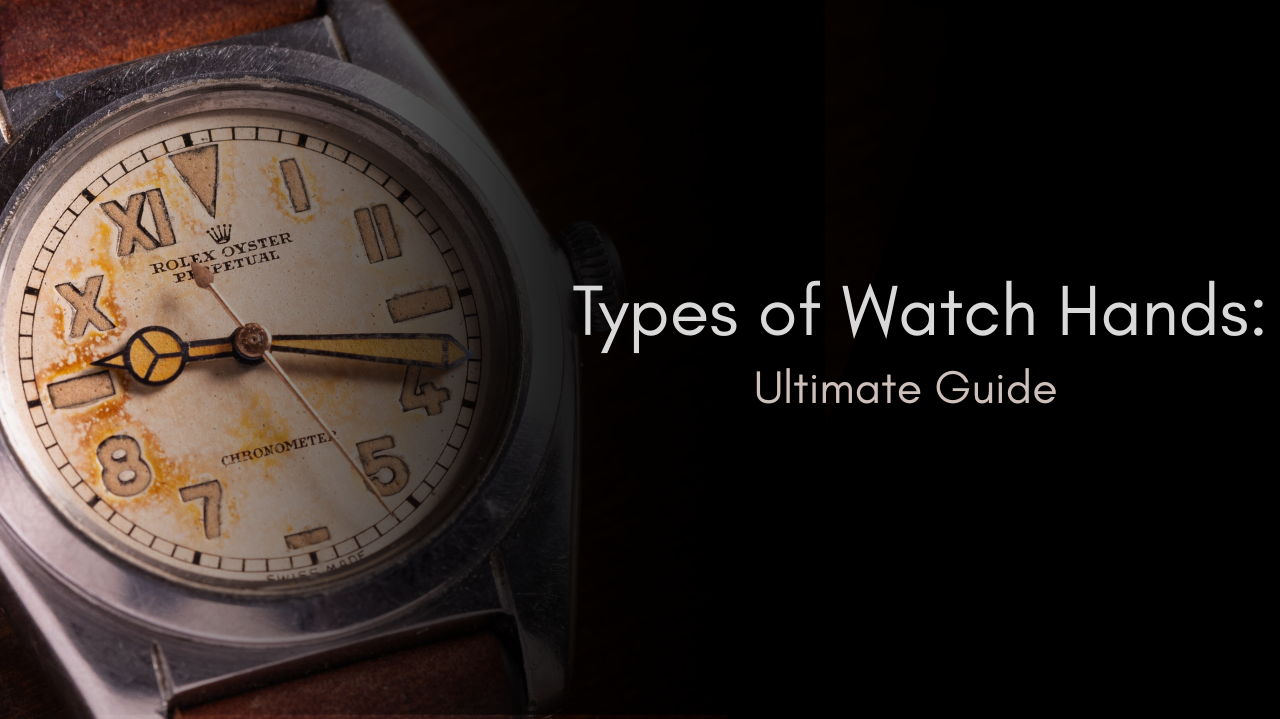
The most famous hand in watchmaking. The Rolex Mercedes hand — an hour hand whose circular head is divided into three segments resembling the three-pointed star — became standard on the brand's professional models from the early 1950s onward. The practical rationale is lume stability: the three-way division supports the luminous material within the circle. Whatever the origin, it is now inseparable from the identity of the Submariner, Explorer, and GMT-Master — and its presence on a vintage Oyster is a quick period reference point.

Snowflake
Introduced by Tudor in 1969 on its Submariner references, reportedly to meet the legibility demands of professional and naval divers. The angular, square-tipped hour hand maximises lume surface in a way no round-headed hand can, and it has become Tudor's most recognisable design signature — revived on the modern Black Bay line precisely because collectors never stopped asking for it. Original snowflake-handed Tudors are now serious collector property.

Plongeur
French for "diver," and the name tells you everything. Plongeur hands are deliberately oversized — most famously the broad, arrow-tipped minute hand, often in high-visibility orange or with maximal lume — because on a dive watch, elapsed minutes matter more than the hour. The style is most associated with 1970s professional divers, Seiko's in particular, and its industrial confidence is pure seventies tool-watch design.

Arrow
An hour or seconds hand terminating in a bold triangular arrowhead, sometimes open, sometimes lume-filled. Arrow hands appear across 1950s–60s sports and military watches — Omega used a broad arrow hand on early Speedmasters — and Soviet makers embraced the style enthusiastically. The Vostok Amphibia and Komandirskie lines wear arrow hands as standard, and the crackled-dial Vostok in our collage is a perfect example of why Soviet watches remain such an accessible entry into tool-watch collecting.

Mid-Century & Modernist Hands
As dial design cleaned itself up through the 1950s and 60s, hands followed. This family strips away ornament: straight lines, consistent widths, geometry over decoration.
Pencil
A straight hand of even width, closing to a short point — exactly like its namesake. Pencil hands are the everyman of hand design: legible, inexpensive to produce, and stylistically neutral, which is why they appear on everything from field watches to dress pieces. The lumed pencil hands on a black-dial Doxa Anti-Magnétique show the style doing what it does best: quiet, honest work.

Obelisque
A skeletonised, angular hand that tapers like its monumental namesake — an Art Deco favourite that suits rectangular cases exceptionally well. Longines used obelisque-style hands on its 1930s–40s tank-form watches, where the open framework keeps a small dial from feeling crowded. If you are dating an unbranded rectangular watch, obelisque hands are a reliable pointer to the Deco decades. For sector-dial and rectangular Longines pieces specifically, serial verification through our Longines serial number decoder will confirm the production year.

Baton
The most reduced hand possible: a plain straight stick, square-ended or minimally tapered, often with a thin lume stripe. Baton hands rose with 1960s minimalism and became near-universal in the early quartz era — the Omega Constellation Quartz in our collage is a textbook pairing of baton hands with an applied-index dial. On thin dress watches, batons signal restraint; on 1970s pieces, they simply signal the decade.

Teardrop
A slim hand that swells into a soft, elongated drop before tapering to its tip — one of the most graceful profiles of the 1940s. Teardrop hands appear frequently on mid-century chronographs, where their fluid line offsets the density of tachymeter and telemeter scales; the Baume & Mercier chronograph in our collage wears blued teardrop hands over a beautifully complicated dial. The style is subtle enough that many collectors never learn its name — which makes recognising it a quiet mark of expertise.

The Unconventional Ones
The Circle Hand
The most radical entry in this guide abandons the pointer altogether. Circle hands replace the traditional blade with a full ring — the ring's position on the dial, rather than a tip, indicates the time. The most celebrated vintage execution is the Raketa Kopernik ("Copernicus"), the Soviet design in our collage, where a gilt disc serves as the hour hand and a slim ring as the minute hand, evoking planets in orbit. It is one of the most imaginative dials ever produced at the Petrodvorets factory, and a fixture of serious Soviet watch collections. In the modern era, the French independent Beaubleu built its entire identity on circular hands — which is why the style now often carries the brand's name. The Kopernik got there first.

Hand nomenclature is convention, not standard. The same profile may be called leaf or feuille, spade or poire, sword or glaive depending on the source — and some styles (alpha, obelisque) blur into their neighbours at the margins. Auction catalogues from Christie's and Antiquorum are the closest thing to an authoritative usage record. What matters for a collector is not the label but the ability to recognise when a hand is wrong for the watch — a skill the next section covers.
Hands as an Authentication Tool
Here is the practical payoff of everything above: hands are one of the fastest authentication checks available, because they are the component most often replaced during indifferent servicing — and the replacement is usually detectable from photographs alone.
Style match: Does the hand style belong on this reference in this era? A dauphine hand on a 1930s trench watch, or a modern glossy sword hand on a 1940s chronograph, is an immediate red flag.
Lume consistency: Hand lume should age in step with dial lume. Bright white or greenish hand lume against creamy aged dial plots means the hands were relumed or replaced.
Bluing tone: On heat-blued hands, hour and minute should show the same depth of blue. Chemically blued or painted replacements read flat and dark next to true heat bluing.
Length and fit: Original minute hands reach the minute track; original hour hands reach the hour markers. Hands that fall short or overshoot were sourced from parts stock.
Finish quality: Original facets are crisp; the centre ridge of a dauphine catches light cleanly. Soft edges and dull surfaces suggest generic service replacements.
None of these checks requires opening the case, and together they filter out a large share of problem watches before money changes hands. Replaced hands are not always disqualifying — on a 60-year-old daily wearer, a period-correct service replacement is common and honest — but they must be priced accordingly, and disclosed. A proper service preserves original hands wherever possible; our vintage watch servicing guide covers how a competent watchmaker handles them, including safe removal and refitting without dial damage.
The same logic extends to cases and markings: hand originality is one pillar of authentication, hallmarks are another. Our guide to Swiss watch hallmarks completes the picture for precious metal cases.
Which Hand Style Defines Your Collection?
Most collectors, whether they realise it or not, gravitate toward one family of hands — because hand style and collecting taste are the same instinct expressed twice. Here is how the styles map:
The classical canon. Blued leaf hands on a LeCoultre calendar, faceted dauphines on an Omega Constellation — these are the styles that reward close looking and careful buying.
Lume-carrying, purpose-built, history-laden. Original luminous material is the whole game here — condition and consistency of the lume drives both value and authenticity.
The icons. Each of these three styles is inseparable from the brand that made it famous — and each is a period marker precise enough to date a watch at a glance.
From the Vostok arrow to the Raketa Kopernik's orbiting rings, the unconventional end of the spectrum — where some of the most original design thinking in horology still trades at accessible prices.
Learn these eighteen profiles and something changes in how you look at watches: dating becomes faster, listings become more transparent, and the occasional mismatched hand on an otherwise convincing piece stops slipping past you. Few skills in collecting cost so little to acquire and pay back so consistently.
From blued leaf hands on Jaeger-LeCoultre calendars to arrow hands on Soviet tool watches — every piece at DuMarko is verified for originality before it is listed.
Browse the CollectionYour Questions Answered
Frequently Asked Questions