
If you're trying to work out what's actually on your wrist — or what's in the listing you're about to pay for — we've got you covered. Learning how to identify a vintage watch isn't about one secret trick. There's no single vintage watch identifier that does the job for you, so we use the same ten steps on every watch that reaches us, and anyone can follow them.
An old watch is not automatically an original vintage watch. It can have a genuine case, a genuine movement, and a genuine dial, and still be a mix of parts that never left the factory together. Collectors call those pieces "Frankenwatches," and they're worth a lot less than a correctly configured example. That's why identification matters. It tells you when the watch was made, which movement it should contain, whether the dial has survived untouched, and whether the case has been polished away.
This guide walks through the ten checks we use at DuMarko before any watch goes on the site. You don't need to be a watchmaker. You need to know where to look, what should agree with what, and when to ask for help.
What Makes a Watch Vintage?
Collectors put the line somewhere between 20 and 30 years, and they also look for materials and designs that clearly belong to the decade the watch came from. Our guide to what makes a watch vintage explains the eras, the terms and what makes one collectible.
How to Identify a Vintage Watch: The Ten-Step Method
Here's the whole process in one table. Each step produces a clue, and the clues have to agree with each other. A watch passes when the dial, case, numbers, movement, and documents all point to the same reference and the same period.
| Step | What You Check | What It Tells You | Needs Case Opened? |
|---|---|---|---|
| 1. Brand & model | Dial text, logo, case shape, size | Working hypothesis | No |
| 2. Numbers | Reference and serial | Production period, correct configuration | Sometimes |
| 3. Caseback | Engravings, hallmarks | Metal, maker, era, polishing | Sometimes |
| 4. Movement | Calibre, signature, finishing | Whether the engine belongs | Yes |
| 5. Dial | Printing, lume, patina | Original, refinished, or replaced | No |
| 6. Case | Lugs, edges, proportions | How much metal has been lost | No |
| 7. Components | Crown, crystal, bezel, bracelet | Period-correct or later parts | No |
| 8. Provenance | Papers, archives, service records | Documented history | No |
| 9. Red flags | Cross-check all of the above | Redial, Frankenwatch, or fake | No |
| 10. Value | Comparable sales | What it's worth today | No |
Six of the ten checks needed to identify a vintage watch require nothing more than good light, a loupe, and clear photographs. That's the encouraging part. Most problem watches reveal themselves before anyone touches the caseback.
Step 1: Identify the Brand and Model
Before you search serial charts or ask a watchmaker to open anything, gather what the watch is already telling you. Note the manufacturer, any visible model name, the layout of the dial, the case shape, the approximate size, the crown position, and how the strap or bracelet attaches. This gives you a working hypothesis to test later.
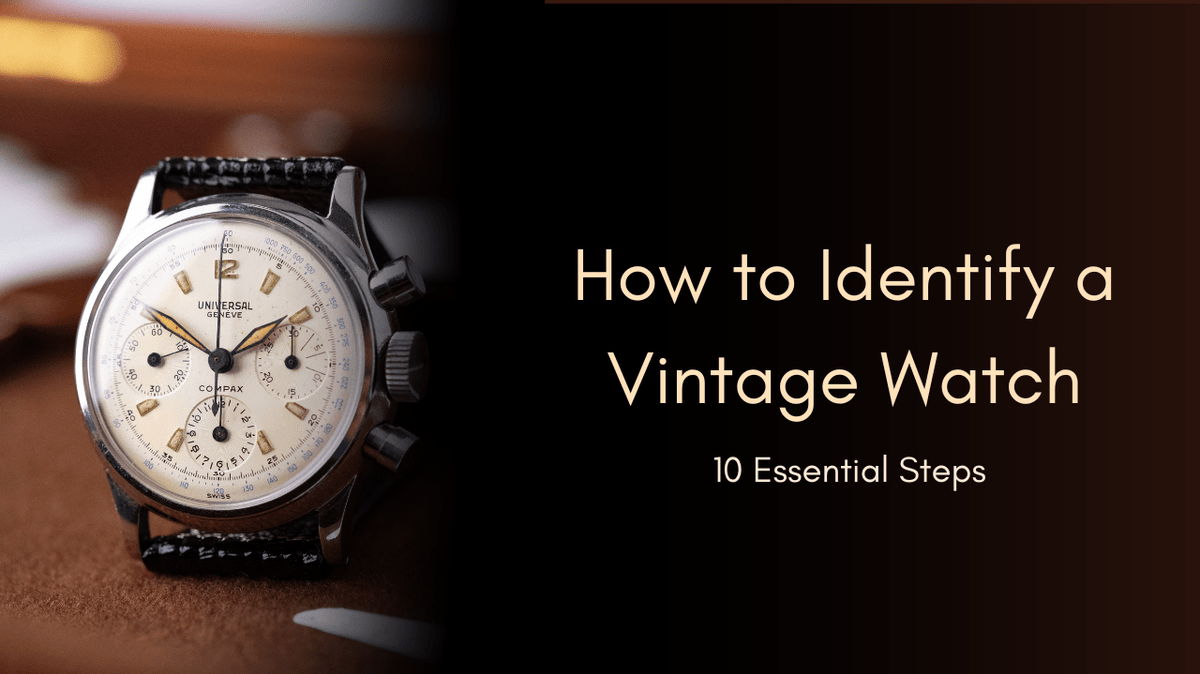
Take "Omega Seamaster" as an example. That name covers hundreds of references across radically different decades. Add a rectangular gold-plated case and a manual movement, and the field narrows fast. The same logic applies to a Cartier Tank, a Longines dress watch, a Universal Genève chronograph, or a Rolex Oyster.
Don't identify a vintage watch purely by visual similarity. Two watches can look identical from the front and contain different calibres, or belong to different references. The reverse is also true: one reference can exist with several legitimate dial colours, bracelets, or minor production variations. Image matching is where you start, not where you finish.
Photograph everything before you do anything else: straight-on dial, both case flanks, crown, caseback, clasp, bracelet end links, and every visible engraving. If a watchmaker later opens the case, photograph the movement too. You're building a small evidence file, and inconsistencies are much easier to spot once every clue sits side by side.
Study the Dial, Logo, and Model Name
The dial is usually the quickest way to start identifying an unknown vintage watch. It's also the component most likely to mislead a beginner. Start with the obvious: brand signature, model name, sub-dials, date window, minute track, hour markers, luminous material, and any country-of-origin wording.
Small words carry big clues. "Automatic," "Chronometer," "Waterproof," "Antimagnetic," "Swiss," "Swiss Made," and "T Swiss T" all help narrow the period. The "T" marks, for instance, indicate tritium lume and point to roughly the 1960s through the late 1990s. Their absence can be just as telling. You don't need to memorise every configuration. You need to compare the watch with confirmed examples of the same reference and similar serial range.
Retailer signatures deserve special care. A vintage Omega, Rolex, or Cartier carrying a second name on the dial isn't automatically a fake. Prestigious retailers such as Tiffany & Co. and Cartier were historically allowed to add their signatures to watches they sold. Auction houses describe these as "double-signed" dials, and authentic examples can be more collectible, not less. Something unusual should trigger research, not an instant verdict.
Assess the Case Shape, Size, and Material
Now look at the case as if the dial were blank. Case design is one of the strongest clues to era and category. Measure the diameter, or width and length on a rectangular watch, excluding the crown. Note the lug shape, bezel profile, thickness, crown guards, and how the case meets the bracelet. Mid-century dress watches look surprisingly small next to modern pieces. Nineteen-seventies designs often use integrated bracelets, tonneau or TV-shaped cases, and bold geometry that dates them instantly.
Then work out the metal. Solid gold, gold-filled, gold-plated, vermeil, stainless steel, and chrome-plated base metal are not interchangeable terms. A yellow case might be 18K, 14K, gold-filled, electroplated, or simply a replacement case that doesn't belong to the reference. Look for wear-through on high-contact points such as lug tips and case edges. Exposed silvery or brassy metal underneath means plating.
Case design also has to agree with the supposed model. If every documented example of a reference uses straight lugs and yours has twisted lugs, something needs explaining.
Step 2: Find the Reference and Serial Numbers
If the dial gives you the watch's identity in broad strokes, the numbers give you coordinates. A reference number identifies a model or configuration. A serial number identifies an individual watch or movement. Together they can establish the production period, case type, movement family, material, and sometimes even the market the watch was shipped to.
Never treat one number as proof of authenticity. Serials can be copied. Cases can be swapped. Movements can be transplanted. Real vintage parts can be assembled into a configuration that never existed. The power of number research is correlation. When the reference, the serial, the movement, and the dial all point to the same period, confidence rises. When one of them disagrees, you've found the question to ask.
Record every visible number exactly as engraved, including dots, slashes, letters, and leading zeros. Don't "correct" an engraving because you think you recognise the reference. Manufacturers changed numbering systems repeatedly, and one character can separate two generations.
Reference Number vs. Serial Number
The difference confuses a lot of new collectors, so here's a simple way to hold it. The reference is the car model. The serial is the individual vehicle's identification number. Thousands of watches share a reference. A serial is meant to identify one watch or one movement.
| Feature | Reference Number | Serial Number |
|---|---|---|
| Main purpose | Identifies a model or configuration | Identifies one watch or movement |
| Shared by many watches? | Usually yes | Normally no |
| Useful for dating? | Sometimes | Frequently |
| Useful for checking parts? | Very — tells you the correct dial, case, movement, bezel | Very — when matched with the reference and archives |
| Proves authenticity alone? | No | No |
The safe conclusion is never "the serial is right, so the watch is real." It's "the serial fits the expected period, and the reference, dial, case, and movement all look consistent with it." Vintage authentication is a chain of evidence, and it's only as strong as its weakest link.
Where to Find Watch Identification Numbers
There's no universal location. Depending on the brand and period, the reference may sit inside the caseback, outside it, between the lugs, on a movement bridge, or on the clasp. Serials may be on the movement, the case, or both. Older Rolex watches carry the reference between the lugs at 12 o'clock and the serial between the lugs at 6. Omega and Longines put the serial on the movement, which means the case has to come off to read it.
For those two brands, DuMarko's free tools save a lot of table-reading. Enter the movement serial into the Omega serial number decoder or the Longines serial number decoder and you'll get an estimated production year in seconds.
Some vintage watches can't be fully identified without removing the caseback. Resist the urge to attack it with a knife, a screwdriver, or a cheap opening tool. One slip can gouge the case, destroy a gasket, crack an aged crystal, or damage a valuable movement. A vintage-competent watchmaker will open it safely in minutes and usually won't charge much to do so.
If you're buying and the seller won't provide movement or inside-caseback photographs for a model where those details matter, treat that as missing evidence. It doesn't make the watch bad. It does mean your confidence, and the price you're willing to pay, should reflect the gap.
Step 3: Read the Caseback, Engravings, and Hallmarks
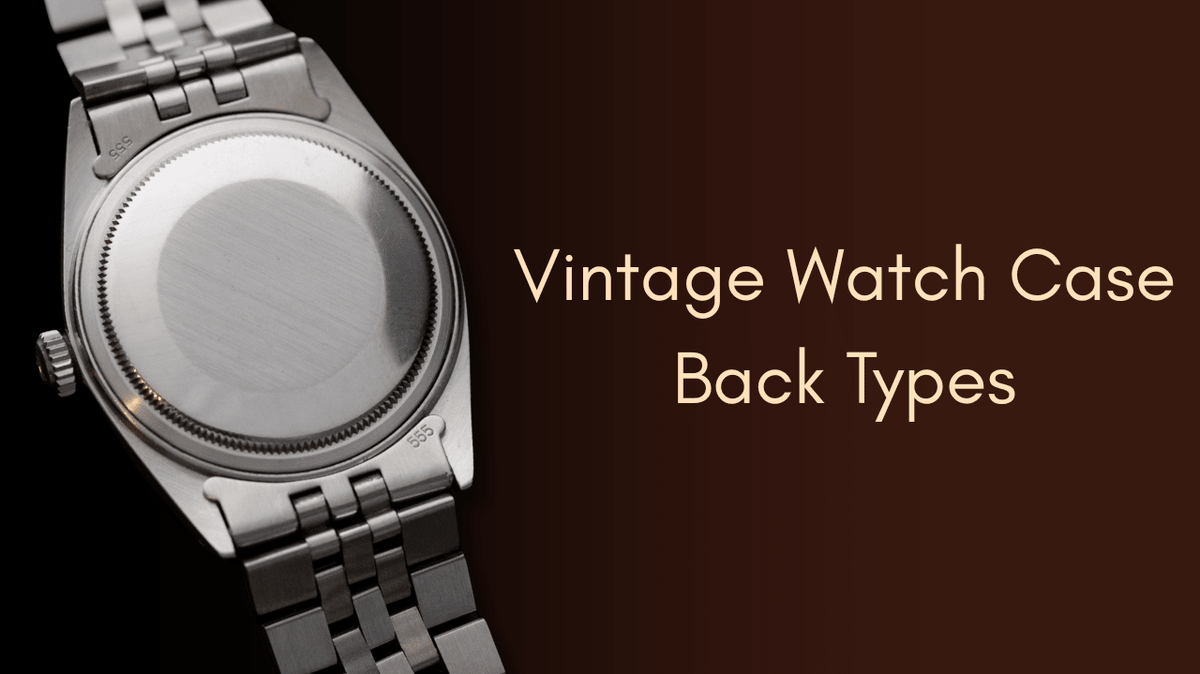
A vintage caseback works a bit like an old passport. It may carry reference numbers, precious-metal hallmarks, case-maker marks, patent numbers, waterproofing terms, military engravings, retailer information, service scratches, or serials. Some marks are visible on the outside. Others hide inside. Compare their depth, alignment, typography, and location with trusted examples of the same reference. Factory engravings should make sense for how that brand marked watches in that period.
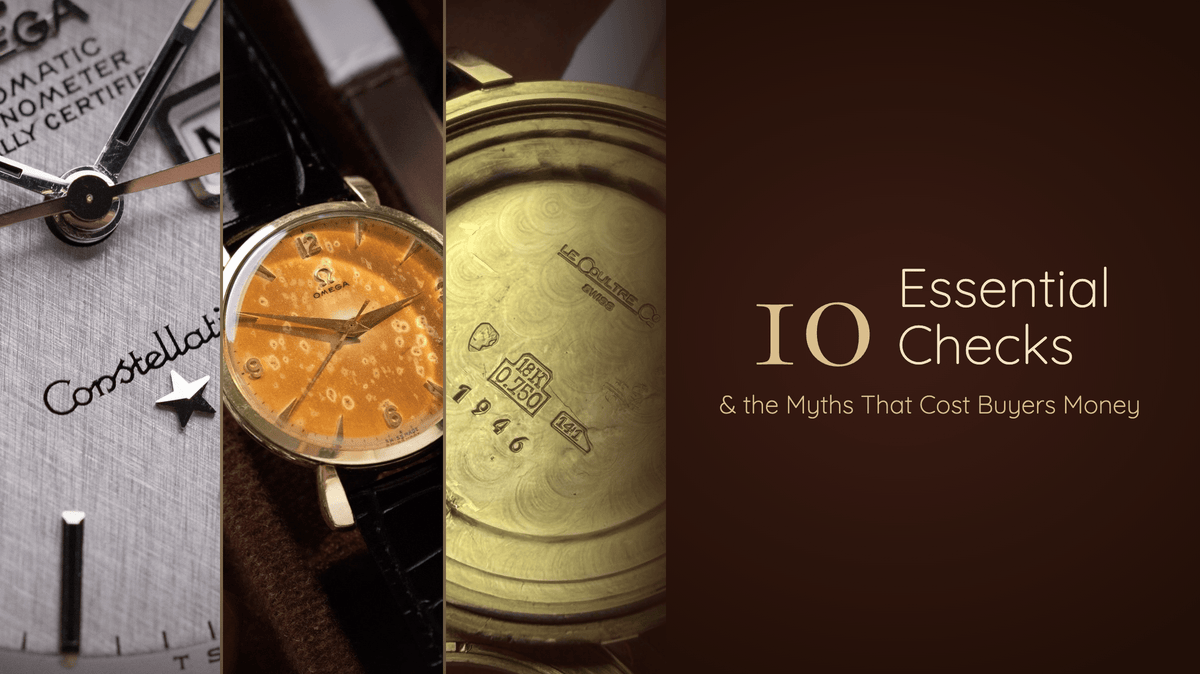
Hallmarks matter most on gold and silver watches. Swiss precious-metal marks use pictorial stamps, such as the Helvetia head for 18K gold, alongside fineness numbers like 0.750 or 0.585. A case sold as solid 18K should carry evidence to match. The marks also reveal condition. Aggressive polishing removes metal, so once-crisp stamps go shallow or vanish entirely after repeated trips to the wheel. Our guide to Swiss watch hallmarks covers the symbols in detail.
Engravings can also tell stories beyond factory spec. A presentation inscription dated 1964 on a reference launched in 1972 is an obvious contradiction. A military issue number, a company award, or an owner's name can strengthen provenance, as long as style and chronology make sense. Treat every engraving as a clue to test, not as automatic added value.
Step 4: Examine the Movement and Calibre
If the dial is the face of a vintage watch, the movement is the engine room. A single look inside answers several questions at once. It shows whether the movement comes from the expected manufacturer and whether the calibre is correct for the reference. It also shows whether the production period agrees with the case and dial, and whether there's corrosion or careless repair. That's why serious authentication gets much easier the moment a competent watchmaker removes the caseback.
Start with the calibre. Confirmed examples and manufacturer records tell you which movements were fitted to a given reference. One vintage Omega reference may have used a single calibre. Another may span three generations. Early chronographs often used specialist movements from Valjoux, Lemania, or Venus, sometimes modified and signed by the watch brand. That's not a warning sign. Movement sourcing was normal throughout Swiss watchmaking, and even the most prestigious houses did it.
Look at signatures and finishing, not just the presence of a familiar logo. Transplanted or counterfeit parts can carry convincing markings. The architecture, jewel count, regulator design, bridge layout, calibre stamp, movement serial, and finishing should all agree with documented examples. Correct identification comes from seeing those details as a system.
Moisture damage is the other thing to look for. Rust on screw heads, pitting on plates, or a dial with brown bleeding around the edges all point to water that got in at some stage. That's a cost, not always a deal-breaker, but it should be priced in.
Step 5: Decide Whether the Dial Is Original
This is where vintage identification gets both fascinating and difficult. A dial can be original and aged, original but cleaned, partly restored, relumed, refinished, fully repainted, or replaced during an official service. Every version can look attractive. Collectors don't value them equally. For many important vintage watches, the untouched original dial is the single largest driver of price.
So many dials were refinished because, decades ago, restoration was considered good maintenance. A customer brought in a faded or stained watch and expected it back looking new. Nobody imagined that fifty years later collectors would pay more for the faded dial. As a result, plenty of legitimate old watches now wear repainted dials.
So separate authenticity from originality. A genuine Omega with a professionally repainted Omega dial is still a genuine Omega. It just isn't original in the collector's sense. An official manufacturer service dial is authentic too, but historically wrong for the production date. The question isn't whether the dial is real. It's whether this is the dial that belongs to this reference and period, and whether it still carries its original finish.
Examine Printing, Fonts, Logos, and Signatures
Dial printing is one of the most powerful tools you have when learning how to authenticate a vintage watch. Compare the logo, letter thickness, spacing, serif shapes, minute-track alignment, numerals, model text, and "Swiss" markings against confirmed period examples. You're looking for consistency, not cosmetic beauty.
Redials usually give themselves away in small relationships. Minute markers that don't line up with the hour indices. Uneven letter spacing. A crosshair passing awkwardly through printed text. A logo sitting slightly too high. "Swiss Made" missing where every known example has it. Printing that looks thick and soft because it was recreated by hand or from a new stamp.
Don't turn these into rigid rules. Vintage brands often used several dial suppliers, and legitimate variations exist within a single reference. A difference only becomes suspicious when it conflicts with the specific reference and period you're investigating. Good authentication is comparison. Find several trustworthy examples, not one random listing, and look for repeating patterns.
Check the Lume, Hands, and Natural Patina
Patina may be the most misunderstood word in vintage watches. Natural ageing doesn't mean every old component must turn brown, and matching creamy lume doesn't prove originality. What matters is whether the ageing makes physical and historical sense. Luminous material changes colour over decades. Lacquer spots, fades, crazes, and shifts tone. Some collectors chase exactly these effects because they make each watch unique.
Look at the relationship between dial lume and hand lume first. A perfect colour match is pleasing, but original hands and dial plots often age differently because they're built and exposed differently. On the other hand, bright white modern-looking lume on an otherwise heavily aged watch suggests replacement hands or a relume. Use a UV torch only as supporting evidence. Aged compounds behave unpredictably, and "it glows, so it's fake" is not a reliable rule.
Check that the hands themselves are correct: shape, length, finish, centre construction, and lume style should all match the reference. And don't confuse damage with desirable patina. Flaking lacquer, spreading rust, or active corrosion threaten the watch. Beautiful ageing tells a story. Destructive corrosion becomes an expensive repair.
Step 6: Judge the Case Condition and Signs of Polishing
A shiny vintage watch isn't necessarily a well-preserved one. One of the ironies of collecting is that honest scratches often beat a mirror finish. Polishing removes metal. Done carefully once, it may have little effect. Done repeatedly or aggressively, it softens edges, narrows lugs, erases bevels, flattens brushed surfaces, weakens engravings, and changes the case's basic proportions. That metal can't be put back.
This is why experienced collectors study case geometry before anything else. Compare the left and right lugs for symmetry. Check that chamfers are still there where the reference should have them. Look for edges that are strangely rounded, a bezel polished into the wrong profile, brushed areas that have been mirror-finished, and hallmarks that have gone faint. Lugs are the usual giveaway. They're thin, they catch the wheel first, and a set that's lost its definition tells you the whole case has been worked.
You don't need a watch that's never seen a polishing cloth. Evidence matters more than vocabulary. "Unpolished" is easy to type into a listing. Judge what you can actually see, and remember that a lightly polished case with sharp lugs is far better than a "never polished" claim you can't verify.
Step 7: Check the Crown, Crystal, Bezel, and Bracelet
Collectors concentrate on the dial and movement and forget that a vintage watch is an ecosystem of smaller parts. The crown, pushers, bezel, crystal, bracelet, clasp, and end links all help decide whether a watch is still period-correct. Each may also have been legitimately replaced during decades of maintenance. Your job isn't to treat every replacement as a disaster. It's to know exactly what you're buying.
Start with the crown. Check whether it's signed, whether a signed crown was actually correct for this reference when new, and whether its shape and size suit the period. Service crowns can differ subtly from originals. On chronographs, check the pushers as well. Bezels need the same attention, especially on dive watches and chronographs where an original insert can represent a real share of the value.
Crystals are different. They're wear parts and were commonly replaced. Most collectors forgive a replacement crystal, unless the original carried a signature or an unusual shape that's part of the reference's identity. Bracelets need their own research: maker signatures, reference codes, clasp date stamps, end-link numbers, and construction style. A correct period bracelet adds real completeness. A tasteful aftermarket one can look excellent without being original.
Original: the component the watch left the factory with. The most desirable state for almost every part.
Period-correct replacement: a genuine part of the right type and era, fitted later. Often accepted, especially when it's indistinguishable from what could have been fitted new.
Later service part: a genuine manufacturer component from a later production run. Authentic to the brand, but historically wrong for the watch's date.
Aftermarket: a part made outside the manufacturer. Should always be disclosed, and priced accordingly.
Step 8: Confirm Provenance, Archives, and Service History
Once the physical inspection looks promising, move from the object to its paper trail. Provenance means evidence of where a watch came from and, ideally, who owned, sold, or serviced it. Original warranty papers are the gold standard. Dated receipts, service invoices, letters, old photographs, presentation inscriptions, and auction records all count too. None replaces inspecting the watch. All of them strengthen the picture.
Manufacturer archives are the most useful documents of all, but you need to understand exactly what each one certifies. Longines is a clear example. The brand's Extract from the Archives reports what its records hold for a given serial: original calibre, case type, dial, and the market the watch was invoiced to. Longines states plainly that this document does not certify the authenticity of the watch or its components. That's a separate service, the Certificate of Authenticity, which requires sending the watch to St-Imier for examination by a watchmaker.
Other houses draw the same line. Audemars Piguet and Jaeger-LeCoultre both offer archive extracts that confirm recorded case and movement numbers, and separate authentication services that involve examining the piece. Patek Philippe's archive records reach back to the 1830s and can confirm manufacturing and sale information for eligible watches. Read what the document actually says. "Archive paper" and "certified original" are not the same thing.
Service history rounds out the file. Ask when the watch was last overhauled and by whom. A recent service from a vintage specialist is worth money, because a proper overhaul costs several hundred dollars and takes weeks.
Step 9: Spot Redials, Frankenwatches, and Counterfeits
Three different problems get lumped together under the word "fake." Separating them makes you a much sharper buyer, because each one is caught in a different way.
A watch made to imitate another manufacturer's product. Caught by movement inspection, wrong finishing, wrong weight, and details no factory would get wrong. Rare among affordable vintage, common among vintage Rolex and Patek.
A genuine watch whose dial has been repainted or heavily refinished. Caught by printing comparison. Not a fake, but a major reduction in collector value, and it must be disclosed.
Genuine parts that don't belong together: a correct case with a later movement, a service dial from another reference, a bracelet from a different model. Caught only by cross-checking everything against the reference.
Everything is real, but the case has been heavily polished, the hands relumed, and the crystal, crown, and gaskets replaced. Honest as a wearer. Weak as a collectible.
The best defence against all four isn't a secret trick. It's consistency across components. The reference agrees with the case shape. The serial fits the era. The calibre belongs in that reference. The dial matches documented examples. Hands, bezel, crown, caseback, and bracelet all make sense together. Nothing looks altered.
Be especially careful with watches that look too perfect and come with no documentation. A flawless dial on a seventy-year-old dress watch is possible, but it deserves a closer look. Equally, don't assume a grubby watch is genuine because it looks old. Artificial ageing exists. For expensive pieces, photographs alone aren't enough. Paying a specialist to inspect the watch is part of buying intelligently, not a sign you failed to identify it yourself.
Step 10: Estimate the Age and Current Market Value
Once you know how to identify a vintage watch by manufacturer, reference, year, movement, and configuration, you can start estimating value. Notice the order: identify first, value second. Pricing a watch before you know whether the dial is original is like valuing a classic car before checking whether it has its original engine.
Search recent sales of the same reference in, as closely as possible, the same configuration. Auction archives help with rare pieces. Marketplaces show current asking prices, which aren't the same as achieved prices. Then compare condition carefully. A freshly refinished example, a heavily polished example, and a sharp original example of the same reference can sit in completely different parts of the market.
The wider secondary market moves too, and it has been through a soft patch and a slow recovery over the past few years. That's why old price guides are never permanently valid. For vintage, though, reference-level data is only half the equation. Originality, rarity, dial quality, case preservation, provenance, bracelet completeness, and mechanical condition can outweigh any broad market trend. Price the watch in front of you, not the ideal example you found online.
How Much Checking Does Your Watch Need?
Knowing how to identify a vintage watch doesn't mean every watch needs all ten steps done to forensic standard. The right amount of effort scales with the price and with how much originality drives the value of that particular model. Here's how we'd calibrate it.
Steps 1, 5, 6, and 7 from photographs. Confirm the movement runs and the dial isn't an obvious redial. A generic crystal or crown is fine. Don't pay for archive extracts.
All ten steps, with movement photographs mandatory. Run the serial through a decoder, verify the calibre against the reference, and ask specifically about dial, hands, and crown originality.
Bezel inserts, hands, and pushers become value drivers. Spend extra time on Steps 5 and 7, and expect to pay a premium for a documented original set. Frankenwatches cluster here.
Hallmarks verified, archive extract requested where available, and a specialist inspection in person before money changes hands. At this level, paperwork is part of the watch.
The most useful habit of all is simply refusing to hurry. Vintage watches reward comparison. Study several confirmed examples of a reference before you decide one looks right. Ask sellers for clear photographs and precise descriptions of anything replaced or restored. A vintage watch doesn't need to be cosmetically perfect to be special. Often the scratches, the faded dial, and the aged lume are exactly what connect it to its history. What matters is knowing which marks came from honest age and which came from later hands.
Every watch listed at DuMarko has been through this exact process before it goes live. You can browse the vintage Swiss watch collection knowing the movement has been photographed, the serial has been dated, and any replaced component has been disclosed in the listing.
Every DuMarko Watch, Identified the Same Way
Dated movements, disclosed parts, honest photographs, and a team happy to answer the questions in this guide about any piece in stock.
Browse the CollectionYour Questions Answered
Frequently Asked Questions
How can I tell how old my vintage watch is?
Does a serial number prove a vintage watch is authentic?
How do I know if a vintage watch dial has been repainted?
What is a Frankenwatch?
Is a vintage watch less valuable with replacement parts?
Should I polish my vintage watch?
What's the difference between an archive extract and a certificate of authenticity?
How can I identify a vintage watch?
How do I find out what my vintage watch is worth?
What should I check before buying a vintage watch online?