
Buying a vintage watch can feel confusing the first time, because you're judging a fifty-year-old object from a few photos and a seller's description. We handle vintage watches every day at DuMarko, and the same questions come up again and again. This guide goes through the 10 checks we'd run before buying one from anyone, including us.
Here's the short version. A good vintage watch is coherent, which means its case, dial, hands, movement and papers all belong to one watch and have aged together. The expensive mistakes come from judging those parts one at a time.
Every check compares the watch with how its reference left the factory, so you need to know the reference first. If you don't yet, our guide on how to identify a vintage watch shows how to find the reference, date the movement and estimate the value.
When someone asks us whether a watch is worth buying, our first question back is the reference number inside the caseback. Once we know that, we can tell what the watch should look like and what it should cost.

At a Glance: The 10 Checks and the Myths They Bust
The ten checks fall into four groups. Some of them matter more to collectors who want an original watch, and others matter more to people who want a watch they can wear every day. After check 10 you'll find a checklist you can tick for the watch you're thinking of buying.
Polishing history, the shape of the lugs, hallmarks and what the case is really made of. We see the biggest price differences here.
An original dial with honest aging and matching lume is what separates a period-correct watch from one that someone has tidied up.
Whether the movement belongs in the case, who serviced it last and how it performs on a timegrapher.
Water resistance, box and papers, provenance and the seller's return policy. Buyers tend to think about these only after something has gone wrong.
| Check | The Myth | Verdict | Matters Most To |
|---|---|---|---|
| 01 Case & polishing | "Polishing ruins a watch" | Depends | Both |
| 02 Dial originality | "Every redial is a scam" | False | Collectors |
| 03 Patina | "Patina is just dirt" | False | Collectors |
| 04 Lume | "Old lume is dangerous to wear" | Mostly false | Both |
| 05 Hallmarks & metal | "Gold-filled means solid gold" | False | Both |
| 06 Movement & case | "Genuine parts means original" | False | Collectors |
| 07 Service history | "Serviced means problem-free" | False | Wearers |
| 08 Timekeeping | "It should run like a new watch" | False | Wearers |
| 09 Water resistance | "It says waterproof, so I can swim" | False | Wearers |
| 10 Papers & returns | "No box means it's fake" | False | Both |
1. Case Condition: Has It Been Polished, and How Well?
This is the first question buyers ask us. If you've read collecting forums, you may think a polished case is a ruined case, and we see it differently.
It Depends
If someone wore a watch for fifty years, a watchmaker almost certainly polished it during a routine service, because that was standard workshop practice at the time. What matters more is whether the case still has its original shape, with full lugs, visible bevels and crisp edges. On a case like that, fine scratches from decades of wear won't worry a collector.
If originality is the main reason you're buying, heavy polishing is a much bigger problem, because every pass on the polishing wheel removes metal that nobody can put back. At the top of the market the difference shows clearly. In November 2015 Phillips sold an unpolished steel Rolex ref. 8171 "Padellone" for CHF 905,000, against an estimate of CHF 350,000 to 700,000. The catalogue notes that steel examples of this reference turn up in average to poor condition because of polishing, and it presented the untouched case as the watch's main strength.
Not every buyer is building a collection, though. Some buyers, younger ones in particular, want an everyday steel watch that looks fresh, and for them a professional refinish makes sense. Skilled workshops use flat lapping to keep surfaces flat and edges sharp, and laser welding can even add metal back into dents. Just don't pay a collector's price for a refinished case.
The one case we'd always advise against polishing is a gold-plated or chrome-plated watch. The plating on these cases is thin, and once a polish goes through it the base metal shows. The only fix after that is re-plating, which collectors treat as restoration.
What to Check on the Case
Start with the lugs, which should look full and even, with no thinning or rounding at the tips. A heavy polish removes the small angled bevels along their edges first, so it's a good sign if you can still see them clearly. Brushed surfaces should keep their brushed finish, and the caseback text, serial number and hallmarks should be easy to read. Compare the case with the dial as well, since a gleaming case next to a heavily aged dial suggests the two have had different lives.

Source: matthewbaininc
2. Dial Originality: Original, Service Dial or Redial?
A dial can be one of three things: the original dial, a factory service dial or a redial.
False
An original dial left the factory with that watch. A service dial is a genuine replacement that the brand supplied, and watchmakers fitted it during a service. It's authentic, but collectors pay less for it. A redial is an old dial that someone has stripped and repainted.
Redials have a bad name, and the deceptive ones deserve it. On an inexpensive everyday watch, a neat redial that the seller discloses and prices honestly is still a fair purchase. The trouble starts when someone sells a redial as original, because on a collectible reference that can wipe out a large share of the watch's value.
What to Check on the Dial
- Printing: under a 10x loupe, original printing sits slightly raised and crisp, while a redial can look flat, thick or blurry.
- Fonts: compare every letter with verified photos of the same reference.
- Minute track: the markers should be evenly spaced and properly aligned.
- Markings: the text at six o'clock should match the watch's era and the type of lume.

Soviet watches are some of the most affordable vintage watches you can buy, and their low prices have also attracted fantasy pieces. Workshops made the dials with tanks, submarines, red stars or KGB emblems after 1991 for tourists and export, while genuine military-issue dials were plain.
A souvenir dial still has some value, as long as the price matches a souvenir. Before you pay extra for a "rare military" piece, compare the dial with the factory catalogues.
3. Patina: Honest Aging or Damage?
Patina is the natural aging of a dial and its hands. Over the years the lacquer warms in color, the printing softens a little, and the lume turns cream or even orange.
False
Collectors' tastes have changed here. Until the late 2000s the market preferred the cleanest, most carefully restored examples, and today a large group of buyers looks for honest aging instead. The best-known example is the tropical dial, where a black dial has slowly turned brown in the sun, and on the right reference it can add a serious premium. Even this kind of patina isn't dirt, and an attempt to clean an old dial can damage it for good.
The difficult part is telling patina from damage. Real patina spreads evenly across the dial, the printing stays intact, and the lume on the hands and dial ages to a similar tone. Damage looks patchy, with dark spots near the edges, bubbles or cracks in the lacquer, or lume that's starting to fall out. Be careful when a seller calls a dial "tropical" on a reference that collectors don't know for it, because sellers sometimes describe water damage that way.

For a closer look at the different kinds of aging, see our guide to patina types.
4. Lume: Does It Match, and Does It Fit the Date?
Lume gives you a quick test, and it also raises a worry we hear from first-time buyers.
Mostly False
Watchmakers have used three main types of lume over the past century, and knowing roughly when each one appeared helps you date a dial.
- Radium: brands used it from the 1910s into the early 1960s, and the end date varies from brand to brand.
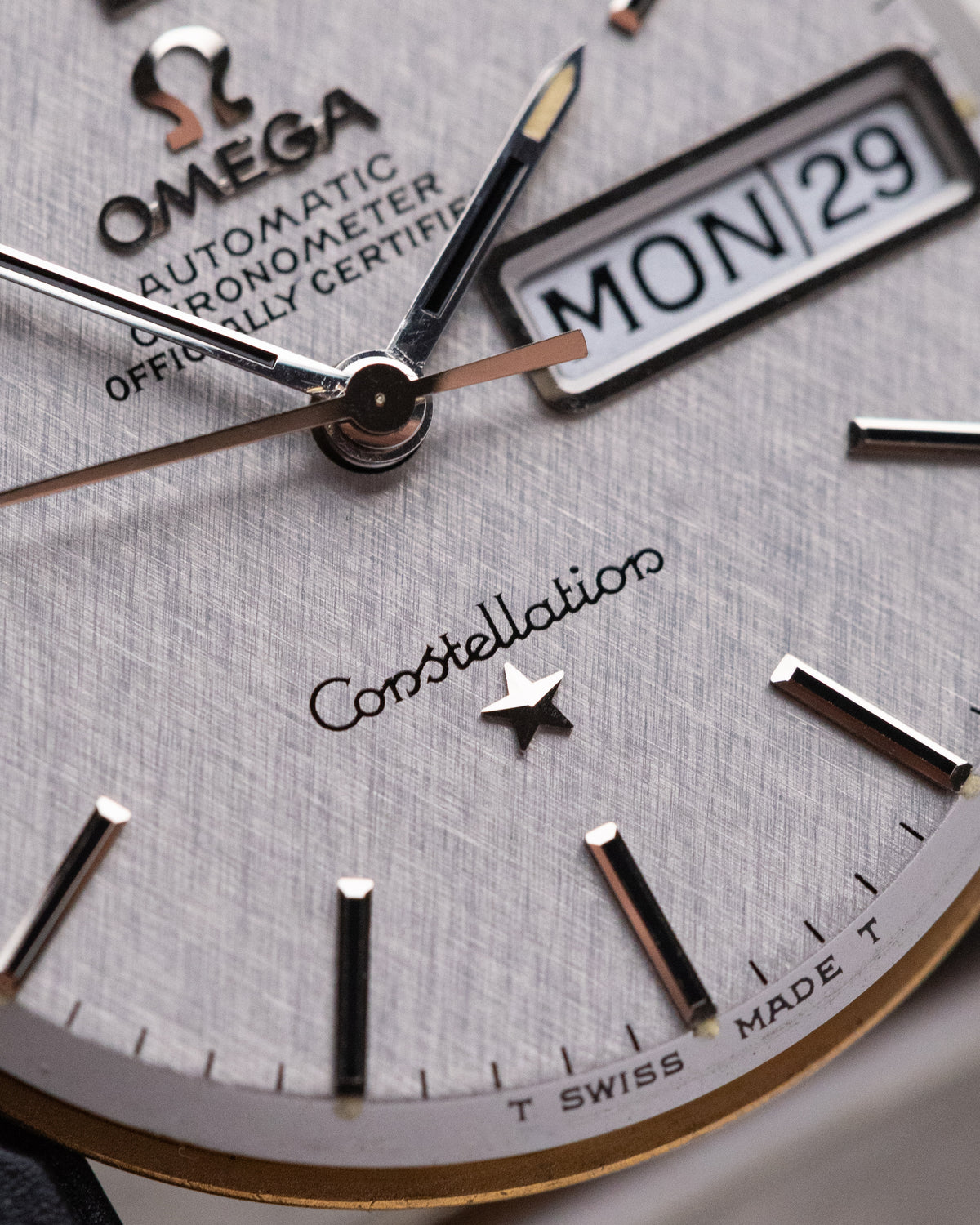
- Tritium: it took over during the 1960s, and dials that use it carry "T SWISS T" or "SWISS T<25" at six o'clock.
- LumiNova: this non-radioactive material appeared in 1993 and had spread across the industry by the late 1990s.
Tritium has a half-life of about 12.3 years, so after several decades it barely glows. A dark dial on a watch from the 1970s is normal and doesn't mean anything is wrong.
The more useful check is whether everything matches. The lume on the hands should have aged to the same color and texture as the lume on the dial, and bright white hands over cream markers point to replaced hands. The type of lume should also fit the dial markings, so fresh LumiNova on a "T SWISS T" dial points to a relume.
A Word on Safety
An intact tritium dial isn't a practical concern, because the exposure from wearing it is negligible. Radium needs more care, although the risk comes mainly from handling and storage and much less from wearing the watch. In 2018, researchers from the University of Northampton and Kingston University measured the radon from 30 radium-dial watches in a small, poorly ventilated room and found about 67 times the UK's action level for homes. If you own radium pieces, keep them sealed and don't scrape or relume them yourself. A larger collection belongs somewhere with good ventilation.
5. Hallmarks and Case Metal: What Is It Really Made Of?
The word "gold" in a listing can describe several different things. It can mean a solid gold case, a gold-capped, gold-filled or gold-plated case, or vermeil, which is gold over silver, and each of them wears differently over the years.
False
A gold-filled case has a thick layer of gold bonded to a base metal. Omega Forums' guide puts it at about 80 microns, against roughly 200 microns for a gold-capped case. Gold plating is much thinner, at about 20 microns, and some casebacks mark it as "20M." None of these is solid gold, and a well-kept gold-filled or plated watch from a good maker is still a pleasure to wear, as long as the price reflects what it is.
Solid gold Swiss cases carry official hallmarks. Until 1 August 1995, 18k cases carried a Helvetia head and 14k cases a squirrel, and today a single St Bernard's head covers all precious metals. Next to it you'll find a purity stamp such as 750 or 0.750, along with a small letter for the assay office that tested the case.
On plated cases, look for brassing, the yellowish-gray wear that shows on the lug edges, the side of the crown or the caseback rim once the plating has worn through. On solid gold, a deep and crisp hallmark is a good sign, and it also suggests that nobody has polished the case much. Our guide to Swiss watch hallmarks shows each of these marks in detail.

6. Movement and Case: Do They Belong Together?
A "frankenwatch" is a watch that someone has built from the parts of several different watches. Some workshops put them together openly to use up spare parts, and others assemble them on purpose to pass as a rarer and more valuable reference.
False
A watch can contain only genuine parts and still not be an original watch, because those parts may come from three different watches.
The movement should be the correct caliber for the case reference and the period, and the serial numbers on the case and movement should fall in a believable date range. Glue or adhesive dots in place of proper dial feet suggest that someone has swapped the dial. The hands and crown should match the style of the reference, and the number inside the caseback should agree with the case and the movement.
Before you buy, ask the seller for clear photos of the movement. An honest seller expects that request and answers it quickly, and if someone refuses to open the case, you've learned something important about the watch.

Soviet watches have their own version of this problem. You'll come across oversized wristwatches built around Molnija pocket-watch movements, and some of them are well made and fun to wear, as long as you buy them as modern conversions.
7. Service History: Who Opened It, and What Did They Change?
"Recently serviced" sounds reassuring in a listing, but on its own it tells you little, because sellers use the phrase for a full overhaul and for a quick oiling alike.
False
Brand service centers focus on timekeeping and water resistance. Over the years some of them replaced original dials, hands and crowns with current service parts, which keeps the watch running well and can lower its value sharply. An independent watchmaker who specializes in vintage watches will try to keep the original parts. Either way, a fresh service doesn't guarantee a trouble-free watch.
When a seller says the watch has had a service, ask who did the work and when, what they replaced, and whether the old parts came back with the watch. A good service record answers all of that, ideally with a dated invoice and timegrapher readings from after the work.
Set money aside for servicing too, because it's part of the real cost of a vintage watch. Bob's Watches puts a complete overhaul at a Rolex service center at $800 to $1,600 and says independent watchmakers quote 30% to 50% less. Chronographs cost more to service than simple watches. On a watch that cost a few hundred dollars, a single service can take up a large share of its value.
If you'd like to know what a proper overhaul involves, our vintage watch servicing guide goes through the process step by step.
8. Timekeeping: What the Timegrapher Should Say
Timekeeping is where buyers' expectations and reality drift apart. Buyers compare a vintage watch with a modern one, and a sixty-year-old movement works to different standards.
False
A healthy vintage watch that keeps a steady rate within about ±20 seconds a day is working fine. Even certified chronometers have a tolerance, and the benchmarks below help you put a vintage reading in context.
| Measure | Benchmark | What It Tells You |
|---|---|---|
| COSC chronometer | −4 / +6 s/day | Modern certified standard |
| Standard mechanical | −5 / +15 s/day | Common workshop guideline |
| Vintage, realistic | around ±20 s/day, stable | Perfectly serviceable |
| Amplitude | 270–310° (dial up, full wind) | Healthy movement |
| Beat error | under 0.5 ms ideal; 1–2 ms common on aged movements | How evenly it ticks |
The Magnetism Trap
If a watch suddenly gains several minutes a day, magnetism is a more likely cause than a broken part. Phones, speakers and magnetic bag clasps can make the coils of the hairspring stick together, and the watch then runs far too fast. A watchmaker can demagnetize it in about a minute, so rule this out before you accept a large repair quote.
9. Water Resistance: When Was It Last Tested?
Water resistance is the check that surprises buyers the most.
False
Whatever the case says describes the watch as it was when new. Water resistance depends on the rubber seals around the caseback, crystal and crown, and over the decades those seals dry out and shrink while the text on the case stays the same.
The standards have changed as well. ISO 2281, in its 1990 edition, set the rules for watches sold as water resistant until ISO 22810 replaced it in 2010.
Before you wear the watch to a pool or the beach, ask when it was last pressure-tested and what the result was, if the seller knows. It also helps to know whether the watchmaker replaced the gaskets, crown and crown tube at the last service. On a screw-down crown, check that it screws down smoothly and all the way.
Our advice for anyone buying a vintage watch is to treat it as not water-resistant. Water can stop a movement, and it can also stain the dial and create the fake "tropical" look we described in check 3.
10. Papers, Provenance and Returns
A full set with the original box, papers and receipts is lovely to own, and the papers add value only when they're genuine and belong to that particular watch.
False
Few vintage watches still have their original box and papers. Vintage boxes are easy to buy separately, forgers copy papers, and sellers offer replica "box and papers" sets openly online. That's why paperwork that doesn't match the watch is worse than having none.
Papers add the most value on rare references. On an everyday vintage watch, they shouldn't add much to the price.
If papers come with the watch, check that the serial and reference numbers match it exactly and that the dealer stamp and sale date fit the year of production. The design of the papers and the style of the box should also suit the period. Omega and Longines are among the brands that issue archive extracts confirming how a watch left the factory.
Provenance doesn't have to be official, and old service receipts, family photos or a clear ownership story all help. Read the seller's return policy carefully as well. Ask when the return period starts, whether the guarantee covers original parts and whether an independent watchmaker may open the case.
Your Vintage Watch Checklist
Tick each check that the watch you're looking at passes. The result below changes as you go and tells you which questions to put to the seller before you pay. Three of the boxes decide what the watch actually is, so the checklist treats the reference, the dial and the movement as the ones you can't skip.
Buying a Vintage Watch? Send the Seller These Questions
Before buying a vintage watch, send the seller a short list of questions. How openly and quickly they answer tells you almost as much as the answers themselves.
Which reference number appears inside the caseback, and which caliber is the movement?
Is the dial original, or is it a service dial or a redial?
Does the lume on the hands match the lume on the dial, and is the case solid gold, gold-filled or plated?
Could you send clear photos of the movement and of the inside of the caseback?
When was the watch last serviced, and what did the watchmaker replace?
When was it last pressure-tested? Do the papers match the serial number, and what does your return policy cover?
Buying Your First Vintage Watch: Tips for Beginners
No single answer to these checks suits everyone. The same polished case can be a poor buy for one person and a sensible one for another, depending on what they want the watch for.
If this is your first vintage watch, start with a simple three-hand model from a known brand, because it costs less to service than a chronograph. Buy it from a seller who answers your questions and accepts returns, and you'll have time to learn about it as you wear it.
If originality matters most to you, the shape of the case, the dial, matching lume and a correct movement come first. It's worth paying more for an honest, unpolished example and walking away when the parts don't agree with each other.
If you mainly want a watch to wear every day, the service history, steady timekeeping and a recent pressure test count for more. A refinished case or a service dial is fine for you, as long as the price reflects it.
On a first purchase, find out what metal the case is and set money aside for servicing. If you also buy from a seller with a clear return policy, you'll avoid the mistakes we see new buyers make.
Soviet watches are affordable, and fantasy dials and pocket-watch conversions turn up among them. Compare the dial with the factory catalogues, and pay no more than a souvenir price for a fantasy dial.
If you have a question about a particular watch, including one of the questions from this article, send it to us and we'll be glad to answer it. You can also browse our Swiss watch collection or our Soviet watch collection and look at the case, dial and movement photos with this checklist in mind.
Your Questions Answered
Frequently Asked Questions