
For more than seventy years, one wristwatch has done something almost no other can: it speaks. The Jaeger-LeCoultre Memovox — Latin for "voice of memory" — is the alarm watch that JLC turned from a novelty into a signature, carrying it without interruption from a post-war boardroom to the floor of the ocean and, eventually, to the heart of a modern sports collection.
Few model families in horology have proven so adaptable, and fewer still have stayed in continuous production for so long. This is the full story - the calibres, the references, the dive icons, the curious US-market split, and what a collector should actually look for before buying one. If you want to see what's currently in the vault, start with the vintage Jaeger-LeCoultre collection at DuMarko.
At a Glance: Four Defining Memovox
The line is genuinely sprawling - JLC seemed determined to put the alarm movement into every case shape imaginable, which is precisely why a complete reference list is nearly impossible to assemble. But four pieces tell the whole arc, from a sober dress watch to the most coveted alarm diver ever built.
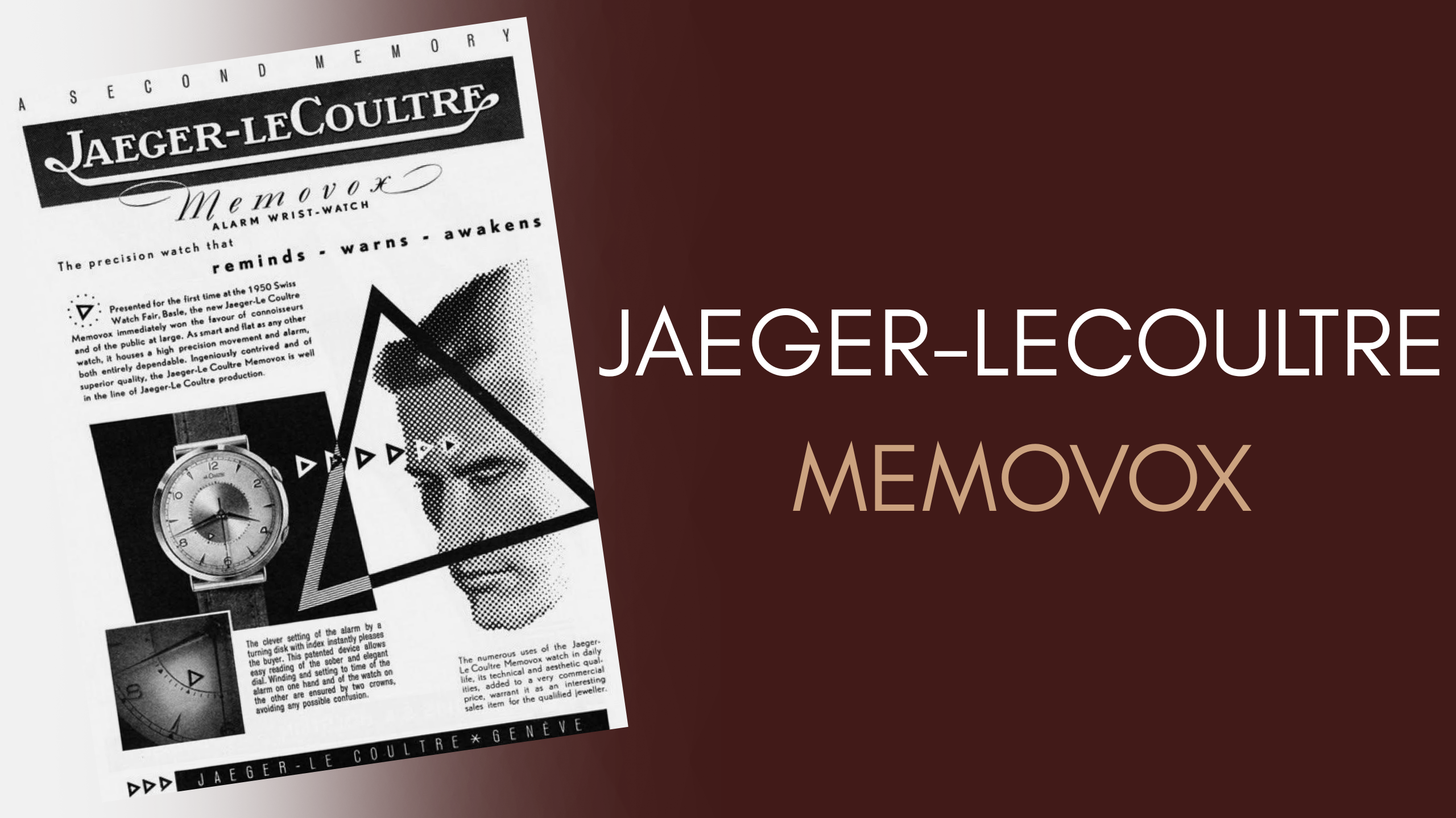
The 1950 original. A manually wound dress watch built around twin mainspring barrels — one for timekeeping, one for the alarm — which is why every Memovox since carries two crowns and that central rotating triangle.
1956. The world's first automatic alarm wristwatch movement. No more daily hand-winding — the change that suited the Memovox to "the man of action" and underpinned every dive reference that followed.
1959. The world's first diver's watch with an alarm — the chime repurposed as an ascent warning. Roughly 1,061 made between 1959 and 1962, making it one of the rarest vintage Memovox of all.
1965–1970. A 42 mm three-crown diver with an inner resonance case to amplify the alarm underwater. Just 1,714 pieces across all variants — and, for many collectors, the single most desirable Memovox ever made.
| Model / Reference | Era | Calibre | Defining Feature |
|---|---|---|---|
| Wrist Alarm / early Memovox (3150/3151) | 1950–1958 | 489 (manual) | First JLC alarm; twin barrels, two crowns |
| Automatic Memovox (e.g. E 853) | 1956 on | 815 (auto bumper) | World's first automatic alarm wristwatch |
| Memovox Calendar (e.g. E 855) | c. 1960–1974 | 825 (auto + date) | First automatic alarm watch with a date |
| Memovox Worldtime / Parking | 1958 | 815/825 family | Alarm disc reused for world time / parking |
| Memovox Deep Sea (E 857) | 1959–1962 | 815 | First dive watch with an alarm; rare |
| Memovox Polaris (E 859) | 1965–1970 | 825 | The icon; 42 mm, three crowns, resonance case |
| Memovox Polaris II | c. 1970–1972 | 916 | High-beat (28,800 vph) full-rotor successor |
| Master Control Memovox | 1998 | 914 | Modern revival within the Master line |
| Tribute to Polaris / Deep Sea | 2008 / 2011 | 956 | Faithful heritage re-editions |
| Polaris collection / Mariner Memovox | 2018–present | 956 | Modern sports-luxury alarm line |
Origins: The Wrist Alarm of 1950
The Memovox was born at the Basel fair in 1950, initially under the plain name "Wrist Alarm" before the Memovox branding was adopted later that same year. A few sources cite 1951 for general availability, with the dedicated alarm calibre in production from roughly 1950 — minor discrepancies that simply reflect the gap between a trade-fair debut and the retail rollout.
It did not arrive in a vacuum. The Vulcain Cricket had appeared in 1949 as the first wristwatch alarm, and the early 1950s saw fierce competition over who could build the best chiming reminder. JLC's answer was the in-house, manually wound Calibre 489, and its defining innovation was structural: two separate mainspring barrels, one powering the timekeeping and one powering the alarm.
That separation is the reason every Memovox to this day carries two crowns — the lower for winding and time-setting, the upper for winding and setting the alarm. The dial was built in two parts, the inner section a rotating disc with a small triangle the wearer lines up with the desired alarm time. That dual-crown silhouette and the central triangle became the family's instantly recognisable signatures.
It is not a quirk — it is the whole architecture. One barrel runs the watch; a second, independent barrel powers the alarm hammer. The lower crown winds and sets the time. The upper crown winds the alarm and rotates the inner disc so the central triangle points to your chosen hour.
On the diver references this logic extends to a third crown for the internal rotating bezel. If you ever handle a Memovox where the alarm winds and sets crisply but rings weak or dead, that is a service issue — and a more involved one than a standard movement overhaul.
The early Memovox was a sober, elegant dress watch aimed at white-collar professionals who needed a discreet reminder for meetings — JLC's advertising leaned on the idea that the watch "reminds, notifies, and wakes up." Its celebrity moment came in 1953, when the authorities of the Canton of Vaud, home to JLC's manufacture in the Vallée de Joux, presented a Memovox to a famous local resident: Charlie Chaplin. Over the decades the watch reached wrists ranging from Miles Davis to Stirling Moss, and found a new generation of admirers through its appearances on Mad Men. Reference points from this first era include the early hooded-lug ref. 3150/3151, built on the manual P489 family.


The Automatic Breakthrough: Calibre 815
In 1956 JLC delivered the blow that turned the rivalry decisively in its favour: the Calibre 815, the world's first automatic alarm wristwatch movement. It was a bumper — hammer-rotor — automatic, beating at 18,000 vibrations per hour with roughly a 45-hour power reserve. No longer requiring daily hand-winding, the automatic Memovox suited a more active wearer, a shift JLC eventually crystallised in its 1970s slogan, "Memovox, for the man of action."
Shortly after came the Calibre 825, which added a date complication — making the Memovox the first automatic alarm watch with a calendar. This is the movement behind the calendar-equipped reference E 855, introduced in 1959 and produced into the early-to-mid 1970s, and one of the most beloved everyday vintage Memovox references. Crucially, it is also the calibre at the heart of the Polaris dive watches. JLC built roughly 45,000 examples of the 825 over its decade-long run, making it by far the most widely produced of the vintage alarm calibres — and the reason a genuine in-house alarm complication remains attainable today.
JLC kept refining the manual-wind line in parallel — the date-equipped Calibre 814 arrived in 1953, and the higher-frequency 910/911 family followed in the 1960s — but the decisive leap was automatic winding.
An Alarm in Deep Water: The Memovox Deep Sea (1959)
By the late 1950s the dive watch had arrived — the Blancpain Fifty Fathoms and the Rolex Submariner in 1953, the Omega Seamaster shortly after. The booming popularity of scuba diving, fuelled in part by Jacques-Yves Cousteau's Oscar-winning The Silent World (1956), created demand for purpose-built underwater instruments — and the impetus came largely from the American market.
JLC's contribution, launched in 1959, was genuinely novel: the Memovox Deep Sea, the world's first diver's watch equipped with an alarm. Powered by the automatic Calibre 815, its chime was repurposed from a meeting reminder into a safety device — a vibration and acoustic signal warning a diver that it was time to begin the ascent. It is one of the rarest vintage Memovox models. JLC's own Heritage Gallery records roughly 1,061 examples produced between 1959 and 1962, the bulk in the first two years, though some accounts cite figures closer to 950. The original case measured around 39.8 mm.
The Deep Sea is also the cleanest illustration of the Memovox's transatlantic split personality. It was issued in two distinct versions: a European edition signed "Jaeger-LeCoultre" with a cleaner dial, and a US edition signed "LeCoultre" with "Deep Sea Alarm" in a playful handwritten script on the alarm disc. The two are visually quite different, and the US version in particular has become a collector favourite — more on why the same watch carried two names below.

The Icon: The Memovox Polaris (1965–1970)
If the Deep Sea proved the concept, the Polaris perfected it — and became, for many collectors, the single most desirable Memovox ever made.
The watch was conceived in 1963, when JLC produced a pre-series of around 50 prototypes of reference E 859, then called the Memovox de plongée. The case was an unusually large 42 mm, exceptional for the era and chosen for underwater legibility. The name "Polaris" — evoking polar expeditions, deep-sea exploration, and the space race, and echoing the contemporaneous missile of the same name — came from JLC's US division. Series production ran from 1965 to 1970, with a total of 1,714 pieces across all variants.

The Polaris is built around the automatic Calibre 825 and carries three crowns: one to wind and set the alarm, one to operate the internal rotating dive bezel, and one to wind the movement and set the time. The technical centrepiece is the case — a multi-part construction associated with the Piquerez "Compressor" patent, incorporating an inner case that acts as a resonance chamber to amplify the alarm underwater. Later examples added a perforated case back drilled with 16 holes to stop a diver's wetsuit muffling the sound (sources variously associate this enhancement with 1966 and with the second-generation 1968 dial). It is water resistant to roughly 200 metres.
The two dial generations
Collectors distinguish two dial generations, both under reference E 859. The earlier "1965" dial sits closer in look to the black-dial E 855, with applied metal indices and dauphine hands. The later "1968" dial — in fact already appearing in 1967 catalogues — carries large printed luminous indices and baton hands, and is the look most people picture when they think "Polaris." A second-generation model, known in North America as the Polaris II, ran from roughly 1970 to 1972, fitted with the new high-beat Calibre 916.
On vintage Polaris and Memovox dials, the signature and the alarm disc should agree. A "LeCoultre" dial generally pairs with a "Memovox" (or, rarely, "Memodate") marking on the alarm disc, whereas a "Jaeger-LeCoultre" dial typically leaves the disc unmarked. A mismatch is worth a second look — and a conversation with the seller.
Variants, Oddities & the High-Beat Era
Between the 1960s and 1980s, JLC put the Memovox movement into nearly every imaginable case shape and use case. To celebrate its 125th anniversary in 1958, it introduced two clever repurposings of the alarm mechanism. The Memovox Worldtime turned the rotating disc into a 24-hour world-time display — set the alarm hand to your local time and the inner city ring shows the corresponding hour in 23 other cities.

The Memovox Parking repurposed the alarm as a parking-meter reminder, alerting the motorist when paid time was about to expire — a genuinely period-specific complication for the age of coin-operated meters.

Other notable references include the round 43 mm "Snowdrop" ref. E 877 from the 1960s–70s, and the Memovox GT ref. E 861. The movement was prestigious enough that it was supplied to and retailed by other great houses of the era, appearing under Gübelin, Van Cleef & Arpels, and even Cartier signatures.
Around 1970, JLC modernised the alarm movement with the Calibre 916, nicknamed the "Speed Beat" — its first alarm-calendar movement with a fully rotating rotor, beating at the modern high frequency of 28,800 vibrations per hour with roughly a 45-hour reserve. The 916 powered the Polaris II and a range of 1970s references, and is generally regarded as the direct ancestor of the modern alarm calibre. But the 1970s also brought the quartz crisis, which decimated the mechanical alarm-watch market. The Memovox endured in catalogues but lost its central place, and JLC's underwater ambitions eventually passed to the later Master Compressor line. The classic mechanical alarm went quiet — for a while.
The Modern Revival (1998–Present)
The Memovox's resurrection began in 1998 with the Master Control Memovox, driven by the Calibre 914 and certified under JLC's demanding "1,000 Hours Control" programme. It re-established the alarm complication within the refined Master line, and what followed was a steady stream of heritage re-editions and technical evolutions.

The Master Grande Memovox / Master Grand Réveil of the early-to-mid 2000s (Calibre 909-440/2) paired the alarm with a perpetual calendar and moon phase, replacing the traditional resonance case back with a hanging gong. The 909 also introduced something genuinely novel — a selectable alarm that rings either as a traditional gong strike or as a silent vibration, one of very few mechanical wristwatches ever to offer a pulsation mode. (Sources date these pieces variously between 2000 and 2007, so the exact year is best treated with caution.)
Two faithful re-editions followed. The Memovox Tribute to Polaris (2008) re-created the 1968 icon at 42 mm, powered by the modern automatic Calibre 956 and water resistant to 200 m. The Memovox Tribute to Deep Sea (2011) meticulously revived the 1959 original, issued — like its ancestor — in two dial versions: a European "Jaeger-LeCoultre" edition of 959 pieces (honouring 1959) and a US "LeCoultre" edition of 359 pieces, with the case grown slightly to 40.5 mm and period-correct Plexiglas and an engraved frogman case back retained.
A 60th-anniversary edition in 2016 drew on the 1970s "Snowdrop" with a blue vintage-style dial. Then came the most significant modern move of all: the Polaris collection of 2018. For the 50th anniversary of the 1968 original, JLC built an entire sports-luxury collection around its design language — three-hand automatics, date models, chronographs, and a world-time chronograph — anchored by a 1,000-piece limited-edition Polaris Memovox (Calibre 956). The line has since become a permanent pillar of the catalogue, including the deeper-diving Polaris Mariner Memovox, rated to 300 m. Current pieces such as the Master Control Memovox Timer even add a countdown function to the classic alarm — proof that a movement first conceived in the 1950s still rings with the times.
LeCoultre vs. Jaeger-LeCoultre Explained
Anyone shopping for a vintage Memovox will quickly notice that some dials read "LeCoultre" and others "Jaeger-LeCoultre." This is not a sign of a fake or a lesser watch — it is a quirk of mid-century US trade policy, and understanding it is one of the most useful things a buyer can carry into a deal.
From roughly the 1930s to the mid-1970s, US import duties on fully assembled Swiss watches were far higher than duties on movements alone. To stay competitive in America, JLC shipped movements and dials — signed "LeCoultre" — to the US, where distributors, principally through a relationship with the Longines-Wittnauer Watch Company, cased them in US-made cases from firms such as Star Watch Case Company and Schwab & Wuischpard. The same logic explains why US-market movements were typically capped at 17 jewels even where the identical European calibre carried more: jewel count affected the tariff. US-imported movements often bear the import code "VXN" on the balance cock.
A "LeCoultre"-signed Memovox uses the same JLC calibres and the same standards as its European twin. The meaningful difference is usually the case and, sometimes, the dial styling. With a few exceptions imported as complete watches — the Deep Sea Alarm, the Polaris, and chronometers among them — most US-market LeCoultre pieces were locally cased.
The name on the dial tells you which market a watch was built for, not how good it is.
What to Check Before Buying a Vintage Memovox
A vintage Memovox is one of the most rewarding entries into serious manufacture watchmaking — but the alarm complication adds a few checks that a three-hand watch never demands. Most of them follow directly from the history above.
Alarm function: This matters enormously. The alarm should wind, set, and ring crisply. A dead or weak alarm signals a service issue that is more involved — and more expensive — than a standard movement overhaul. For what a proper vintage service actually entails, our vintage watch servicing guide walks through the full process.
Disc-and-dial pairing: Use the signature relationship as a quick authenticity check — a "LeCoultre" dial generally pairs with a "Memovox"-marked disc, while "Jaeger-LeCoultre" dials usually leave it blank.
Case integrity and resonance back: On the dive references, the multi-part case and resonance back are part of what makes a Polaris or Deep Sea what it is. Replaced or incorrect backs materially affect value.
Lume consistency: On tritium-era pieces the dial, hands, and the separate rotating triangle aged under different conditions. Perfectly uniform lume across all three can be a red flag for redone work.
Hallmarks on precious-metal references: For gold dress Memovox, the caseback marks confirm the metal. Our guide to Swiss watch hallmarks explains how to read them.
As for where the money sits: the Polaris and Deep Sea sit at the top of the market and command strong, sometimes five-figure prices for honest examples. The everyday references — the E 855 calendar models and their kin — remain among the most rewarding ways in: a genuine in-house alarm complication, with real history, often available for a fraction of the dive icons.
So, Which Memovox Is Right for You?
The honest answer depends on what you want the watch to do — and how deep you want to go. Here is how the major references map to different kinds of collector.
The most rewarding entry point. A genuine in-house automatic alarm with a date, real history, and accessible pricing relative to the dive icons. The one to buy and actually wear.
The grail. A 42 mm three-crown diver with a resonance case and just 1,714 examples ever made. Top-of-market, but the definitive vintage Memovox statement.
Roughly a thousand pieces, the first dive watch with an alarm, and a transatlantic split that makes the US "LeCoultre" version its own pursuit. Scarce and historically significant.
Heritage design with contemporary water resistance, warranties, and serviceability. The way to own the Memovox idea without the fragility of a sixty-year-old dive case.
What sets the Memovox apart from almost every other vintage line is that it does something no quartz module and few mechanical watches can match: a real alarm, struck by a real hammer, on a movement family that has been refined without interruption for more than seventy years. That kind of continuity is rare, and it is exactly what makes these watches worth understanding before you buy.
Every piece in our vault is handpicked for originality and condition — from in-house alarm complications to the wider world of mid-century Swiss watchmaking. Find the one that speaks to you.
Shop Jaeger-LeCoultre Browse Swiss WatchesYour Questions Answered
Frequently Asked Questions