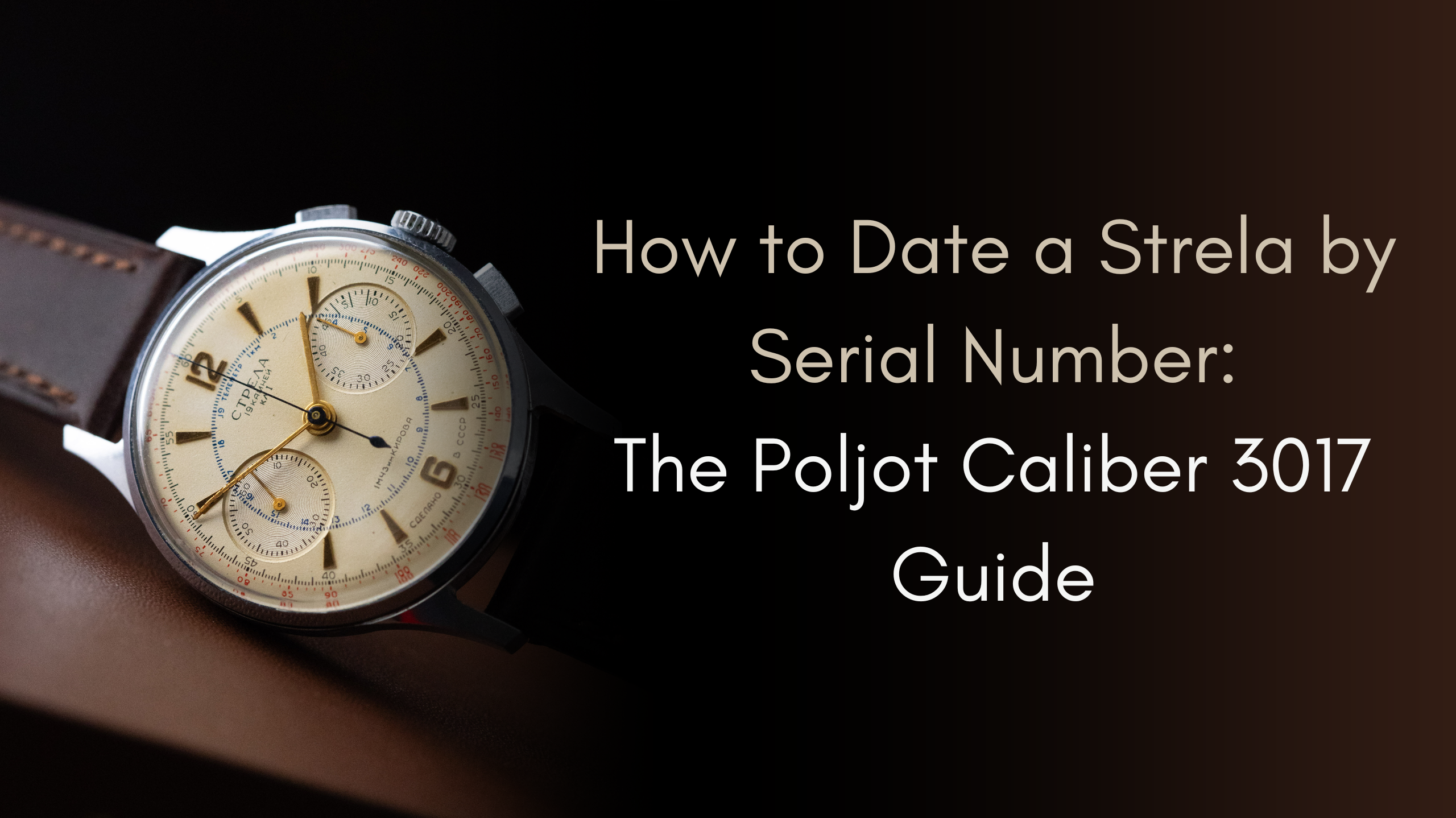

There is no factory ledger for the Poljot caliber 3017. No archive extract, no certificate request line, no official record of which serial number left the bench in which year. Everything collectors know about dating a Strela comes from cross-referencing thousands of individual watches — and the picture that emerges is useful, but it isn't exact.
This guide walks through how serial number dating works for the 3017-powered chronographs sold as Strela, Poljot, and Sekonda, where to find the number, and how to read it against a production-year estimate. For the full history of the movement and how to tell the three brandings apart, our Strela, Poljot, Sekonda covers that ground in depth. This piece is narrower and more practical: serial number in, estimated year out, with the caveats that actually matter.
What a 3017 Serial Number Can — and Can't — Tell You
Swiss manufacturers like Longines kept continuous, sequential production records for over a century, which is why a Longines serial number can be cross-checked against an actual company archive. The First Moscow Watch Factory did not operate that way, and no equivalent Soviet archive has surfaced. What exists instead is a reconstructed timeline, built by collectors who have logged serial numbers against known dial branding, case features, and the rare watch that arrived with a dated military or factory paper trail.
That reconstruction is good enough to place a 3017 within a reasonable production window - usually within a year or two for early examples, and within a broader range for later ones. It is not good enough to certify an exact production date the way a Longines or Omega extract can. Treat the estimate that follows as a strong indicator, not a verdict, and always weigh it against the watch's branding and physical details before drawing conclusions.
The Four Branding Eras at a Glance
The same caliber 3017 movement was cased and dialed under four different identities over twenty years of production. Knowing which era a serial number should fall into is half of the dating exercise — the other half is checking that the watch in front of you actually matches it.
"СТРЕЛА" in Cyrillic script, issued to Soviet pilots and cosmonauts. Light dials only — white, silver, or cream. No black-dial Strela was ever produced.
Rebranded after the factory itself was renamed Poljot in 1964. Broader paddle-style hands, luminous markers, and a wider civilian distribution.
Branded for Western buyers from 1966 onward. First Soviet branding to use black dials, and occasionally cased in stainless steel rather than chrome-plated brass.
The same 3017 movement was also fitted into pocket and panel-instrument chronographs by Molnija and the Chistopol Watch Factory, drawing from the same serial pool throughout the run.
Where to Find the Serial Number
The serial number is stamped on the movement itself, which means the caseback has to come off to read it — there is no dial or crown reference that substitutes for it. On a genuine 3017, it appears as a five-digit number (leading zeros included, so an early example might read 00586 rather than 586).

Movement serial: Five digits, stamped on the movement, used for production dating. This is the number every estimate in this guide refers to.
Case stamp: Some casebacks carry an entirely separate code — collectors have reported markings such as "P-098845-1961," where the trailing four digits are the year itself, stamped directly into the case at the time of casing. This is not the movement serial, and the two numbers will not match. A case stamp with a literal year in it is a useful clue on its own, but only when it's genuinely present — most 3017 casebacks carry no date at all.
The Quick Estimate: Divide by 5,000, Add 1959
Collectors working through the early-to-mid production run use a simple rule of thumb: divide the serial number by 5,000, then add 1959. A movement numbered 27,600, for example, gives 27,600 ÷ 5,000 = 5.52, plus 1959, landing at late 1964 to early 1965 — which happens to fall squarely in the window associated with the watch Alexei Leonov wore during the first spacewalk.
The formula assumes a roughly steady production pace of 5,000 units a year, and that assumption holds reasonably well through the early-to-mid 1960s. It holds less well later in the run, for reasons covered in the reliability section below — treat it as a fast mental check, not a final answer.
Serial Number to Production Year Reference Table
The table below synthesizes the collector-built serial chart against documented examples and known anchor points — including watches with confirmed 1959 and 1965 production. Bands widen toward the later years, where the underlying data is thinner and the production pace less consistent.
| Serial Number Range | Estimated Year(s) | Branding to Expect |
|---|---|---|
| 00000 – 02000 | 1959 | Strela (Cyrillic) — earliest known examples |
| 02000 – 10000 | 1960 – 1962 | Strela (Cyrillic) |
| 10000 – 19000 | 1963 – 1964 | Strela (Cyrillic), transitioning to Poljot |
| 19000 – 31000 | 1964 – 1965 | Poljot (Latin) — the Leonov-era range |
| 31000 – 40000 | 1966 | Poljot continues; Sekonda export branding introduced |
| 40000 – 55000 | 1967 – 1969 | Poljot / Sekonda |
| 55000 – 70000 | 1970 – 1972 | Poljot / Sekonda |
| 70000 – 85000 | 1973 – 1975 | Poljot / Sekonda; Molnija and ChChZ variants common in this range |
| 85000 – 99999 | 1976 – 1979 | Poljot / Sekonda — final years before the caliber 3133 changeover |
Why Dating Gets Less Reliable After the Mid-1960s
The early bands above hold up reasonably well — there simply aren't many surviving 3017s under serial number 15,000, and the ones that exist consistently show Cyrillic Strela branding, light dials, and period-correct hands. Past the mid-1960s, the picture gets noisier, for three concrete reasons.
First, total production across the entire 1959–1979 run is generally put at around 100,000 movements, which means the count reached its five-digit ceiling more than once over twenty years. Collectors have documented examples where the numbering appears to start over from 00000 without adding a sixth digit, so two watches separated by a decade can carry an identical serial. Second, these are chronographs, and chronographs get serviced. Mainsprings, balance assemblies, and other components were swapped during repairs across six decades of use — sometimes from later production stock — which can leave a movement's stamped serial out of step with its actual parts. A proper service shouldn't introduce this kind of mismatch, but on a 60-year-old Soviet chronograph, it's worth assuming some movements have a mixed history; our guide to vintage watch servicing covers what a proper service should and shouldn't touch. Third, Soviet production volume simply wasn't constant year to year, so any chart built on an assumed steady pace will drift further from reality the longer the timeline runs.
None of this makes the serial number useless — it makes it one data point among several, which is exactly how experienced collectors treat it.
Cross-Referencing: What Else to Check
Because the serial number alone has limits, the more reliable approach is to check it against the watch's other period-correct features and see whether the whole picture agrees.
Factory mark on the movement: The 1MWF/Poljot factory logo stamped near the balance changed shape over the run — collectors generally associate a diamond-shaped mark with earlier production, a pentagon shape with the middle years, and a crown logo with later Poljot output. It's a useful tiebreaker, though not an exact science either.
Case lug shape: Round lugs appear on the earliest cases, giving way to faceted lugs and later a flatter lug profile as production continued. A case style that doesn't match the serial number's expected era is worth a second look.
Dial branding and color: Strela is Cyrillic and light-dialed only. Poljot is Latin script, white, silver, or grey. Sekonda is the only one of the three that legitimately appears with a black dial. A black-dialed watch marked "Strela" is a contradiction, not a rare variant.
Jewel count: Earlier 3017 movements typically carry 19 jewels; some later production increased this to 21. On its own this narrows little, but it can support or undercut a serial-based estimate.
Putting It Together
Start with the serial number and the table above to get a working estimate. Then check that estimate against the dial branding, the case lug profile, and the factory mark on the movement. If all three agree, you can hold the estimate with real confidence. If they disagree — a Poljot-branded dial on a sub-1,000 serial, for instance, which is exactly the kind of mismatch that has prompted collectors to ask questions on forums like WatchUSeek — treat the watch as a possible "Frankenwatch," assembled from mismatched parts, rather than forcing the numbers to agree.
It's also worth comparing your serial number against currently listed examples on marketplaces like Chrono24, where sellers frequently disclose movement serials in their listings. A handful of comparable examples either side of your number is a reasonable sanity check on the table above. For the broader history of the 3017 and a full authenticity walkthrough covering movement, dial, and case, the Strela, Poljot, Sekonda decoded guide is the natural next stop. And if you're building out a wider collection, the current Soviet watches selection at DuMarko is a good place to compare branding and case details against verified, in-hand examples.
Your Questions Answered
Frequently Asked Questions