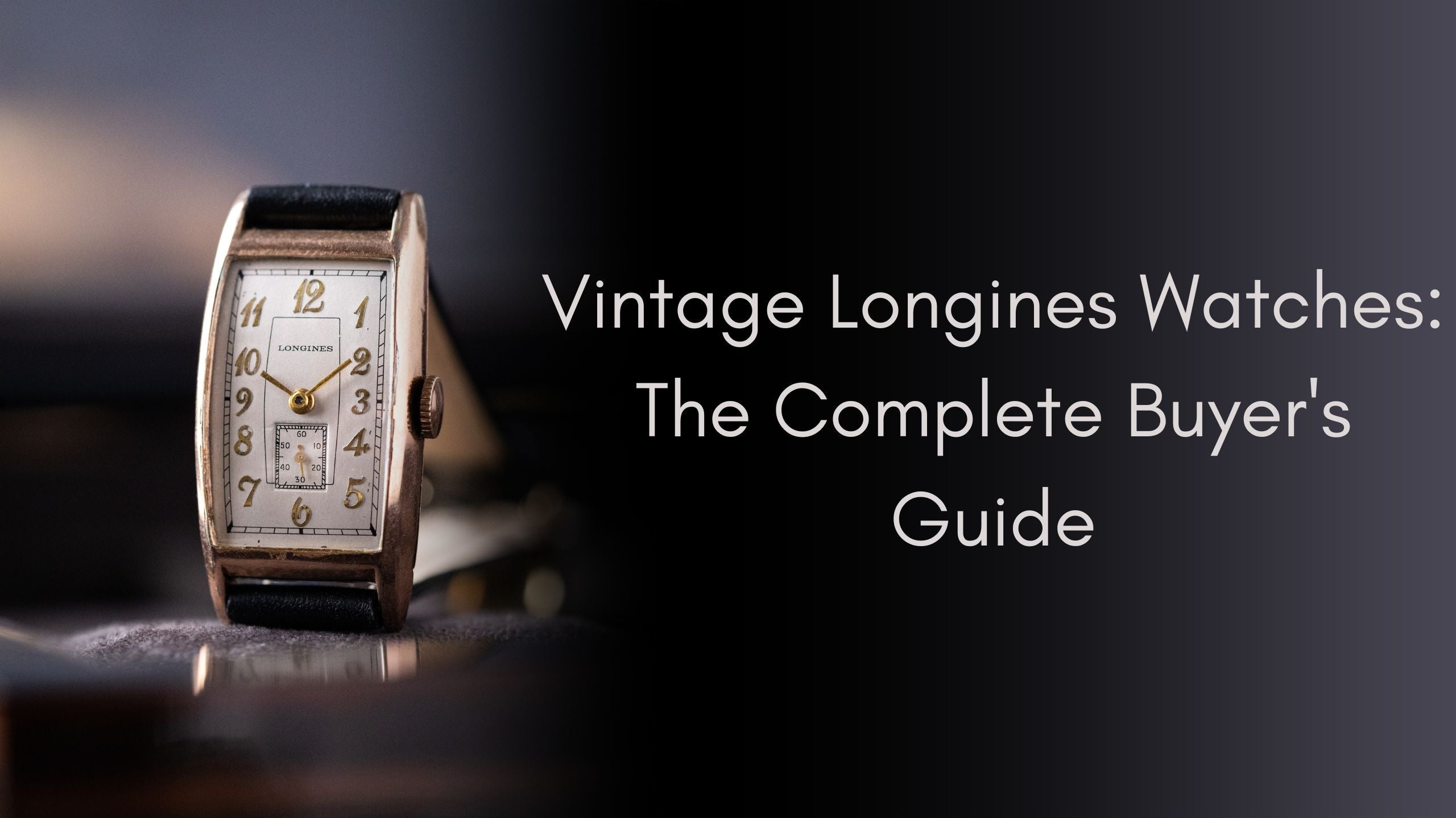

In the world of horology, few designs create as much visual impact as the square watch and the elegantly elongated rectangle watch. Their sharp lines, perfect symmetry, and architectural presence set them apart from the endless sea of round timepieces. Today, collectors and enthusiasts are increasingly rediscovering the charm of rectangular watches, the boldness of square watches for men, and the refined proportions of womens rectangle watches.
Whether you’re searching for a square face watch, exploring vintage square watches, or evaluating high end square watches, this guide will help you understand the history, their rising popularity, and the most iconic brands that shaped the evolution of this rare and beautiful watch style.
What Makes Rectangular and Square Watches So Special?
Most watches throughout history have been circular — but the moment you put on a square shape watch for man or a small rectangle watch, the entire mood changes. Geometry becomes the star.
1. Bold, Architectural Design
A square watch demands attention. The four equal sides give the dial a strong visual presence, especially in large formats like large square watches or minimalistic designs like a black square watch.
Rectangular pieces, including black thin rectangle styles or the luxurious rectangle gold watch, communicate elegance through their elongated silhouette.
2. Deep Art Deco Heritage
Many of today’s classic square watches trace their roots to 1920–1940 watchmaking, when Art Deco dominated the design world. Two-tone designs, like a two tone rectangular watch, stepped bezels, and refined geometry were the standard of sophistication.
3. Mechanical & Technical Prestige
Engineering a square mechanical watch, a square automatic watch, or a slim rectangular movement requires skill. Watchmakers had to adapt calibers to fit geometric cases, making these shapes rarer and more collectible.
4. Increasing Trendiness
Collectors often ask: are square watches in style?
The answer is absolutely yes. Search trends for rectangular watches and square swiss watch continue to rise, driven by a renewed taste for minimalism, vintage proportions, and clean geometry.
Rectangular vs. Square: Understanding the Difference
Although both shapes fall into the same geometric family, they create different impressions on the wrist.
| Feature | Square Watches | Rectangular Watches |
|---|---|---|
| Proportions | Equal height and width | Longer than they are wide |
| Aesthetic Style | Strong and bold aesthetic | More refined look |
| Wrist Presence | Excellent wrist presence | Perfect as dress watches |
Each shape delivers a different personality, making this category rich and diverse for collectors.
The History of Rectangular Watch Design
The early 20th century was a period of dramatic creativity in watchmaking. As wristwatches became more common, designers pushed beyond traditional round shapes. Art Deco ideals — symmetry, geometry, modernism — inspired new forms.
This era produced:
-
stepped and curved rectangular cases
-
champagne, silver, linen, and black dials
-
ultra-thin mechanical movements
-
early waterproof “tank-style” rectangular models
Today these features remain highly sought after, especially among collectors of vintage Swiss brands.
Top Brands Known for Square & Rectangular Watches
Below is a detailed look at the top brands that shaped the world of rectangular and square watchmaking — starting with Omega, one of the most historically important manufacturers in this category.
Omega
While Omega is globally recognized for its Speedmaster and Seamaster models, the brand also produced an impressive selection of rectangular watches, and vintage square watches from the 1930s to the 1970s. These pieces blend Swiss craftsmanship with timeless Art Deco aesthetics, making Omega one of the best choices for collectors searching for a square swiss watch, square automatic watch, square mechanical watch, or an elegant small rectangle watch.
1. Omega Rectangular Tank-Style Watches (1930s–1950s)
Omega’s early rectangular models were heavily influenced by Art Deco geometry. These watches are refined, slim, and exceptionally elegant — perfect for wrists that prefer a black thin rectangle or minimalistic dress style.
📌 Notable Models
Omega Ref. CK 730 — a pure 1930s rectangular classic, known for its slim Art Deco case and elegant proportions. It remains one of the most recognizable early Omega rectangular dress watches.

Vintage Omega CK 730 rectangular watch — original catalog illustration
In addition to the CK 730, a whole family of Omega rectangular models powered by the calibre T17 holds a special place among collectors. These watches were produced in numerous dial and case variations, making them some of the most attractive early Omega designs.
T17 models can be found with:
-
Chocolate dials — warm brown tones that developed naturally over decades, often featuring gilt printing, giving the watch a rich, vintage character.
-
Black gilt dials — deep black backgrounds paired with gold-colored indices and minute tracks, offering a strong Art Deco aesthetic and excellent legibility.
-
White or silver dials — clean, classic dress-watch configurations with railroad minute tracks, Arabic numerals, or applied markers.

Dial diversity within the Omega T17 series, illustrating the brand’s pre-war aesthetic range
These T17-powered pieces appear in different case metals, including steel, gold, and two-tone variations, and they are highly valued today for their combination of elegant design, reliable movement architecture, and authentic pre-war vintage charm.
2. Omega De Ville Rectangular & Square Watches (1960s–1980s)
The De Ville line introduced some of the most elegant geometric Omega designs, making them favorites for those who love understated classy square watches and modernist styling.
📌 Standout References
Among Omega’s rectangular and square dress watches, several De Ville references stand out as especially attractive to collectors and vintage enthusiasts:
-
De Ville Ref. 511.0378 — a classic vintage De Ville with a clean rectangular case and elegant dial layout, ideal as a refined everyday dress watch.

-
De Ville Ref. 511.0404 — a subtle, minimalist De Ville variant that shows how Omega translated 1960s–1970s design language into slim rectangular form.

-
De Ville Ref. 151.0041 — a more striking execution within the same family, often chosen by collectors who appreciate sharp lines, strong geometric presence on the wrist and automatic movements.

-
De Ville Ref. 395.0877 — one of the best-known rectangular De Ville references, combining a thin case with a timeless dial configuration that still feels modern today.

These references all appear in Omega’s official vintage catalogues and represent some of the most charismatic rectangular De Ville models. In our collection at Dumarko you can see them not only through archival catalogue images, but also as real, fully serviced vintage pieces — a living link between historical documentation and the watches as they look on the wrist today.
Longines
Longines is one of the most historically important brands in the world of rectangular watches and vintage square watches. While the brand is often associated with elegant round dress pieces and mid-century classics, Longines was one of the early pioneers of geometric case designs.
From the 1920s through the 1990s, the brand produced an extraordinary variety of square and rectangular models, many of which are now highly collectible. Their cases were beautifully proportioned, the dials ranged from conservative to experimental, and the movements were among the finest Swiss calibers of their era.
Today, Longines remains one of the best “hidden gem” sources for collectors searching for an authentic square swiss watch, a refined small rectangle watch, or a bold piece with strong Art Deco identity.
1. Longines Pre-War Rectangular & Square Watches (1920s–1940s)
The pre-war era (1920s–1940s) is one of the most fascinating chapters in Longines history, especially for collectors of rectangular watches and vintage square watches. During these decades, Longines produced an impressive variety of geometric designs that perfectly embodied the spirit of Art Deco — sharp lines, symmetry, refined proportions and functional elegance.
These early Longines models remain highly desirable due to their craftsmanship, reliability, and the extraordinary diversity of dial and case variations.
📌 Dial Variations
Longines produced numerous dial executions in this era, each with its own character:
-
Sector dials — one of the most iconic Longines layouts of the 1930s, prized for their balanced geometry
-
Black gilt dials — deep black backgrounds with gold-printed or radium numerals and tracks; extremely collectible today
-
Two-tone dials — including designs historically associated with “medical” or “doctor’s” Longines watches, featuring clean, legible outer scales
-
Classic white and silver dials — with railroad minute tracks, Arabic numerals, or elegant applied markers

Dial variations of pre-war Longines rectangular watches from our Longines collection
These dials give pre-war Longines watches their distinctiveness and strong identity.
📌 Case Materials & Design
Longines offered a wide spectrum of case constructions, many of which have survived remarkably well:
-
Staybrite steel cases — highly durable, corrosion-resistant steel alloy widely used by Longines in the 1930s; survives in excellent condition even today

-
Gold-plated cases — offering a warm, luxurious look at an accessible price point

-
Slim rectangular and square cases — pure Art Deco design with straight lugs and sharp edges
The geometric shapes from this era remain some of the finest examples of early rectangular Swiss watchmaking.
📌 Important Calibers of the Pre-War Period
Pre-war Longines movements were exceptionally well-made. Many were small, compact, and specifically engineered for rectangular cases. Among the most notable calibers:
-
Cal. 20.28 — a classic rectangular movement used in elegant 1930s dress pieces
-
Cal. 2517 — known for stability and accuracy in rectangular configurations
-
Cal. 9.32 — one of the brand’s signature pre-war calibers
-
Cal. 9L — compact, reliable, used in many gold rectangular and square watches
-
Cal. 25.173 — part of the strong family of Longines hand-wound movements of the era

All these calibers were robustly constructed, easy to service, and remarkably reliable — many of them still running today with excellent precision.
Pre-war Longines remains one of the richest and most rewarding areas of vintage collecting — the perfect entry point for enthusiasts searching for authentic rectangular and square watch designs, and early Swiss mechanical craftsmanship.
2. Longines Rectangular, Square & Elliptical Designs (1970s–1990s)
The period from the 1970s to the 1990s marked a significant transformation for Longines. While earlier decades focused on mechanical Art Deco-inspired rectangular designs, this era introduced an entirely new wave of rectangular, square, and even elliptical watches — many of them powered by quartz movements. Longines embraced modernity, experimenting with slimmer profiles, innovative case shapes, and highly decorative dial textures.
These watches are now experiencing a surge in popularity, especially among collectors who appreciate geometric vintage aesthetics and the warm elegance of gold-toned cases.
📌 Case Styles: Rectangular, Square & Ellipsoidal
Throughout the 1970s–1990s, Longines explored a broad range of geometric case forms:
Rectangular and Square Cases
-
Sleek, compact quartz-driven designs
-
Strong 1970s and 1980s geometry
-
Excellent everyday dress pieces
-
Often finished in gold color, making them perfect for anyone seeking a vintage gold rectangle or square watches
Ellipsoid / Ellipse-Shaped Cases
A signature design move of the period, ellipsoid cases brought:
-
Smooth, curved silhouettes
-
A softer alternative to strict rectangular geometry
-
A luxurious, jewellery-like wrist presence

These shapes blended futuristic design with vintage elegance — a perfect reflection of Longines’ shift during the quartz revolution.
📌 Textured Dials & Timeless Color Palettes
One of the most recognizable characteristics of Longines watches from the 70s–90s is their beautiful dial textures. Instead of flat surfaces, the brand introduced:
-
linen-like woven textures
-
vertical or horizontal striping
-
subtle check or grid patterns
-
classic sunburst finishes

These textures added depth and a premium feel to even the most minimalistic designs.
Color palettes remained warm and refined: gold, champagne, cream, and ivory dominated, perfectly matching the gold-tone cases. Silver dials appeared more often in stainless steel square models, reinforcing their cleaner, more modern identity.
📌 The Longines “St. Moritz” — A Cult Revival
One of the standout families from this era is the Longines St. Moritz — a collection named after the iconic Swiss mountain resort associated with winter luxury and European high society.
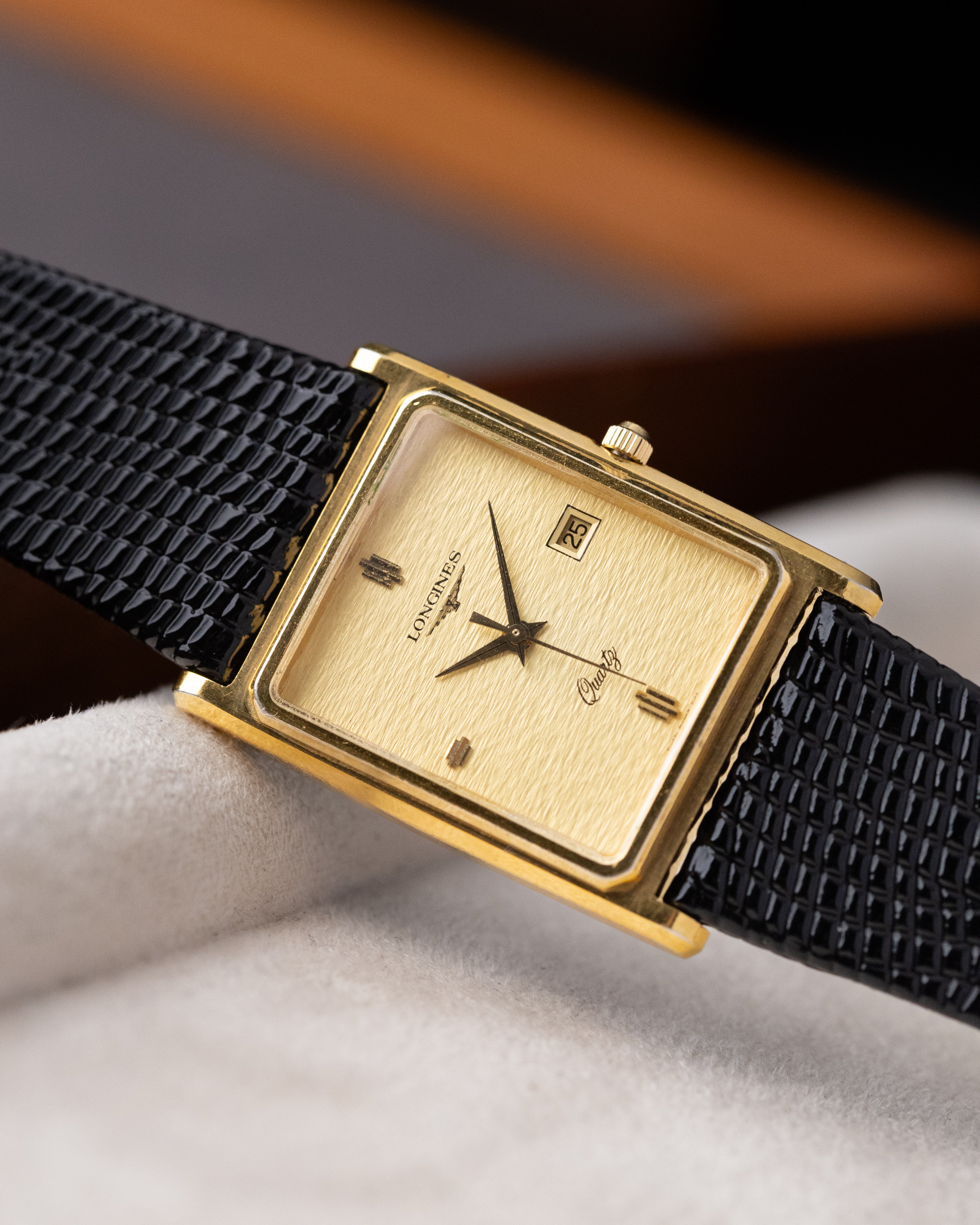
Vintage Longines “St. Moritz”, Art Deco Tank, Quartz Cal. 152, Swiss Made from 1990's
This elegant Longines “St. Moritz” is a refined example of late 1980s quartz luxury, blending precision timekeeping with understated gold-tone styling.
$1,390.00
See MoreSt. Moritz models feature slim rectangular gold-tone cases, sometimes integrated bracelets, and elegant textured dials. Originally produced as stylish everyday dress watches, they have recently become extremely popular in the vintage community. Their clean geometry, light profile, and refined 1970s–80s charm resonate strongly with today’s trend for “quiet luxury.”

Longines St. Moritz variations from our collection, showing both the integrated bracelet design and the leather-strap configuration
Collectors now seek St. Moritz pieces as affordable alternatives to Cartier Tank and Piaget classics, with a distinctly Longines identity.
Jaeger-LeCoultre
Jaeger-LeCoultre occupies a unique place in the history of rectangular watchmaking. No other brand has shaped this category as deeply, consistently, and artistically as JLC. Their designs stand at the crossroads of engineering, geometry, and timeless elegance — and nowhere is this more evident than in the Reverso and the maison’s early rectangular creations.
1. The Reverso — The Icon of Rectangular Watchmaking
Introduced in 1931 for British officers playing polo in India, the Reverso was built to solve a practical problem: protecting the watch crystal during sport. Its patented reversible rectangular case became one of the most original concepts in watchmaking history.

A Jaeger-LeCoultre Reverso shown with authentic 1930s–1950s advertising materials
Over time, the Reverso transformed from a sports tool into a symbol of timeless Art Deco luxury.
📌 Notable Reverso Variants
-
1930s Reverso “original style” — small, pure Art Deco proportions
-
Reverso Classique — thin, refined, timeless
-
Reverso Grande Taille — modern interpretation with a larger case
-
Reverso Duo / Dual-time — two dials, two time zones
-
Reverso Lady — elegant smaller formats

Each generation maintained the brand’s unique rectangular identity.
2. Vintage JLC Rectangular Classics (Uni-Plan, Tank-Style & Art Deco Variants)
Although the Reverso is the headline piece, Jaeger-LeCoultre produced a rich portfolio of other rectangular watches throughout the 1930s–1960s. These models are less known to the general public but highly appreciated by collectors for their design purity, thin cases, and beautifully finished movements.
📌 JLC Uni-Plan (1930s)
One of the most elegant pre-war rectangular JLC watches, featuring:
-
a slim, elongated case
-
delicate Art Deco typography
-
stepped or flat sides depending on the variant
-
early hand-wound movements with refined finishing

Jaeger-LeCoultre Uni-Plan Model J, an elegant 1930s rectangular design preserved in our Dumarko collection
The Uni-Plan demonstrates JLC’s mastery of rectangular shapes even before the Reverso became iconic.
📌 JLC Tank-Style and Art Deco Models
Parallel to Cartier’s Tank, JLC created its own interpretation of the rectangular dress watch:
-
clean, straight lugs
-
minimalist dials with applied markers
-
refined steel or gold cases
-
hand-wound calibers and later ultra-thin movements

These “Tank-style” JLC watches offer the same level of refinement as the brand’s more famous models — often at significantly better value.
Together with the Reverso, these vintage rectangular models represent the deepest heritage in rectangular Swiss watchmaking.
Conclusion: The Enduring Power of Geometric Watchmaking
Square and rectangular watches offer a blend of elegance, geometry, and timeless design that round cases simply cannot replicate. From early mechanical icons to modern quartz classics, these shapes have defined entire eras of watchmaking and continue to attract collectors who value character and individuality.
Whether you prefer the bold presence of a square case or the refined lines of a rectangular one, these watches remain some of the most expressive and enduring pieces in horology. For anyone building a thoughtful collection, geometric timepieces are not just an option — they’re essential.
FAQs
Q1. Why are square and rectangular watches considered special in horology?
A1. Square and rectangular watches stand out due to their strong geometric design, architectural presence, and rarity compared to round watches. Their shapes require specialized movements and reflect deep Art Deco heritage, making them visually distinctive and highly collectible.
Q2. What is the main difference between square and rectangular watches on the wrist?
A2. Square watches have equal height and width, giving them a bold and balanced presence, while rectangular watches are longer than they are wide, creating a more refined, elegant look often associated with dress watches.
Q3. Which historical period influenced the design of rectangular and square watches the most?
A3. The Art Deco era (1920s–1940s) had the strongest influence, introducing symmetry, sharp geometry, stepped cases, and elegant dial layouts that still define many classic rectangular and square watches today.
Q4. Which brands are most important in the history of square and rectangular watches?
A4. Omega, Longines, and Jaeger-LeCoultre played key roles. Omega produced elegant rectangular and square models from the 1930s onward, Longines pioneered many Art Deco and later quartz geometric designs, and Jaeger-LeCoultre defined the category with the iconic Reverso and early rectangular classics.
Q5. Are square and rectangular watches currently in style?
A5. Yes. Interest in square and rectangular watches is growing due to renewed appreciation for vintage proportions, minimalist design, and geometric aesthetics, making them increasingly popular among collectors and modern enthusiasts alike.