
Few timepieces have achieved what the Cartier Tank has: over a century of continuous production without a single meaningful concession to trend. Understanding it — its models, its movements, its place in collecting — means understanding a design that essentially invented the modern dress watch.
The Tank was born from an observation, not an inspiration. In 1917, Louis Cartier looked at the Renault FT-17 military tank rolling across the Western Front and saw a watch case. The parallel treads became brancards — the vertical sidebars flanking the dial. The chassis became the case. The resulting geometry was unlike anything on a wrist at the time: rectilinear, architectural, deliberately anti-round. When the watch reached retail in 1919, it created a category that every other rectangular watch since has been measured against.
Origin: The Design Born from War
The Renault FT-17 was introduced in 1917 and changed the course of World War I. Louis Cartier saw in its tracked silhouette a watch case profile: the tank's side tracks became brancards, the chassis became the case. Cartier gave the first Tank to General John Pershing in 1917. Two years later a commercial run followed — landing at precisely the right cultural moment as the 1920s embraced geometric modernism and Art Deco rationalism.
What made the original design so durable is that it had no excess. Every element served the composition: brancards gave structural emphasis; Roman numerals preserved legibility; blued-steel hands provided contrast; the cabochon spinel crown added a single decorative accent without compromising the geometry. There was nothing to remove. That is why it has never needed to change.
Anatomy of the Tank: Design Codes Explained
- Brancards — Parallel vertical sidebars flanking the dial. Rounded and separated from the case in the Louis Cartier; integrated into the bracelet in the Française.
- Roman numeral dial — Standard across virtually all references. Cartier's house typeface has remained consistent across the entire production history.
- Railroad minute track — Fine segmented track around the outer dial edge, a hallmark of Cartier dial construction.
- Blued-steel sword hands — Faceted, tapered, heat-blued to a deep blue-black. A consistent signature since 1919.
- Cabochon crown — Winding crown set with a polished round sapphire spinel cabochon — dark blue-purple, highly polished. One of the most recognised details in watchmaking.
The Major Tank Models
The closest contemporary expression of the 1917 original. Slim, precious metal construction (yellow gold, rose gold, platinum). Andy Warhol wore one daily from the mid-1970s until his death in 1987.
Best for: Collectors, formal wear, heritage authenticityCreated in 1973 to bring Cartier to a wider market. Silver-gilt cases, quartz movements, exceptional dial variety including lacquered colours. See our complete Must de Cartier dial guide.
Best for: Daily wear, first Cartier, modern stylingFirst Tank with an integrated metal bracelet as a design element. Softer, more rounded case lines. Princess Diana wore it in its early years. Available in quartz and automatic in steel, gold, and two-tone.
Best for: Bracelet preference, business wear, 1990s aestheticStretches and curves the case body, producing an arched profile that wraps the wrist more naturally than the flat Louis Cartier. Carries mechanical automatic movements in its more prestigious references.
Best for: Mechanical depth, wrist presenceDramatically elongated and curved along its length — a case that appears almost to melt around the wrist. Always limited production, always precious metals. The most prestigious and historically important Tank variant among serious collectors.
Best for: Serious collectors, investment, architectural puritySimplified steel version of the Louis Cartier, quartz only. Discontinued in the early 2020s and replaced by the Tank Must. Pre-owned references represent strong value — design is indistinguishable from the Louis Cartier at a glance.
Best for: Entry-level Cartier, pre-owned valueMovements: Mechanical vs Quartz
| Movement Type | Found In | Notes for Collectors |
|---|---|---|
| Manual wind | Tank Louis Cartier, Cintrée limited | Thinnest possible profile; Calibre 430 MC in current production. Most prized. |
| Automatic | Tank Américaine, Française mid-range | Self-winding; slightly thicker case. Calibre 1847 MC in current references. |
| Quartz (ETA-based) | Tank Must, Tank Solo, Louis Cartier entry | Widely accepted. Reliable, thin, historically appropriate. Battery every 2–3 years. |
| Solar quartz | Tank Must SolarBeat | Solar cell beneath dial; 16-year claimed battery life. |
In vintage Must de Cartier Tanks (1973–1990s), the quartz movements are ETA-based ébauches regulated by Cartier. Reliable, well-supported, and affordable to service. A stopped vintage Must almost always just needs a new battery.
Case Sizes and Fit Guide
| Model | Small | Medium/Large | Notes |
|---|---|---|---|
| Tank Must | 29.5 × 22mm | 33.7 × 25.5mm / 41 × 31mm | Three sizes; medium is the most versatile |
| Tank Louis Cartier | 29.5 × 22mm | 33.7 × 25.5mm | Two sizes; wears flat and understated |
| Tank Française | 20 × 25mm | 25 × 30mm / 28 × 32mm | Bracelet adds significant wrist presence |
| Tank Américaine | 34 × 22mm | 46 × 24.4mm | Reads more prominent than measurements suggest |
| Tank Cintrée | Varies by era | 45+ × 16–18mm | Extremely elongated; unique wearing experience |
Who Wore the Tank
I don’t wear a watch to know what time it is. I wear it to know there is a time.
Investment Value
The Cartier Tank offers century-long cultural validation, genuine cross-demographic demand, and a resale market that has remained liquid through multiple economic cycles. It is not a speculative piece but an exceptionally stable one.
- Original box and papers — Complete sets command 20–40% premiums over naked pieces.
- Precious metal construction — Yellow gold 1970s–1980s references are consistently strong performers.
- Dial condition and originality — No redials, no touch-ups, crisp Roman numerals, intact minute track.
- Cabochon crown — Original sapphire spinel is irreplaceable. Incorrect replacement material is a significant value deduction.
- Must de Cartier lacquer colour — Deep green and burgundy lacquer dials in excellent condition are the most sought-after vintage Must pieces currently.
Buying Vintage: What to Look For
The brancards. Polished on the flat faces, brushed on the sides — a finishing distinction that is difficult to replicate. Run your fingernail along the transition. You should feel a distinct edge. Over-polished pieces lose this entirely.
The dial printing. Cartier's Roman numeral typeface has remained consistent across all decades. The "Cartier" signature at 12 o'clock should be a specific serif font. "Swiss Made" at 6 o'clock indicates post-1970s production.
The cabochon. Dark blue-purple sapphire spinel, highly polished and rounded. Flat, pale, or glass-topped crowns indicate replacement. Original spinel has visible depth; a flat version does not.
Case hallmarks. French-market pieces carry eagle-head assay marks for 18ct gold. Serial numbers engraved between the lugs can be cross-referenced for production date. See our Swiss hallmarks guide and our guide to gold types in vintage watches.
The Tank Aesthetic in Vintage Swiss Watches
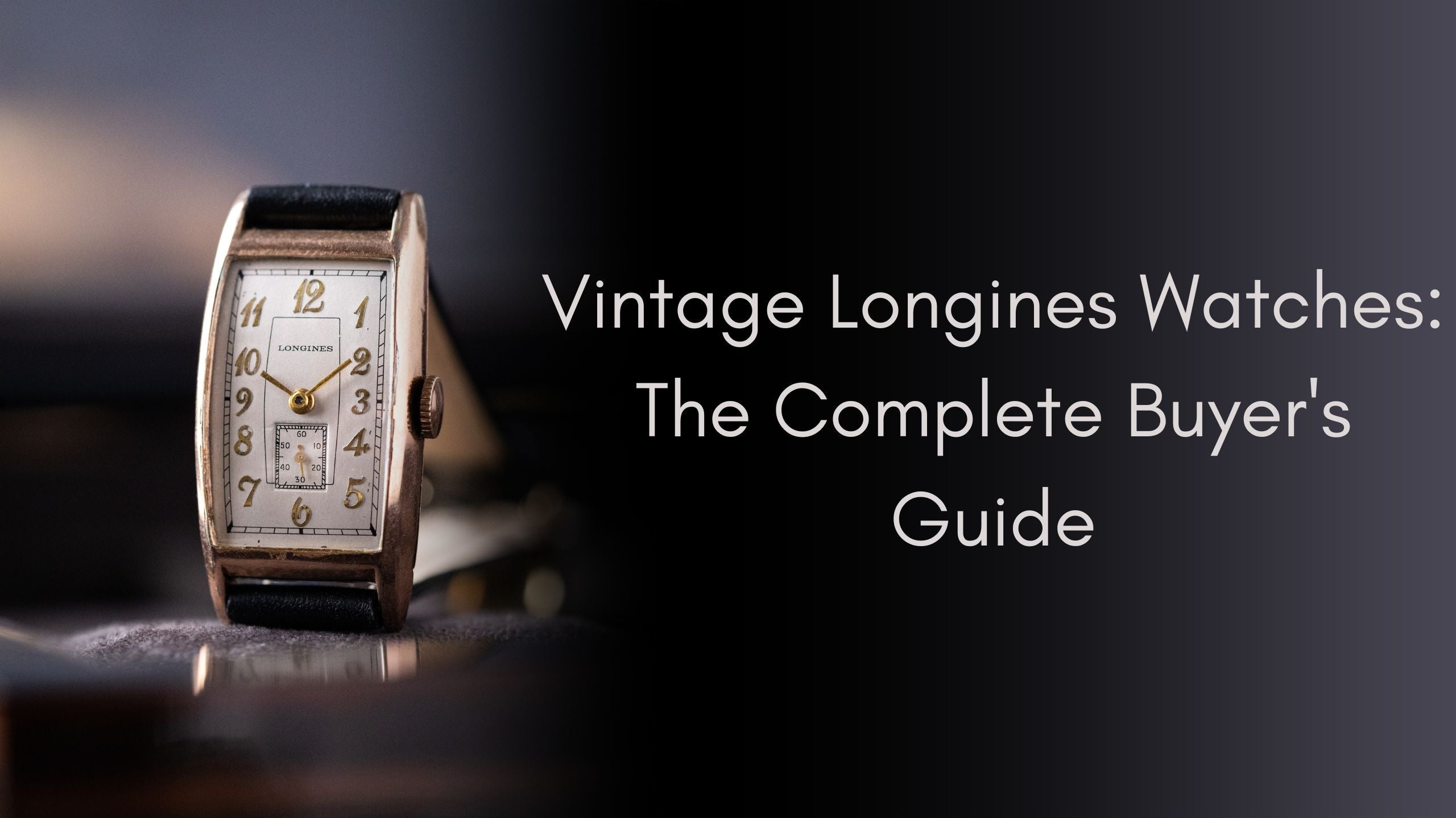
Longines, Omega, Zenith, and others all produced rectangular tank-style watches from the 1920s through the 1970s — contemporary with Cartier's own production, often of comparable mechanical quality, available today at a fraction of what an equivalent vintage Tank commands. Our complete guide to vintage rectangular watch alternatives covers this category in full.

A 1934 Longines in the precise tank tradition — rectangular case, clean Roman numerals, slim profile. The sector dial is the standout: a stepped, concentric design associated with the highest-grade Art Deco watch production of the 1930s. The Longines Cal. 20.28 manual-wind movement is one of the most respected calibres of the interwar period. Produced in the same decade as the golden age of the Cartier Tank, and in many respects its equal as a design object.

A "Gold Medal" designation Longines in a 10K gold-filled tank case from the 1960s. Conservative, refined proportions, impeccable Swiss movement. The gold-filled case has aged beautifully.

A 1970s Longines square tank with a linen-texture dial — a warm, tactile finishing technique of the period. Slim, understated, completely original.

A 1940s Omega in solid gold with a tank-profile case — the same proportions and aesthetic as the Cartier Tank Louis Cartier of the same decade, with Omega's own distinguished movement.

A Jaeger-LeCoultre rectangular-case watch with moonphase aperture, pointer date hand, and JLC quartz movement. Double-signed dial, two-tone case. One of the rarest rectangular complication watches of the 1990s.
Reader Questions
Cartier Tank — FAQ