
Gold vs gold-plated vs gold-filled: if you've browsed vintage Swiss watches, you've seen all three words, often alongside gold-capped and vermeil. They sound alike, but the amount of real gold behind each one can differ a thousand times over.
This guide explains what each type means, how thick the gold really is, and how you can tell which one you're holding. We've also included the stamps to look for and the at-home tests that work, along with the ones that don't.
When a gold watch comes in to us, the first thing we do is read the hallmark, and in most cases that tells us everything we need to know.
This guide is built around the same approach. Once you know what each stamp means, the difference between solid, filled, capped and plated gold stops being a mystery.

At a Glance: The Gold Types Compared
Before we go into detail, here's where the four main types sit relative to each other. Vermeil, a gold layer over sterling silver, gets its own section further down.
The whole case is a gold alloy, usually 14k or 18k, with no base metal underneath. Look for fineness numbers like 750 or 585 and, on older Swiss cases, the Helvetia head or the squirrel.
A thick cap of solid gold, around 200 microns on Omega cases, bonded to the front of a steel case. You'll usually find a steel caseback. Omega, Longines and Universal Genève used it widely in the 1950s and 60s.
A sheet of gold bonded to a base metal by heat and pressure. Under US rules the gold must be at least 1/20 of the metal's weight. It was very popular in mid-century American watchmaking.
Gold deposited on steel or brass by electroplating. The layer can be a fraction of a micron or as much as 40 microns on good Swiss cases. Once it wears through, only re-plating brings it back.
| Type | Gold Layer | Durability | Value | Best For |
|---|---|---|---|---|
| Solid Gold | The whole case | High (soft, but no base metal to reveal) | ★★★★★ | Long-term ownership |
| Gold-Capped | About 200 microns | Very high | ★★★★☆ | Daily wear |
| Gold-Filled | About 80 microns, min. 1/20 by weight | High | ★★★☆☆ | Everyday wear, first gold watch |
| Vermeil | From 2.5 microns over silver | Medium | ★★★☆☆ | Cartier Must fans |
| Gold-Plated | Under 1 to 40 microns | Low to medium | ★★☆☆☆ | Occasional wear, smaller budgets |
How Thick Is the Gold? Microns Explained
The word "plated" covers a huge range, and that's where most of the confusion starts. A micron is a thousandth of a millimetre, and the number of microns on a case decides how long its gold will last.
In the US, a watch sold as "gold electroplate" needs only 0.175 micron of gold, and "heavy gold electroplate" starts at 2.5 microns. Anything thinner than the minimum has to be called "gold flashed" or "gold washed". These limits come from the FTC Jewelry Guides, as summarised by the Jewelers Vigilance Committee.
Swiss makers were often far more generous, and good Swiss cases tell you exactly how much gold is on them. Swiss rules let them stamp the thickness in microns next to a code: GP for plated, GR for laminated gold and GC for gold-capped. Our 1962 Longines Cal. 280, featured below, is stamped "Plaqué Or G 40 Microns".
In practice, this means two watches both listed as "gold-plated" can be very different objects. A case with 40 microns of gold can last decades of careful wear, while a flashed case can wear through quickly.
Solid Gold Watches: The Real Deal
Solid gold watches are made entirely from a gold alloy rather than being coated. You'll rarely find 24k gold because it's too soft for a case, so most solid gold watches are 14k or 18k. British-cased watches are often 9k. They feel noticeably heavy on the wrist, and that weight is part of the appeal.

Solid gold ages well and develops a soft, warm tone over the years. Classic examples include 1950s Omega Constellations and early Rolex Datejusts, which come in both men's and women's sizes.
Are Solid Gold Watches a Good Investment?
They can be, though not always for the reasons people assume. The gold itself gives the watch a floor price based on its weight and the current gold price. That makes solid gold pieces more stable in value than plated or gold-filled ones.
The brand, rarity, condition and originality of a watch usually matter more than its gold content. A solid gold case from Rolex, Patek Philippe or Omega will normally sell for more than a lesser-known brand with the same amount of gold.
So it's best to buy a solid gold watch because you like the model and its quality. The gold weight is a safety net rather than the main reason to buy.

Gold-Capped Watches: The Quiet Sophisticate
A gold-capped case has a thick layer of solid gold bonded to the front of a steel case under heat and pressure. On Omega cases the cap is roughly 200 microns, about ten times thicker than good plating. From the front it looks just like a solid gold watch.
The cap takes polishing far better than plating does, but it's still soft gold and it scratches like any gold case. Turn the watch over and you'll usually find a stainless steel caseback, with steel showing at the rear of the lugs. Swiss rules give capped cases their own code, GC, followed by the thickness in microns.
Omega, Longines and Universal Genève used this technique widely during the 1950s and 60s. A gold-capped watch gives you a lot of real gold for the money and a steel core that keeps the case strong.

Gold-Filled Watches: The Sturdy Middle Ground
Gold-filled watches sit between plated and solid gold. A sheet of gold is bonded to a base metal by heat and pressure, and under US rules the gold must make up at least 1/20 of the metal's weight. If the share is between 1/40 and 1/20, the fraction has to be stamped, as in "1/40 12K RGP".

Gold-filled cases were especially popular in mid-century America, with brands like Hamilton, Bulova and Elgin using them widely. On Omega cases the layer is often around 80 microns, and it usually covers the back and the rear of the lugs too. That's why a well-kept gold-filled watch can still look like solid gold after decades.
The stamp is usually easy to find on the caseback or between the lugs. You'll see marks such as "10K Gold Filled", "14K GF" or "1/20 10K RGP". The karat figure describes the gold layer, not the whole case.

Gold-Plated Watches: The Look Without the Weight
Gold-plated watches start with a steel or brass case that's coated with gold by electroplating. The layer can be anything from a fraction of a micron on cheap fashion pieces to 20 or even 40 microns on good Swiss cases. When it's new, it looks the same as solid gold.
Each polish or knock takes a little of the gold away, though. Once the base metal shows through, the only fix is re-plating. The places that wear first are the ones that touch things most, like the lug edges, the caseback rim and the crown.
That's why a well-preserved plated watch is worth more than a worn one, and why the micron number on the case matters so much. With 20 or 40 microns of gold, a vintage Swiss or Soviet plated case can stay in very good shape if it's been looked after.

What Is Gold Vermeil? The Watch World's Most Misunderstood Finish
Gold vermeil (pronounced vehr-MAY) is a layer of gold over sterling silver rather than base metal. In the US the term is regulated. The base must be sterling silver (92.5% silver), and the gold must be at least 10 karat and at least 2.5 microns thick.
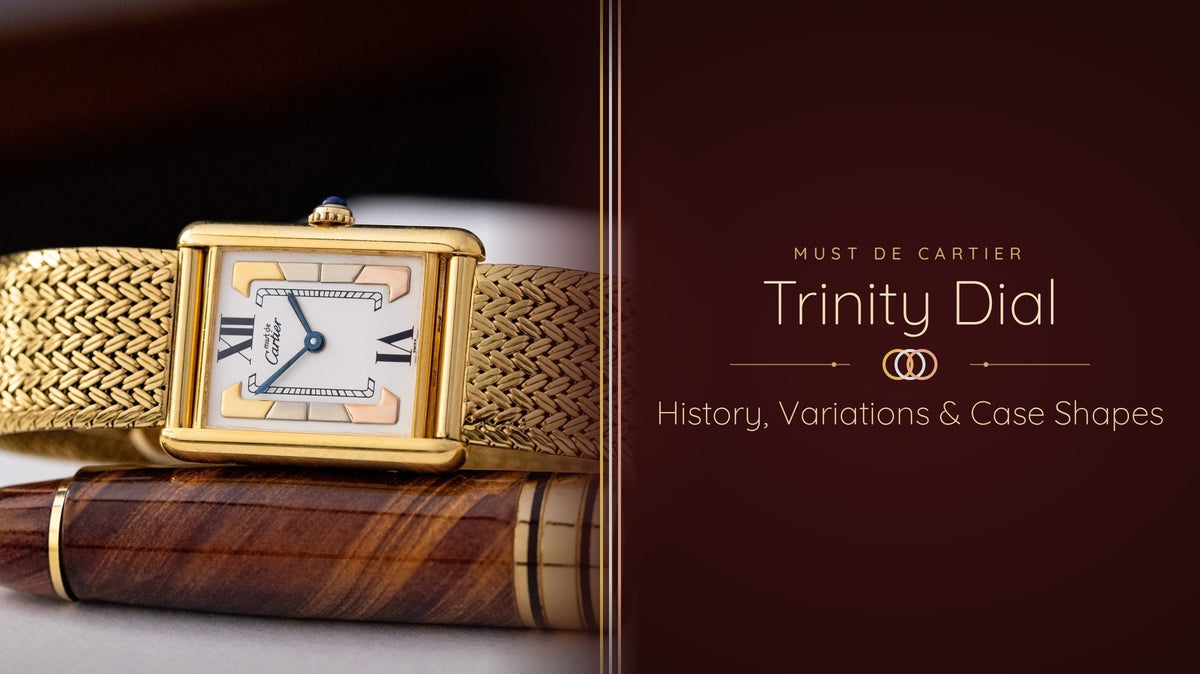
In watches, vermeil is best known from the Cartier Must de Cartier line, launched in 1973. Cartier used sterling silver cases with a thick gold finish as a design choice, and the result has a slightly warmer tone than gold over steel or brass. Our Must Tank below carries 20 microns of 18ct gold, eight times the legal minimum.
Base material: Vermeil needs sterling silver underneath, while gold plating can go over any base metal, including brass or steel.
Gold thickness: Vermeil starts at 2.5 microns. Plain gold electroplate can legally be as thin as 0.175 micron, so a vermeil case usually lasts much longer.
Material value: There's real silver under the gold, which gives vermeil a higher material value than plating on steel or brass.
Hallmarks: On Cartier Must pieces, look for the "925" sterling silver mark next to the Cartier signature.
Vermeil still wears at the lugs, the caseback edges and the crown after decades of use. The thicker gold and the silver base mean it takes much longer than on most plated cases. Well-kept vermeil Cartier pieces from the 1970s and 80s are among the more durable gold-finish watches you can buy today.

What Does "AU20" Mean on Vintage Watches?
"Au" is the chemical symbol for gold, from the Latin aurum. So when you see "AU" or "AU20" on a case, there's real gold on it, but that doesn't mean the watch is solid gold.
On Soviet watches, "Au 20" means the case is plated with a 20-micron layer of gold. That's a thick plating, far more than the US electroplate minimum, but the case underneath is base metal.
You'll find the mark on Soviet watches such as Poljot, Raketa, Slava and Vostok, made between the 1960s and the 1990s.

How to Tell If Your Watch Is Real Gold
Most of the time you can work out what a case is made of without damaging it. Start with the stamps and the wear. The chemical tests come last, and they're best left to a jeweller.
1. Read the Stamps
Solid gold cases carry a fineness number, such as 750 for 18k or 585 for 14k. Older Swiss gold cases often add an official hallmark too, like the head of Helvetia on 18k or a squirrel on 14k. Today Switzerland uses a single mark, a St Bernard's head, for every precious metal.

Plated and filled cases use different words, and a karat figure next to them describes only the gold layer. Tap a stamp below to see what it means.
18K
The metal is 75% pure gold. On older Swiss cases you'll often see the head of Helvetia next to it, and on newer ones a St Bernard's head.
14K
The metal is 58.5% gold. Older Swiss cases may show 0.583 and a squirrel hallmark. 14k is harder than 18k, so it was common on mid-century watches.
9K
The metal is 37.5% gold. You'll see it most often on British-cased watches, which also carry British assay marks.
Gold Filled
A layer of 10k (or 12k, 14k) gold bonded to base metal. Under US rules the gold is at least 1/20 of the metal's weight. The karat refers to the layer only.
10K RGP
Made the same way as gold-filled. The fraction shows the gold's share of the metal weight, and anything under 1/20 must carry the fraction, such as "1/40 12K RGP".
40 Microns
Electroplated gold over base metal. On Swiss cases the number tells you the thickness, so "Plaqué Or G 40 Microns" means 40 microns of gold, as on our 1962 Longines.
The Swiss code for a solid gold cap over a steel case, followed by the thickness in microns. Many older capped cases have no stamp at all, apart from a steel caseback.
A 20-micron gold layer over base metal, common on Soviet watches from the 1960s to the 1990s. It's real gold, but the case isn't solid gold.
The case is 92.5% silver. If it's gold in colour, it's vermeil, as on Cartier Must watches. The gold layer is at least 2.5 microns under US rules.
HGE (heavy gold electroplate) means at least 2.5 microns of gold. GEP (gold electroplate) means at least 0.175 micron, which wears through quickly.
Steel Back
The back is steel, so the case isn't solid gold. The front may be plated, filled or capped, so look for a second stamp to find out which.
If you want to see the official marks in detail, our guide to Swiss watch hallmarks shows each one up close.
2. Check Where the Wear Shows
Look closely at the lug edges, the rim of the caseback and the crown. On a plated case, these are the first places where brass or grey steel starts to show through. A solid gold case can be scratched and dented, but the colour under the scratch is the same gold.
3. Look at the Caseback and the Back of the Lugs
Gold-capped cases are usually gold on the front only, with a steel back and steel at the rear of the lugs. Gold-filled cases tend to carry the gold over the back as well. On a solid gold watch the caseback is gold too, and it's usually stamped on the inside.
4. The Magnet Test, and Why It Only Rules Things Out
Gold isn't magnetic, so a case that jumps to a magnet isn't solid gold. The trouble is that brass and most stainless steels don't react either, so a case that ignores the magnet hasn't proved anything. Keep strong magnets away from a mechanical watch, as they can magnetise the hairspring and make it run fast.
5. Acid and XRF Tests, Best Left to a Jeweller
The acid test means rubbing the metal on a touchstone and seeing which acid dissolves the streak. To get past a gold layer, the jeweller has to file a small notch, so it leaves a mark on the case. Some stainless steels can even pass an 18k acid test.
An XRF analyser reads the metal in seconds without touching it. It only sees the top 10 to 15 microns of gold, though, so a thick plated or capped case can read like solid gold.
Real or Fake Hallmark?
Hallmarks can be faked, so it helps to see a fake next to a real one. Here's a comparison from watches that have passed through our hands.
For us, the hallmark settles almost every case. We read the fineness number and the official mark together, because a karat stamp on its own can be struck by anyone.
The comparison above shows why it's worth looking closely. We don't rely on magnets or acid for the watches we sell.
So, Which Gold Is Right for You?
It depends on what you want from the watch and how you plan to wear it. Here's how each type suits a different kind of buyer.
The highest material value and the strongest resale floor. Choose it for the model and its quality first, with the gold as a bonus.
The look of solid gold at a fraction of the price, with enough gold to polish and wear for decades.
Real gold on the outside and a sensible price. A good way to start with vintage gold without a big outlay.
Affordable vintage style. Check the micron stamp and the edges, and wear it gently to keep the gold in good shape.
The question we hear most is simply whether a watch is "real gold". The honest answer is usually that there's real gold on almost all of them, and what changes is how much and what lies underneath.
If you're buying your first gold watch, a capped or filled case from the 1950s or 60s often gives you the most watch for the money. With plated cases, we'd look at the condition before anything else, because a plated case in great shape is a far better buy than a worn one at a lower price.
A gold-capped Omega from the 1960s or a gold-filled Hamilton from the 1950s may never be worth a fortune, and that's fine. They're well made and pleasant to wear, and with the stamps in this guide you'll know exactly what you're buying.
Your Questions Answered
Frequently Asked Questions