
The Omega Constellation is the chronometer Omega launched in 1952 to sit at the top of its range, with an observatory and eight stars on the caseback. Over the next thirty years it went through four very different looks, from the faceted pie-pan dials of the 1950s to the clawed Manhattan of the 1980s.
The vintage Constellation falls into four eras: the pie-pan models of the 1950s and 1960s, the C-shape from 1964, the quartz models of the 1970s and the Manhattan from 1982. The eight stars on the caseback stand for two world precision records at Kew-Teddington and six wins at the Geneva observatory.
In our shop, steel and gold-capped pie-pans and C-shapes cost $2,349 to $4,572, counting sold watches and current ones. Manhattans have sold for $1,662 to $2,510. Our top sale so far is an 18K black crosshair Constellation at $9,053.
This guide tells the story of the Constellation from the 1948 Centenary to the 2015 Globemaster, then covers the movements, what each model is worth and what to check before you buy. Every price in it comes from a Constellation we've had in our shop.
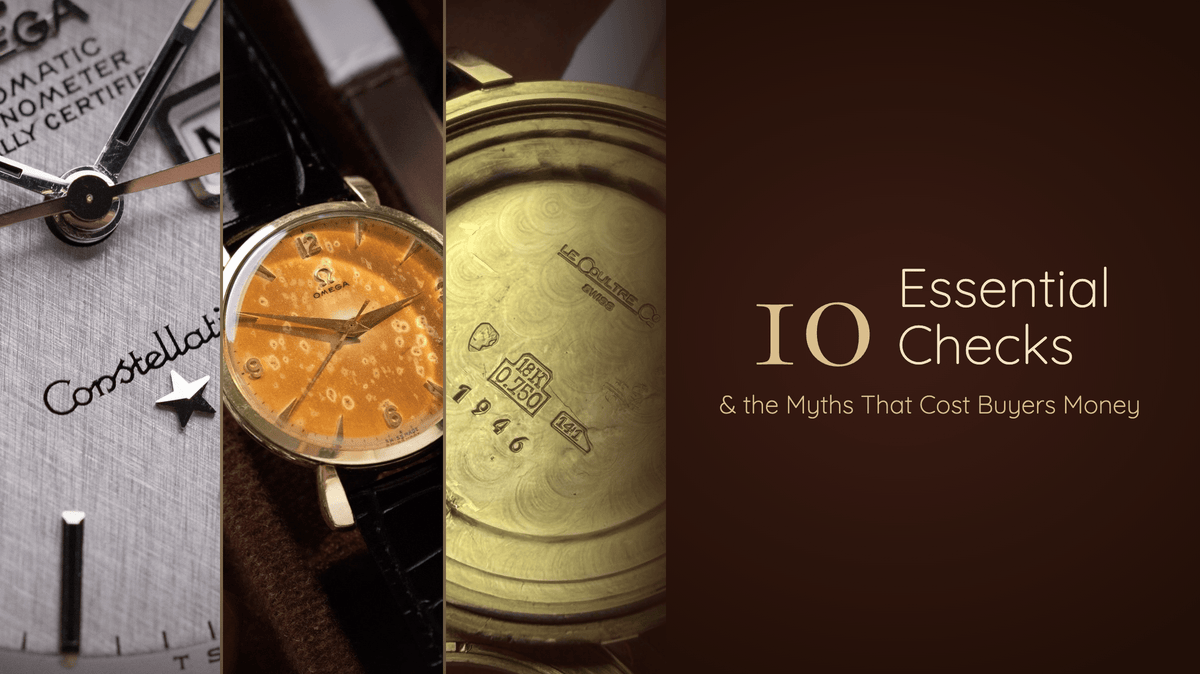
When a Constellation comes into our shop, we start with the dial and the caseback medallion. A redial or a badly opened caseback changes the price more than anything else, and the medallion is also the part customers ask us about first.

What the Eight Stars Mean
Turn over a vintage Constellation and you'll find a medallion showing an observatory under a sky of eight stars. Omega chose this picture because it built the collection around precision, and in those days observatories ran the official accuracy trials for watches.
According to Watchonista's history of the Constellation, two of the stars stand for the world precision records Omega set at the Kew-Teddington observatory in England in 1933 and 1936. The other six stand for Omega's wins in the wristwatch category at the Geneva observatory.
The star on the dial
Constellations also carry a small star on the dial, either below the Omega logo or above 6 o'clock. On vintage models it's applied in gold or steel, and it lets you recognize a Constellation from the front. When people search for the "Omega star watch," this is the watch they mean.
From the Centenary to the Constellation
The story starts in 1948, when Omega turned 100. To mark the anniversary, it made the Centenary, its first automatic wristwatch with chronometer certification. Timeline.watch puts production at around 8,000 pieces, all in solid gold, in a 35.5mm ref. 2500 and a smaller 33mm ref. 2499.
The Centenary sold so well that Omega turned the idea into a permanent collection. In 1952 it launched the Constellation, which Watchonista describes as the first watch family from any brand made only of certified chronometers.
Why early American Constellations say "Globemaster"
In the United States, the Lockheed Constellation airliner already held the rights to the name. Omega sold early Constellations there as the Globemaster until about 1956, and it brought the Globemaster name back in 2015 for a modern watch.
Standard, Deluxe and Grand Luxe
Omega made the early Constellation in three grades. The standard model came in steel, gold-capped steel or gold. The Deluxe was gold only, with applied gold markers, and the Grand Luxe came in gold or platinum with a gold brick-link bracelet and a presentation box. The Constellations that come into our shop are standard models, apart from the solid gold ones.
Omega Constellation Models by Year
Here's how the main models line up from the Centenary to today. Omega changed designs gradually, so the eras overlap by a few years.
The Pie-Pan Constellation
The pie-pan dial is the look people picture when they hear "vintage Constellation." The center of the dial is flat, and the outer ring slopes down in twelve facets, one for each hour marker. Collectors call it a pie-pan because it looks like an upside-down pie dish.

The facets catch the light differently as you move your wrist, so a pie-pan looks different in person from how it looks in photos. Pie-pans came with applied markers and Omega's star on the dial, and from 1958 the Calendar models added a date window.
Crosshair dials
Early Constellations also came with a "crosshair" dial, with two thin lines crossing at the center. Black crosshair dials sell especially well. We've sold two of them, a steel ref. 2852-4 SC for $2,693 and a solid 18K gold ref. 2852/2853 SC for $9,053.

Dog-leg lugs and other case details
Pie-pan Constellations such as our ref. 168.005 have "dog-leg" lugs, which step down sharply from the case like a bent leg. The cases we've had measure 34mm to 35mm, which feels close to a modern 36mm watch. The faceted crown is a small detail that's easy to miss, and an original one matters to buyers.
Bumpers and full rotors
The first Constellations used "bumper" automatics, such as the caliber 354. The winding weight swings in an arc and bounces off small springs, and you can feel a gentle knock on the wrist. From the mid-1950s, Omega moved to full-rotor automatics like the 501 and 505, and later the 551, 561 and 564.


The C-Shape Constellation
In 1964 Omega introduced a new case for the Constellation. Seen from above, the sides curve like two letter Cs facing each other, so collectors call it the C-shape. Luxury Bazaar's Constellation history credits the design to Gérald Genta, who later designed the Audemars Piguet Royal Oak and the Patek Philippe Nautilus.

The C-shape kept the pie-pan dial at first, and flat dials took over later. The case sits lower on the wrist than the older round models, and its broad lugs make a 35mm case look bigger. If you're after a vintage Constellation to wear every day, the C-shape is the one we suggest.
Frosty and linen dials
C-shapes also came with a textured dial that collectors call "frosty" or "linen." Up close it has a fine, grainy finish that softens the light. Photos rarely do it justice, so ask a seller for a close-up taken at an angle.

Fluted bezels and integrated bracelets
WatchTime points to a 1968 Constellation with a fluted bezel as the best-known example of that style, and Omega brought the same bezel back on the 2015 Globemaster. Toward the end of the 1960s, Omega also began fitting Constellations with bracelets that joined the case directly, with no gap at the lugs.
Day-date C-shapes
The day-date models use the caliber 751, which adds the day of the week beside the date. In our shop they cost a little more than the date-only models. We have two day-date C-shapes now, including one with a frosty dial.


Vintage Quartz Constellations
When quartz arrived in Switzerland at the end of the 1960s, Omega put the Constellation name on its first quartz watches. That's why searches for "vintage Omega Constellation quartz" bring up such a mix, from simple everyday models to the Megaquartz.
The Electroquartz
The Omega Electroquartz, introduced in 1969, was the first Swiss quartz watch to go into production. It ran on the Beta 21 movement, with a quartz crystal oscillating 8,192 times a second, and Omega sold it as a Constellation.

According to Wikipedia, Omega sold all five Electroquartz watches it showed at the 1970 Basel Fair. The gold model on an integrated bracelet cost £1,150, and the steel model £330. Omega made about 10,000 Electroquartz watches between 1970 and 1977.
The Megaquartz 2400
The Megaquartz 2400 of 1974 used the caliber 1510, with a quartz crystal vibrating about 2.4 million times a second. Phillips reports that it was accurate to about one second a month, and that it was the first watch with a quick hour-setting system. A Marine Chronometer version followed with an even faster crystal.
Everyday quartz Constellations
Omega also made simpler quartz Constellations in steel or gold-plated cases. They cost less than the automatics, and they're easy to wear. We have a 1970s Constellation Quartz with the caliber 1332 in our shop now.
Yes, if it runs and the dial is original. Early quartz movements are now vintage in their own right, and the Megaquartz is a collector's piece. Ask the seller when a watchmaker last serviced it, because early quartz parts are hard to find.

The Constellation Manhattan
In 1982 Omega gave the Constellation a completely new look, the Manhattan. According to Quill & Pad, the designer was Carol Didisheim, a young designer at Omega. The idea came from her colleague Pierre-André Aellen, who noticed the clasps holding a frameless mirror to the wall.

The four claws
On the Manhattan, four clasps at 3 and 9 o'clock hold the flat crystal in place. Collectors call them "claws," or "griffes" in French. Without a normal bezel, the case could be slimmer and better sealed, and the markers could sit on the underside of the crystal.
Movements and versions
The first Manhattans of 1982 had the slim quartz caliber 1422. Automatic versions followed in 1984, first with the caliber 1111. Quill & Pad says the Roman numerals moved from the dial to the bezel in 1995, and readers of that article date the change to the mid-1980s. Our own 1980s Manhattans include models with Roman numerals on the bezel, so check the reference before you rely on the design.
The Manhattans we've had measure 33mm to 34.5mm, in two-tone steel and gold, including day-date models and one with a solid gold bezel. The integrated bracelet is part of the design, so make sure it comes with the watch.

In the 1990s, Omega's "My Choice" advertising put the Manhattan on the wrist of Cindy Crawford, and her name became closely linked with the watch. All the Manhattans we've listed have sold, so these cards show the prices they sold for.


From the Double Eagle to the Globemaster
The vintage story ends with the Manhattan, but the Constellation kept changing. In the early 2000s, Omega added the Constellation Double Eagle, with the co-axial caliber 2500. That movement used George Daniels' co-axial escapement, which Omega first showed in 1999.

In 2009 Omega redesigned the whole line. According to the Swatch Group, the new Constellation came in five sizes from 24mm to 38mm, with refined claws and a new "Mono Rang" bracelet with a butterfly clasp. Every mechanical model now had a co-axial movement.
2015: The Globemaster
In 2015 Omega used the Globemaster name again for a new Constellation. It was the first watch built to meet Omega's Master Chronometer standard, which Omega developed with METAS, the Swiss Federal Institute of Metrology. According to WatchTime, the test has eight parts, including exposure to a magnetic field of 15,000 gauss, and the caliber 8900 was the first movement to pass.

The design looks back to the beginning. The Globemaster has a pie-pan dial like the 1952 Constellation and a fluted bezel inspired by the 1960s models, more than sixty years after the name first appeared in the United States.
Constellation vs. Seamaster vs. Speedmaster
Omega's three best-known vintage lines started out with different jobs. The Seamaster arrived in 1948 as a robust everyday watch, and the Speedmaster followed in 1957 as a chronograph for timing races. The Constellation sat above both of them as the dress chronometer, the watch Omega used to show how precise it could be.
| Line | Launched | Made For | Best Known For |
|---|---|---|---|
| Seamaster | 1948 | Everyday wear, water and sport | Diving models and the James Bond connection |
| Constellation | 1952 | Precision and dress wear | Chronometer movements and the eight stars |
| Speedmaster | 1957 | Timing races and events | The first watch worn on the Moon |
The vintage Constellations we sell come in gold, gold-capped and steel cases, with applied markers and carefully finished dials. If you want a vintage Omega for a suit or an evening out, we'd point you to the Constellation first. You can read the other stories in our articles on the Omega Seamaster and the Omega Speedmaster.
Vintage Constellation Movements
The movement tells you when Omega made a Constellation. Here are the calibers you'll meet in vintage models, including the ones in watches from our shop.
| Caliber | Type | Era | What to Know |
|---|---|---|---|
| 354 | Bumper automatic | Early 1950s | The first Constellations, like our 1954 ref. 2782-3 SC |
| 501, 505 | Full-rotor automatic | From 1955 | The first full-rotor Constellations |
| 504 | Automatic with date | Late 1950s | Used in Constellation Calendars, like our 1958 18K model |
| 551, 561 | Full-rotor automatic | About 1959–1966 | The 561 adds a date. We see both in pie-pans |
| 564 | Full-rotor automatic with date | From about 1966 | The classic C-shape movement, easy to service |
| 712 | Slim automatic | 1960s | Used in slim models like our ref. 167.021 |
| 751 | Automatic day-date | Late 1960s–1970s | Adds the day of the week |
| 1011 | Automatic with quick-set date | 1970s | The movement of the later C-shapes |
| Beta 21 | Quartz, 8,192 Hz | 1969–1970s | The Electroquartz |
| 1332 | Quartz | 1970s | An early quartz Constellation movement |
| 1510 | Quartz, 2.4 MHz | 1974 | The Megaquartz 2400 |
| 1422, 1444 | Quartz | 1980s | Manhattan movements. The 1444 has day and date |
| 1111 | Automatic | From 1984 | The first automatic Manhattans |
How to Identify and Date Your Constellation
If you've inherited a Constellation or found one at a market, you can learn a lot from the outside of the watch and from two places inside. You'll need a watchmaker to open the caseback for those two.
| Era | What to Look For |
|---|---|
| 1950s | Round case, pie-pan or crosshair dial, dog-leg lugs on references like 168.005 |
| Mid-1960s to 1970s | C-shape case, flatter dial, fluted bezel or integrated bracelet on later references |
| 1970s quartz | "Quartz" or "Electroquartz" on the dial, square or cushion cases |
| From 1982 | Four claws at the sides of the crystal, integrated bracelet |
| From 2015 | Globemaster with pie-pan dial, fluted bezel and "Master Chronometer" on the dial |
The caseback medallion
Vintage Constellations have the observatory and eight stars on the outside of the caseback. If the medallion is missing or the caseback looks plain, the back may come from a different watch. Look at how deep and sharp the engraving is, because heavy wear or tool marks point to careless opening.
The reference number
Omega stamped the reference inside the caseback, such as 14381 or 168.017. Earlier references have four or five digits, and later ones use six digits with a dot, like 168.005. The reference tells you the case style and, in the newer system, the material.
The movement serial number
The serial number on the movement gives you the year Omega made it. You can look it up with our Omega serial number decoder. Then check that the caliber fits that year, using the movement table above.
What Is a Vintage Constellation Worth?
The prices below come from our own shop, and they include watches we've sold and watches we have now. They're in US dollars as of October 2026.
| Type of Constellation | Example | Our Prices |
|---|---|---|
| Pie-pan, steel or gold-capped | Refs. 14381, 14393-2 SC, 167.005, 168.005 | $3,094 – $4,572 (sold) |
| Early crosshair or bumper, steel | Refs. 2852-4 SC, 2782-3 SC | $2,693 – $3,472 (sold) |
| Pie-pan era, solid 18K gold | Ref. 2852/2853 SC, 1958 Calendar | $7,895 (in stock) – $9,053 (sold) |
| C-shape, date | Refs. 168.017, ST 168.0056, cal. 564 and 1011 | $2,349 – $3,896 |
| C-shape, day-date | Ref. CD 168.029, cal. 751 | $3,427 – $3,782 (in stock) |
| Slim gold-capped, 1960s | Ref. 167.021, cal. 712 | $2,980 (in stock) |
| 1970s quartz | Ref. 196.0138, cal. 1332 | $1,593 (in stock) |
| Manhattan, 1980s | Refs. 196.1070, DB 396.1070, cal. 1422 and 1444 | $1,662 – $2,510 (sold) |
What drives the price
- An original dial. This matters more than anything else. A redial loses the collector value, even when it looks perfect.
- An unpolished case. Sharp edges on the lugs and case are worth paying for. Heavy polishing softens the shape for good.
- The case material. Solid gold costs the most, and gold-capped cases sit between steel and solid gold. Our guide to gold-capped, gold-filled and gold-plated watches explains the difference.
- The dial style. Black dials, crosshair dials and frosty C-shape dials sell for more than plain silver ones.
- The bracelet and papers. An original bracelet, box or chronometer certificate adds to the price, especially on a Manhattan.
Famous owners
Elvis Presley owned a Constellation Calendar in a pink gold-plated steel case. He gave it to his friend Charlie Hodge, and it sold at Antiquorum in 2012 for $52,500, according to Quill & Pad.
What to Check Before You Buy
The Constellation sold in large numbers, so the market is full of them, and quality varies widely. These are the checks we make on every Constellation that comes into our shop.
The dial
Look at the printing under magnification. Original text is crisp and fine, while a redial looks thick or slightly blurred. On a pie-pan, check the edges of the twelve facets for lifting or bubbling. The lume on the markers and hands should have aged to the same color.
The case and caseback
Check the lugs and the edges of the case for heavy polishing. On a pie-pan with dog-leg lugs, the bevels should still be sharp. On the caseback, the medallion should be deep and clear. For gold watches, look for the hallmarks, which our guide to Swiss watch hallmarks explains.
The movement and parts
Ask for a photo of the movement. The caliber should match the reference and the dial layout, so a date dial needs a movement with a date. Watches assembled from mixed parts turn up regularly, and they're the main reason we ask to see inside before we buy.
We look at the caseback medallion before we open a Constellation. A sharp observatory and clear stars tell us previous owners looked after the case, and in our experience that goes together with an original dial. Before we list a pie-pan, we also check the dial under a loupe and compare the printing with original examples we've had.
For a first Constellation, we suggest a steel C-shape with the caliber 564 or 1011. It's easy to wear, easy to service and costs less than a good pie-pan.
Constellations We've Sold
These are Constellations that have passed through our shop, with the prices they sold for.
Pie-Pan Era · 18K Gold
Ref. 2852/2853 SC, Black Crosshair, 1956
Sold · $9,053
 Pie-Pan · Cal. 561
Calendar, "Rail Track" Dial, 1960
Sold · $4,572
 Bumper · Cal. 354
Ref. 2782-3 SC, Crosshair Dial, 1954
Sold · $3,472
 Gold-Capped · Cal. 551
Ref. 14381, 1961
Sold · $3,323
 C-Shape · Cal. 564
C-Shape, Gold-Rose Case, 1960s
Sold · $2,854
 Pie-Pan Era · Steel
Ref. 2852-4 SC, Black Crosshair, 1958
Sold · $2,693
 C-Shape · Cal. 564
Ref. 168.017, Grey Dial, c. 1970
Sold · $3,896
You can see the Constellations and other watches we have now in our vintage Omega collection.
Your Questions Answered
Frequently Asked Questions