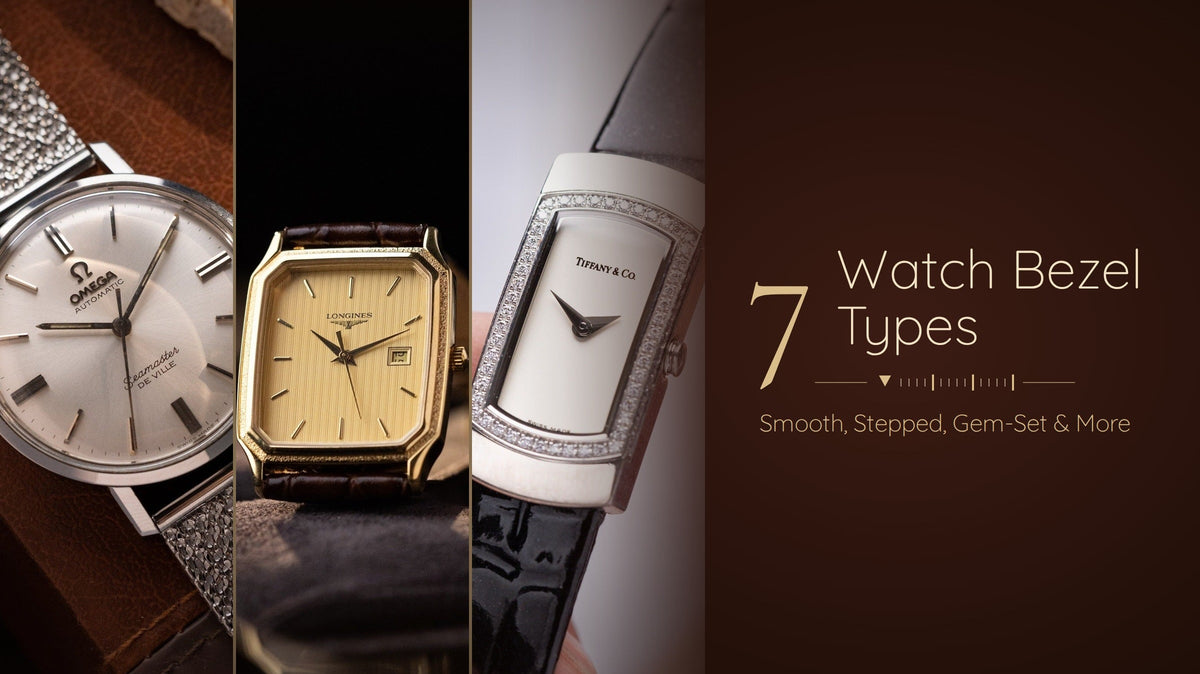

If you've ever wondered why some watches have a plain polished ring around the dial and others have a scale full of numbers, we've got you covered. The bezel is the outer ring that holds the crystal in place, and it can shape how a watch looks as well as what it can do. This guide walks through the seven watch bezel types you'll meet in our vintage Swiss watches and explains what each of them is for.
We looked at how bezels appear across thousands of vintage listings on Chrono24, then compared that with the watches that pass through our hands. The result is a practical map of the seven bezel types, with a buying checklist at the end.
Seven Bezel Types Compared
The seven types of watch bezels below fall roughly into decorative rings and working tools. Here's how four of them compare before we go into more detail.
The default ring on mid-century dress watches. A smooth bezel keeps the attention on the dial and suits almost any wrist. You'll also find it easily in good condition.
Born on the 1926 Rolex Oyster as a way to screw the bezel down tight, the fluted bezel is now just for decoration. Gold fluting on a steel case is a look collectors recognise straight away.
A rotating 60-minute ring that can time anything from a dive to a parking meter. It's very practical for everyday use, and Soviet Amphibia models make it very affordable.
Two tiers of metal around the crystal give a plain dress watch extra depth. You'll find stepped bezels on many 1940s and 1950s dress watches that still sell for modest sums.
| Bezel Type | Main Purpose | Approx. Vintage Entry Price (2026) | Investment Outlook | Best For |
|---|---|---|---|---|
| Smooth | Holds the crystal, clean look | $300 – $3,000 | ★★★☆☆ | Dress watch buyers |
| Stepped | Adds depth to a dress case | $400 – $3,000 | ★★★☆☆ | 1940s and Art Deco fans |
| Fluted | Decoration (originally sealing) | $500 – $4,000 | ★★★★☆ | Gold-accent collectors |
| Gem-set | Jewellery | $1,500 and up | ★★☆☆☆ | Evening wear |
| Diver | Elapsed time | $300 – $5,000+ | ★★★★☆ | Daily wear |
| GMT | Second time zone | $1,000 and up | ★★★★☆ | Frequent travellers |
| Tachymeter | Speed and other scales | $1,500 – $5,000+ | ★★★★★ | Chronograph collectors |
What Is a Watch Bezel?
A watch bezel is the ring that sits on top of the case and surrounds the crystal. On a typical vintage watch it does a quiet job: it holds the crystal in place, seals the top of the case and protects the edge of the glass.
Over the twentieth century the bezel picked up more work. Watchmakers saw that the ring around the dial was the largest surface they had for printing a scale. A ring that turns is also much easier to use than an extra crown, especially with wet or gloved hands. That's why watchmakers put many timing tools of the 1950s and 1960s on the bezel.
Functional and Aesthetic Bezels
We sort watch bezel types into two groups. Functional bezels carry a scale you use, such as the diver's 60-minute timer or the GMT's 24-hour ring. Aesthetic bezels are about appearance, and that group covers the smooth, stepped, fluted and gem-set styles.
The line between the two isn't that strict. The fluted bezel began life as a functional part on the Rolex Oyster and only later became decoration. Some functional bezels are also fixed, and tachymeter scales usually don't rotate at all because the chronograph hand does the moving.
A rotating bezel has a click spring or friction ring underneath it, and those small parts wear out or go missing over the decades. A fixed bezel has fewer things to go wrong, but watchmakers usually press or screw it onto the case.
Dress Watch Bezel Types: Smooth and Stepped
On these watches the bezel's job is to frame the dial, and the two bezel types that usually do this are the smooth and the stepped.
The Smooth Bezel
The smooth bezel is a plain, polished metal ring with no markings, teeth or stones. It's the oldest of all watch bezel types, and until the 1960s watchmakers fitted it as the default. Look through a tray of 1950s Omega or Longines watches and you'll see it on nearly every piece.
The reason is simple. Until the 1960s, a bezel only had to hold the crystal and seal the case, and a smooth ring did both with the least effort. Bezels became a design talking point from the late 1960s onward, when tool watches and the quartz crisis pushed brands to make the ring around the dial work harder.
Today the smooth bezel is still the usual choice for dress watches, although it isn't limited to them. Some well-known sports watches use a plain bezel as well, including the Rolex Explorer and the octagonal Patek Philippe Nautilus.
Because there's nothing to hide behind, a smooth bezel shows every mark. Fine scratches are normal, and collectors usually prefer them to a polish. Look at the edge where the bezel meets the crystal. On an unpolished case it's crisp, while on an overpolished one it rolls away and the crystal starts to look taller than it should. On gold-plated cases, check the top of the bezel for brassing, since that's where plating usually wears through first.
The Stepped Bezel
A stepped bezel consists of two rings of different sizes stacked on top of each other, or of one ring with a clear step cut into it. From the side it climbs towards the crystal in tiers, and from above it adds a second line around the dial, which gives a flat dress watch more depth.
The style was one of the few alternatives to a smooth bezel in the 1940s, when stepped cases suited the geometry of late Art Deco design. It never took over from the smooth bezel, but brands have come back to it several times, especially in the 1990s for slim dress watches. You'll still see it on modern classics such as the Vacheron Constantin Patrimony.
The part to check is the step itself. Polishing can easily wear a sharp step away, and once it's gone the bezel looks like an uneven smooth ring.
How a Dress Bezel Wears on the Wrist
A thin bezel lets the dial fill the case, so a 34 mm watch can wear like a 36 mm one, while a wide bezel makes the same case look smaller and more formal.
That matters with vintage sizes, which run smaller than modern. On a larger wrist, a 1950s watch with a slim bezel and long lugs will look more balanced. A wide stepped bezel on a 33 mm case suits anyone who prefers a compact, period look.
For a first vintage purchase, these two bezel types make a sensible start. They need no servicing and rarely need replacing, so there's less to check before you buy.

Decorative Bezel Types: Fluted and Gem-Set
The next two bezel types serve decoration first. The fluted bezel started as an engineering fix and later became a signature, and the gem-set bezel has always been decorative.
The Fluted /ˈfluː.t̬ɪd/ Bezel
Watchmakers cut a ring of fine vertical grooves into a fluted bezel, so from above it looks a little like a gear wheel. The grooves give the bezel many small faces that catch light from different angles, which is why fluting stands out so well next to a plain brushed case.
The design started with a practical job. When Rolex patented its Oyster case in 1926, the bezel, caseback and crown all screwed down against the middle case to keep water out. Rolex's own account of the Oyster case explains that the fluting let watchmakers screw the bezel down with a tool made only for that purpose.
As case construction improved, the bezel no longer needed screwing down, and the fluting stayed on as decoration. Rolex made it a house signature on the Datejust and Day-Date, usually in gold. Other brands copied the idea, especially from the 1960s onward.
Omega added fluted bezels to the C-shape Constellation from 1966. Collectors now look hard for C-shapes that pair a fluted bezel with a frosted dial, and we cover those references in our vintage Omega Constellation guide.
Fluting spread well beyond Switzerland. Soviet factories made their own versions, and Raketa produced fluted-bezel models that collectors often nickname "Tudor style". By the 1980s fluting had become a familiar sight, especially on two-tone watches.
The Baume & Mercier Shogun shows where the idea went next. Its 18k yellow gold fluted bezel sits on a stepped steel case with an integrated bracelet, and the contrast between the gold and the brushed steel is what defines the design.
Engine-Turned and Coin-Edge Variants
The fluted bezel has two close relatives that are worth knowing. The engine-turned bezel has finer, tighter fluting with smooth gaps at the hour positions, and Rolex used it on some Oyster Perpetual and Datejust references. The coin-edge bezel has very fine ridges that look like the edge of a coin, and you'll find it on many watches from the 1950s and 1960s.
When you buy a fluted watch, look closely at the tops of the ridges. They should be sharp and even all the way round. Rounded or flattened flutes point to heavy polishing, and on a gold-capped or plated bezel they're also where the base metal shows through first.
The Gem-Set Bezel
A gem-set bezel replaces the plain metal ring with a row of stones. Diamonds are the usual choice, but you'll also see sapphires and rubies. These bezels turn a watch into a piece of jewellery, and brands aimed them mainly at women.
Gem-set bezels became more common in the 1980s. After the quartz crisis, Swiss brands needed a clear reason for a luxury watch to cost more than a cheap quartz one. Presenting the watch as jewellery was one answer, and the decade's taste for gold and visible wealth helped it along. Today many major houses, from Rolex to Cartier, offer diamond bezel options, and men wear them far more than they used to.
For vintage buyers, gem-set bezels call for extra care. Aftermarket diamond bezels are common, especially on Rolex, and sellers often fit them to watches that left the factory with a plain or fluted ring. A factory-set bezel can add value, but an aftermarket one usually lowers it because the watch is no longer original.
Ask the seller whether the bezel is factory-set and whether the papers mention it. Check that the stones are evenly matched in colour and size, and that every setting is tight. Loose or chipped stones are expensive to replace, and the work needs a jeweller as well as a watchmaker.
Tool Watch Bezel Types: Diver and GMT
With the next two bezel types, the ring around the dial becomes an instrument that rotates and carries a working scale. Both grew out of professional needs in the 1950s and are still widely used today.
The Diver Bezel
A diver bezel is a rotating ring marked with 60 minutes, usually with the first 15 minutes divided more finely. Its original job was to stop divers running out of air. Before going under, the diver turns the bezel so its zero marker lines up with the minute hand. From then on, the minute hand points to the elapsed time on the bezel scale.
Watchmakers experimented with rotating timing bezels before the war, but the design reached a wider market in 1953. That year Blancpain launched the Fifty Fathoms and Rolex launched the Submariner, both with rotating dive bezels. Zodiac's Sea Wolf arrived around the same time, and within a decade many serious makers had a diver in their range.
The diver bezel is a simple design that needs no pushers, so it doesn't add a weak point to the case, and you can turn it with wet hands or thick gloves.
In 1982 the ISO 6425 standard set out what a true diver's watch needs. It calls for a time-preselecting device, usually a rotating bezel, that resists accidental turning. That's why dive bezels usually turn only anticlockwise. If you knock the bezel by mistake, it can only show more elapsed time than you've really spent underwater, which is the safe direction.
Soviet divers do things a little differently. The classic Vostok Amphibia uses a friction bezel that turns both ways, so it wouldn't meet the modern standard. It's still a perfectly good timer for everyday use, and it's a cheap way to own a genuine vintage diver.
Out of the water, the diver bezel is very handy too. You can use it to time parking or cooking without much thought, which is why so many people wear divers every day.
The GMT Bezel
A GMT bezel carries a 24-hour scale instead of a 60-minute one. It works with an extra hand that goes round the dial once a day, pointing to the hour in a second time zone. Many GMT bezels use two colours, one half for daylight hours and one for night, so you can tell 9 am from 9 pm.
The best-known example is the Rolex GMT-Master, launched in 1955 for Pan American pilots crossing time zones. Its red and blue bezel earned the "Pepsi" nickname, and the look became shorthand for a travel watch.
Using it is straightforward. You set the GMT hand to home time against the 24-hour bezel, and when you travel you set the main hands to local time and leave the GMT hand alone. If you also turn the bezel by the time difference, you can read a third zone.
GMT bezels spread quickly as commercial flying grew in the 1960s and 1970s. Today many major brands offer one, especially in their sports ranges.
Bezel Inserts and Fading
On divers and GMTs, the scale usually sits on a separate insert set into the bezel ring. Early GMT-Masters had Bakelite inserts, which cracked easily, so Rolex soon switched to aluminium. Aluminium fades in the sun, and collectors call a heavily faded insert a ghost bezel.
An evenly faded original adds character, and on some references it adds value too. A replacement insert that's newer than the watch usually lowers the value, so it's worth comparing the font and colour with period photos.
Also check that the bezel still clicks or turns firmly. A loose bezel usually means the spring underneath has worn out, which is a small repair but still worth pricing in.

Chronograph Bezel Types: Tachymeter and Other Scales
Under the tachymeter heading we group every scale that turns a stopwatch reading into another measurement, such as speed or distance. All of them depend on a chronograph, because you need a stopwatch hand to start and stop against the scale.
The Tachymeter Scale
A tachymeter turns the time it takes to cover a known distance into an average speed. You start the chronograph as you pass one marker, stop it at the next, and read the speed where the seconds hand stops. If a car covers one kilometre in 30 seconds, the hand points to 120, so its average speed was 120 km/h.
The maths behind it is simple: speed equals 3,600 divided by the number of seconds. The scale does that sum for you, which is handy when you'd rather not do long division at speed. It works with any unit of distance, so a mile gives you miles per hour.
Brands first printed the tachymeter on the dial, usually as an outer ring or a spiral "snail" track. Omega's Speedmaster of 1957 moved it onto the bezel, which freed up the dial and made the scale larger and easier to read. That layout became the template for racing chronographs through the 1960s and 1970s, including the Heuer Autavia and the Rolex Daytona.
Tachymeter bezels are usually fixed, since the chronograph hand does all the moving. If you'd like to try one yourself, our step-by-step guide to tachymeter and telemeter scales uses a vintage Jaeger chronograph as a worked example.
Telemeter and Pulsometer Scales
A telemeter measures how far away something is, using the gap between seeing an event and hearing it. You start the chronograph when you see a flash, such as lightning, and stop it when you hear the sound. Because sound travels at roughly 343 metres per second, the scale converts that time straight into distance.
Telemeters were common on 1930s and 1940s chronographs, often sharing the dial with a tachymeter. Today owners tend to use them to judge how close a storm is.
A pulsometer measures heart rate. Each scale works for a set number of beats, often 15 or 30, and the dial shows that number beside it. You start the chronograph, count the beats, stop it, and read the pulse in beats per minute. Brands made these watches with doctors and nurses in mind, long before digital monitors.
The Decimal Scale
The decimal scale, sometimes called a decimeter, is the least familiar of the chronograph bezel types. It divides one minute into 100 units instead of 60 seconds. That makes times easier to add up and average on paper, which is why engineers used it for time studies on factory floors.
You'll rarely see a decimal scale on a bezel. You'll usually find it on the dials of specialist chronographs, and that rarity makes those watches interesting to collectors who like unusual scales.
When you buy any scale chronograph, check that the scale lines up with the dial's minute track. A bezel or insert that sits a few degrees off often means it has been replaced or refitted badly. Our Poljot Strela with Cal. 3017 shows the older layout, with its tachymeter printed on the dial.

Other Bezel Styles You'll Come Across
Beyond the seven bezel types above, a few more styles are worth recognising.
- Slide-rule bezel: a rotating logarithmic scale that works with a fixed scale on the dial for flight calculations. The Breitling Navitimer of 1952 made it famous.
- Compass bezel: marked with the cardinal points, so you can find north using the sun and the hour hand.
- Countdown bezel: a 60-minute scale that runs backwards, used to count down to a set moment such as the start of a sailing race.
- 12-hour bezel: a rotating ring marked 1 to 12, used to track a second time zone without a GMT hand.
All of them work on the same principle as the bezels above, using a scale around the dial to save you some mental arithmetic.
What to Check Before Buying a Watch for Its Bezel
Watchmakers and sellers replace bezels often, so on any vintage watch the bezel deserves a careful look. These checks sit on top of the general ones in our 10-point vintage watch buying checklist.
Originality: Compare the bezel and any insert with verified photos of the same reference. Fonts, colours and the shape of the zero marker should all fit the period.
Edges and polish: Fluting, steps and coin edges should be crisp. Soft, rounded details mean the case has been polished hard.
Rotation: A rotating bezel should turn firmly, with even clicks and no wobble. Diver bezels should turn one way only, unless the model was designed otherwise, like the Vostok Amphibia.
Alignment: When the bezel is set to zero, its marker and any scale should line up with 12 o'clock and the minute track.
Gem-set and gold: Ask whether stones or a gold bezel were fitted at the factory, and whether the papers support it. Aftermarket stones usually lower value.
Ask the seller for a side-on photo as well as a straight-on one. The profile of a bezel shows polishing and swapped parts far more clearly than a flat shot.
Do Bezel Types Affect Value?
They do, though originality matters more than the type itself. A smooth bezel on a good 1950s dress watch won't move the price much either way. On tool watches the bezel can be a large part of the value, because inserts fade or get swapped over the decades.
Functional watch bezel types have held their value well over the past decade. Divers and racing chronographs form the backbone of the vintage sports market, and collectors pay a clear premium for original inserts. A tool watch with its correct, honestly aged bezel is worth more than the same watch with a fresh replacement, even when the replacement looks better.
Fluted bezels sit in the middle. On Rolex and Omega they're part of what collectors look for, and a gold fluted bezel on a steel case tends to sell quickly. On less famous brands, fluting adds charm more than money, which makes those watches a sensible way into the look.
Gem-set bezels are harder to judge. A factory-set bezel on a documented watch can carry a premium, while an aftermarket one often costs more to put right than it adds. If you love the look, buy it for the wrist and keep your resale expectations modest.
Smooth and stepped bezels rarely drive value on their own, yet they're a good place to find fair prices. Because the market pays more attention to tool watches, many honest dress watches remain affordable. We think that gap is worth knowing about if you're building a collection on a budget.
As with any vintage purchase, it makes sense to choose a bezel type you'll enjoy using and to treat any rise in value as a welcome extra.
Which Bezel Type Is Right for You?
The right choice depends on what you want the watch to do every day. Here's how the main bezel types map to different kinds of buyer.
These bezel types need little care, and you'll find plenty of them on the market. Choose them if you want a watch that slips under a cuff and works with a suit.
The fluted bezel goes back to the 1926 Oyster and catches plenty of light on the wrist. Look for crisp ridges and, on gold-capped cases, no brassing.
This bezel works well both in and out of the water. A Vostok Amphibia is an inexpensive start, while a Swiss diver with its original insert is a long-term keeper.
These scales suit people who will actually use them. Check the alignment and the insert, and budget for chronograph or GMT servicing.
Once you know the main watch bezel types, you'll start reading watches differently. The ring around the dial tells you what a watch was built to do and, quite often, roughly when it was made. Browse our vintage Swiss watch collection. If you have a question about a particular bezel, send it to us and we'll be glad to help.
Your Questions Answered
Frequently Asked Questions