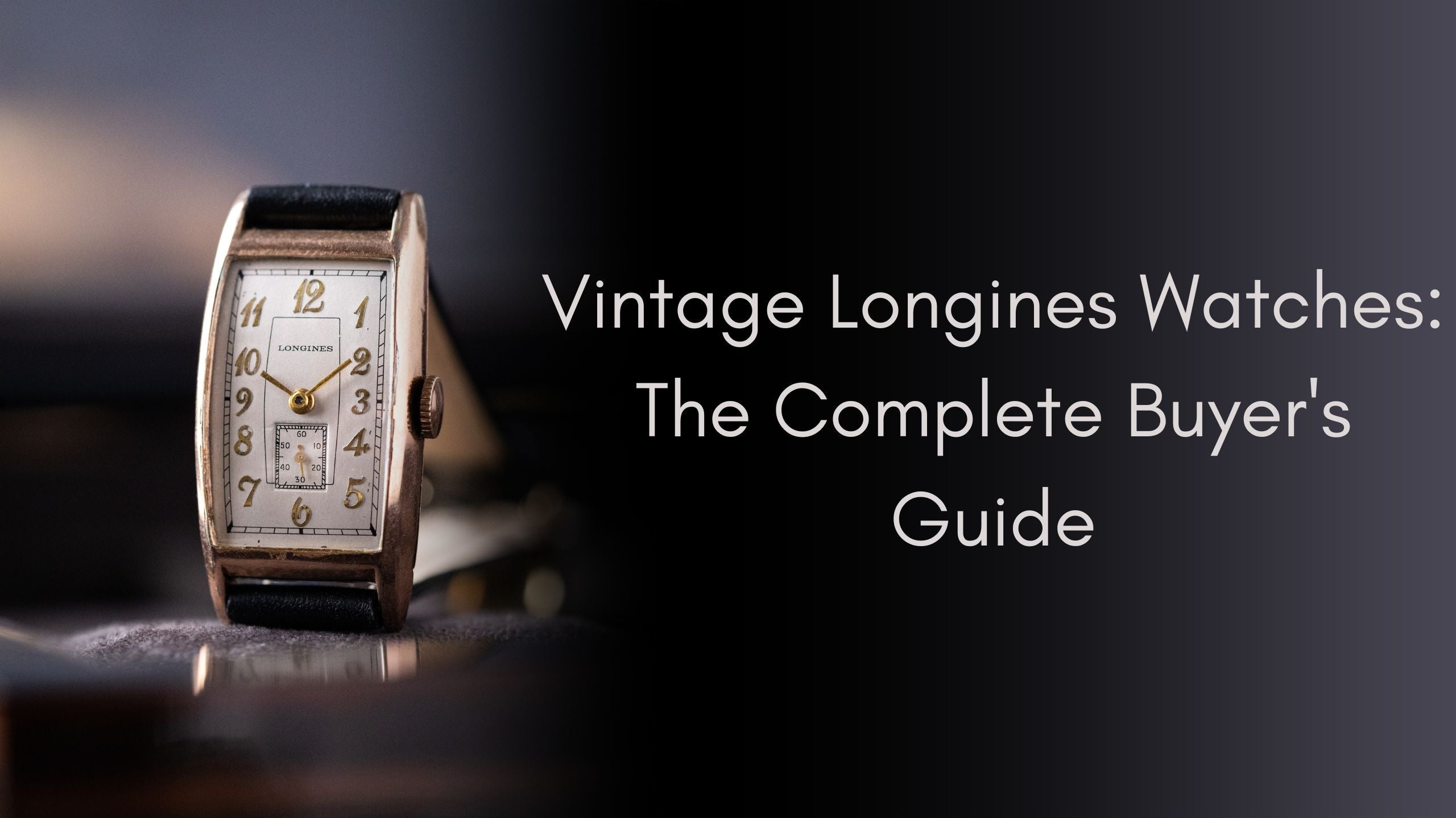

Few watch brands have given serious collectors more to work with — and less recognition for it — than Longines. Founded in 1832 and operating from the same Swiss village ever since, the brand produced some of the finest in-house movements of the 20th century. The secondary market is only now catching up. Browse the current Longines collection at DuMarko — or read on for the full guide to buying right.
This guide covers the key models and movements that define vintage Longines collecting: what makes each one significant, what to verify before buying, and how the market is currently priced. Whether you're starting out or filling a gap in an established collection, the information here will help you buy with confidence.
At a Glance: Key Models Compared
Vintage Longines spans a wide range — from tool watches built for military use to dress pieces that competed directly with the Swiss industry's best. Here's how the key models stack up before diving into the detail.
The finest chronograph movement Longines ever produced. Column-wheel construction, flyback function, extraordinary hand finishing. The grail reference — prices reflect it.
The 13ZN's more accessible successor. Flyback-capable, column-wheel equipped, and easier to service today. The better choice for collectors who intend to wear their watch regularly.
Longines' first named line — sporty, chronometer-certified, and wearing at 35mm on the wrist. The clearest gateway into vintage Longines at an accessible price.
36,000 vph high-beat movement in a 37mm tool-watch case. Near-chronometer accuracy, bold legible dial, and a market that still hasn't caught up to its engineering.
| Model / Reference | Typical Price Range | Movement Type | Investment Outlook | Best For |
|---|---|---|---|---|
| 13ZN Chronograph (steel) | $3,000 – $12,000+ | Manual, flyback | ★★★★★ | Serious collectors |
| 30CH Chronograph (steel) | $1,500 – $5,000 | Manual, flyback | ★★★★☆ | Daily wearers |
| Dirty Dozen WWW | $1,500 – $4,500 | Manual wind | ★★★★☆ | Military collectors |
| Conquest (1st gen, steel) | $400 – $1,200 | Automatic | ★★★★☆ | First-time buyers |
| Flagship (steel/gold-filled) | $200 – $800 | Automatic | ★★★☆☆ | Dress watch wearers |
| Ultra-Chron (steel) | $400 – $1,000 | Automatic HF | ★★★★☆ | Movement enthusiasts |
A Brief History: Why Longines Matters
Longines was founded in 1832 in Saint-Imier, a village in the Bernese Jura of Switzerland — and it has operated under the same name from the same location ever since. That continuity is not incidental. It underpins the brand's remarkable archival record, its institutional relationships with sporting bodies and aviation authorities, and a culture of technical consistency that shaped every movement the company produced.
The decisive moment came in 1867, when Ernest Francillon opened a centralised factory on a plot of land known locally as "Les Longines" — the long meadows — and gave the company its name. Francillon's shift to in-house factory production was radical in a Swiss industry still dominated by distributed cottage-workshop assembly. It gave Longines a quality-control advantage that fed directly into its movement precision. He trademarked the Longines name in 1880 and registered the winged hourglass logo in 1889 — the oldest watch trademark still in continuous use.
Through the late 19th and mid-20th centuries, Longines built its reputation on two pillars: sports timing and aviation instruments. The brand served as official timekeeper for the Fédération Aéronautique Internationale and at the first modern Olympic Games. Its collaboration with Charles Lindbergh — following his 1927 solo transatlantic crossing — produced what many consider the most significant pilot watch ever made. These institutional roles enforced a precision culture that distinguished Longines movements from the broader Swiss mid-market.
The 1970s quartz crisis interrupted that trajectory, as it did for virtually every Swiss mechanical manufacturer. In 1983, Longines joined the Swatch Group, where it remains — positioned below Omega in the group hierarchy. For the vintage collector, the most significant production era runs from the 1930s through the late 1960s: the period when Longines' wholly in-house movements were at their most technically ambitious, and the brand's design language was at its most coherent.
The Movements: What Actually Matters
Longines' collecting appeal rests primarily on the quality of its movements. The brand made fully in-house calibers across both time-only and chronograph categories, and the distinction between movement generations correlates directly with collector desirability and market value. Understanding the key calibers is not optional for serious buyers — it is the foundation of intelligent purchasing.
Key Time-Only Calibers at a Glance
| Caliber | Period | Type | Notes |
|---|---|---|---|
| 23Z | 1948–1960s | Manual, 17j | Reliable workhorse; widely found in dress and sport models |
| 30L / 30LS | 1955–1967 | Manual, 17j | Collector favourite; smooth action; 30LS has central seconds |
| 19AS | Late 1940s+ | Automatic, bumper | One of Longines' first automatics; found in early Conquests |
| 340 / 341 | 1957+ | Automatic | Flagship-era caliber; dependable and easily serviced |
| 431 series | 1960s | Automatic | Conquest and Admiral era; date complications |
| 6942 / HF variants | Late 1960s–70s | Automatic, 36,000 vph | Ultra-Chron and Admiral HF; near-chronometer accuracy |
One detail worth knowing for US-market pieces: movements imported for the American market from this era often carry the code "LXW" on the balance bridge — a customs requirement of the period. This does not indicate a different movement grade or reduced quality.
13ZN Chronograph: The Collector's Grail
The 13ZN is the movement that most collectors mean when they describe a vintage Longines chronograph as a grail. Introduced in 1936, it measured 29.80mm in diameter, ran at 18,000 vibrations per hour with a Breguet balance spring, and incorporated both a flyback function and a column-wheel chronograph mechanism — the combination widely regarded as the gold standard for precision and tactile feel. It also required extraordinary levels of hand finishing: each component of the chronograph mechanism demanded individual attention, and the result was effectively unique to each watchmaker who assembled it.
That craftsmanship is precisely why the movement commands such premiums today — and also why it became economically unsustainable. Parts were not interchangeable between movements assembled by different watchmakers, making field service genuinely difficult. Production ended in 1951 when the more standardised 30CH made continued 13ZN output impractical.
Cases ranged from 34mm to 38mm in steel and gold; dials came in extraordinary variety — silver, black, two-tone, tachymètre — which drives much of the reference's obsessive following. No two 13ZN watches look quite the same. Steel examples with original dials now trade between $3,000 and $12,000 depending on case, dial, and condition. Gold examples with exceptional provenance exceed $25,000.
Research has established that the 13.33Z — produced from 1912 to 1934 — was actually the first wristwatch chronograph movement to incorporate a flyback function and the first to feature two pushers. It predates the 13ZN as a technical milestone. Surviving examples in wearable condition are rare, and the 13.33Z operates at a specialist tier beyond the 13ZN in both rarity and price. For entry-level chronograph collecting, the 30CH is the correct starting point; the 13ZN and 13.33Z are for the dedicated specialist.
30CH Chronograph: The Wearable Masterpiece
The 30CH was introduced in 1947 as the fourth Longines wristwatch chronograph caliber and remained in production into the early 1970s. It incorporated a semi-instantaneous 30-minute counter and could indicate 1/5th of a second. Like the 13ZN, the 30CH could be equipped with flyback functionality — though most examples were produced without it, a consequence of the increased standardisation that made the caliber economically viable where its predecessor was not.
That standardisation is not a mark against the 30CH — it is the feature that makes it the better choice for collectors who intend to wear their watch. Components can be exchanged between movements assembled by different watchmakers, competent watchmakers with parts access are easier to find, and ongoing ownership is proportionally less anxious. Many serious collectors regard the 30CH as the best balance of movement quality and practical wearability in the entire vintage Swiss chronograph category.
The most desirable 30CH examples — 18ct gold with original silver or black dials — now sell for significant sums. Steel versions with later dial configurations offer accessible entry points. The Nonius 8225, a specialist variant featuring a 1/10-second timing function, occupies a particularly desirable niche within the caliber.
Lindbergh Hour Angle Watch: The Historical Piece
The Lindbergh Hour Angle Watch is among the most historically significant pilot watches ever produced, and one of the few watch references with a genuine story behind it. Following Charles Lindbergh's 1927 solo transatlantic crossing, Longines collaborated with Lindbergh and navigation innovator Philip Van Horn Weems to develop a proper aerial navigation instrument capable of calculating longitude by determining the Greenwich Hour Angle of celestial bodies. The result — first produced in 1931 — was a 47.5mm timepiece with a calibrated rotating bezel and inner rotating dial that, used alongside a sextant and Greenwich Mean Time, allowed pilots to calculate their longitude without the complex arithmetic that had previously made celestial navigation a specialist skill.
Original first-generation examples from 1931 are genuinely rare. The Smithsonian Institution holds the original Weems Aerochronometer that preceded it. Longines archives indicate production gaps of sometimes four years between manufacture and delivery, and the watch debuted during the Great Depression — ensuring small production numbers and very few survivors in authentic, unrestored condition. These are museum-grade pieces when found. They do not belong in a discussion of accessible collecting; they belong at specialist auction.
Commemorative reissues began in 1987 for the 60th anniversary of Lindbergh's flight; these carry reference 989.5215 and are entirely different propositions for the collector. Know which you're looking at before any conversation about price.
Dirty Dozen WWW: The Military Reference
Toward the end of the Second World War, the British Ministry of Defence commissioned twelve Swiss watch manufacturers to produce a standardised field watch to the W.W.W. specification — Watch, Wristlet, Waterproof. The twelve manufacturers that supplied them — Omega, IWC, Jaeger-LeCoultre, Longines, Lemania, Cyma, Buren, Eterna, Record, Timor, Vertex, and Grana — became known to collectors as the Dirty Dozen.
The Longines WWW, nicknamed the "Greenlander" for its distinctive stepped case, is among the most desirable variants within the group. Its caseback carries the W.W.W. designation followed by two serial numbers: one civilian (the movement serial from Longines) and one military, with a capital letter prefix. The manufacturer code for Longines is "F." Most examples feature bold Arabic numerals on a matte black dial with original luminous hour plots and cathedral hands.
Authenticity is the central challenge. As surplus stock was sold to multiple armies after the war — including Dutch K.N.I.L. and Indonesian A.D.R.I. forces — some watches carry three sets of serial engravings, which actually increases their historical interest. The real concern is dial and case matching: period fakes and assembled watches with mismatched components are common. Original unrestored dials, matching case and lug reference numbers, and correct military engravings are the markers of a genuine example. Prices for clean, authenticated pieces run from $1,500 to $4,500.
Post-war REME (Royal Electrical and Mechanical Engineers) servicing frequently stripped radium luminous compound from movements for safety reasons. Finding a Dirty Dozen WWW with intact original lume is increasingly rare and commands a premium. Bright white reluming is a clear sign of restoration — it is not original and reduces collectibility accordingly. Period-correct yellowed plots, even if worn, are preferable to pristine replacements.
Conquest: The Sporting Classic
Launched in 1954, the Conquest was Longines' first named watch line — a deliberate shift toward product-family marketing and a clear statement of the brand's sporting ambitions. It was a sporty-elegant proposition: a 35mm case with strong lugs, a clean dial with applied markers, and a movement frequently certified as a chronometer. First-generation examples (1954–1959) are the most collectible, wearing at 35.2mm by 42.6mm with 18mm lugs — proportions that translate well to modern wrists.
Many first-generation Conquests carried official chronometer certification, which adds to their appeal. The case backs on early examples carry the iconic enamel medallion, a detail that distinguishes genuine early stock from later production. Movement variants include the caliber 19AS automatic and related derivatives.
All-original Conquests in steel are relatively scarce in unrestored condition. Gold examples in excellent condition are more frequently encountered through established dealers. Pricing starts around $400–$500 for honest, well-worn steel examples and climbs to $1,200 or beyond for near-mint pieces with box and papers. It represents one of the best access points into vintage Longines collecting — historically significant, mechanically reliable, and still reasonably priced.
Flagship: The Dress Watch Entry Point
The Flagship was Longines' dress watch flagship — the name communicates the positioning directly. Introduced in 1957, it was the formally dressed counterpart to the Conquest's sporting sensibility. The caseback medallion shifted from the Conquest's star to a caravel ship — a detail instantly recognisable to collectors and a key authentication marker.
Most Flagships run the caliber 340 automatic, a reliable and well-regarded movement that continues to be serviced without difficulty today. Case sizes typically run 35–36mm in steel or gold-filled, with slim profiles suited to formal wear. The Flagship is an excellent entry point into vintage Longines collecting: widely available, reasonably priced, mechanically robust, and carrying genuine heritage. Gold-filled examples with original gilt dials in excellent condition represent some of the strongest value in the entire vintage Swiss market — often available for €300–€800.
One practical note: the modern Flagship Heritage reissue has reintroduced the caravel medallion caseback, which causes occasional confusion in the market. Movement serial number, dial typography, and case hallmarks will immediately distinguish a 1960s original from a contemporary production piece.
Ultra-Chron: The Undervalued Technical Watch
The Ultra-Chron is the watch the broader market has not yet caught up with. Released in 1968, it housed Longines' most technically ambitious automatic movement — a high-frequency caliber beating at 36,000 vibrations per hour in a 37mm stainless steel case. The movement was developed to compete directly with Zenith's El Primero and equivalent high-beat calibers emerging from other Swiss houses in the late 1960s, and it performed to near-chronometer standards without requiring COSC certification on every example.
The dial design is deliberately tool-like: large Arabic numerals, bold hands, strong legibility. The case wears larger than 37mm suggests due to its proportions and sits comfortably on a modern wrist. Ultra-Chrons in original condition with correct dials and running movements currently trade between $400 and $1,000 — a number that reflects persistent market undervaluation of high-beat movements from this era rather than any deficiency in the watch itself.
For collectors who prioritise movement engineering over brand hierarchy, the Ultra-Chron offers outstanding value. The Admiral HF models from the same period, housing related high-frequency calibers in larger 41mm cases, offer a similar proposition — often for even less.
Authentication & Serial Numbers
Longines has maintained production records of every watch serial number since 1867 — one of the most comprehensive archives in Swiss watchmaking. The serial number is stamped on the movement, not the caseback. To access it, the case must be opened. Cross-referencing this number against the production table below gives an approximate manufacture year, typically accurate to within six to twelve months.
More usefully, Longines offers an Extract from the Archives service that retrieves documented information about a specific watch: original dial configuration, movement caliber, case material, and market destination. This is available by email request and is free, though it does not constitute an authentication certificate for the watch itself — only for the movement. A watch with a correctly matched Extract is substantially more provenance-secure than one without. To date your movement quickly, use the free Longines serial number decoder at DuMarko.
| Serial Range | Approx. Year | Serial Range | Approx. Year |
|---|---|---|---|
| 1,000,000 | c. 1890 | 8,000,000 | c. 1940 |
| 2,000,000 | c. 1900 | 10,000,000 | c. 1950 |
| 3,500,000 | c. 1910 | 12,000,000 | c. 1960 |
| 5,000,000 | c. 1920 | 14,000,000 | c. 1968 |
| 6,500,000 | c. 1930 | — | Post-1969: contact Longines or specialist database |
The caliber number is separately stamped on the movement bridge alongside the serial number. Common stampings to recognise: 13ZN (wartime flyback chronograph, 1936–51), 30CH (post-war flyback chronograph, 1947 onward), 23Z (reliable 17-jewel manual, 1950s dress models), 30L/30LS (collector-favourite manual, 1955–67), 340/341 (Flagship-era automatic), and the high-frequency 6942 family used in the Ultra-Chron and Admiral HF.
What to Check Before Buying
Originality is the single most important factor in vintage Longines valuation. A lightly worn watch with original components is more valuable than a heavily restored example, even if the latter looks cleaner. Polished cases, replaced dials, and relumed hands are not improvements — they are permanent deductions from collectibility and resale value. Knowing what to look for makes the difference between a sound purchase and an expensive lesson.
Serial number: Insist on a case-back-open photograph showing the movement. Cross-reference the serial against the production date table above, and confirm the caliber stamp matches the stated movement type. A mismatch between case period and movement serial is a red flag for a marriage or replacement movement.
Dial originality: Look for consistent original printing, no hairline cracks at feet holes, correct font for the period, and undisturbed luminous compound. Yellowed radium or tritium plots are correct; bright white reluming indicates restoration and reduces value.
Case condition: Unpolished cases retain the original sharp lug geometry. A polished case loses definition and collector desirability permanently. Gold-filled cases should be checked for wear-through at lug tips and caseback.
Hands: Factory-original hands carry period-correct proportions and lume compound matching the dial. Replacement hands — even correct-period ones from other references — are a deduction and should be noted.
Named model markers: Conquest and Flagship examples must carry the correct era caseback medallion intact and unrestored. Military (WWW) casebacks must carry full, correct engravings without obscuring or re-stamping.
Longines Extract from the Archives: Request this where the reference and price justify the effort. It provides documented confirmation of the movement's original specification and adds meaningful provenance assurance. Our guide to Swiss watch hallmarks covers the precious metal stamps to verify on the caseback alongside this.
For chronographs specifically: Test all functions — start, stop, reset, and flyback if claimed. A flyback that hesitates or misfires needs attention; budget for it or negotiate accordingly. For guidance on what a proper service involves, our vintage watch servicing guide covers the full process.
Market Values
Vintage Longines occupies a genuine sweet spot: historically significant, mechanically excellent, and substantially more affordable than comparable Swiss manufacture work from Vacheron Constantin or Patek Philippe. The brand's persistent undervaluation relative to vintage Omega — with which it is historically competitive on movement quality — remains a feature of the market and a real opportunity for the informed buyer.
| Model / Reference | Period | Condition | Approx. Market Range |
|---|---|---|---|
| 13ZN Chronograph (steel) | 1936–51 | Good original | $3,000 – $12,000+ |
| 13ZN Chronograph (gold) | 1936–51 | Good original | $8,000 – $25,000+ |
| 30CH Chronograph (steel) | 1947–70s | Good original | $1,500 – $5,000 |
| 30CH Chronograph (gold) | 1947–70s | Good original | $3,500 – $12,000 |
| Dirty Dozen WWW | c. 1945 | Original condition | $1,500 – $4,500 |
| Conquest (1st gen, steel) | 1954–59 | All-original | $400 – $1,200 |
| Flagship (steel, auto) | 1957–70s | All-original | $200 – $600 |
| Flagship (gold-filled) | 1957–70s | All-original | $300 – $800 |
| Admiral Day-Date | 1960s–70s | Honest condition | $150 – $400 |
| Ultra-Chron (steel) | 1968 | All-original | $400 – $1,000 |
| 30L dress watch (steel) | 1955–67 | All-original | $250 – $600 |
Exceptional provenance, complete sets (box and papers), and unrestored original condition push values beyond the upper ranges shown. Heavily polished or restored examples may sell below the lower ranges. Chronographs with flyback function command premiums within each range. The Lindbergh Hour Angle Watch (original 1931) is excluded from this table — it is a specialist auction piece, not a secondary market transaction.
Which Longines Is Right for You?
The answer depends on what you want the watch to do and what draws you to the brand in the first place. Here's how each tier maps to a different kind of collector:
The apex of the category. Best for collectors with deep knowledge of the market who are acquiring a benchmark piece. Requires careful authentication and a specialist watchmaker for service.
The better choice for collectors who intend to use their watch. Column-wheel mechanism, flyback capability, and serviceability that the 13ZN cannot match. Outstanding value at the steel price points.
The most accessible entry points into genuine vintage Longines. Both offer real horological substance — chronometer pedigree, in-house automatics — at prices that leave room for error and learning.
The case for buying the Ultra-Chron is simple: near-chronometer accuracy, a high-beat in-house movement, bold wearable design, and a market that has not yet priced in its engineering. The window is open.
What makes vintage Longines different from many collecting categories is the depth of the archival record behind it. The Extract from the Archives service, the serial number documentation, and the caliber-stamped movements mean that provenance is verifiable in a way it simply isn't for many comparable Swiss watches. That transparency rewards buyers who do their homework — and it is one more reason the brand's current undervaluation relative to Omega is unlikely to persist indefinitely.
Browse the current Longines collection at DuMarko — or explore the wider Swiss watch collection if you're building across brands.
Your Questions Answered
Frequently Asked Questions