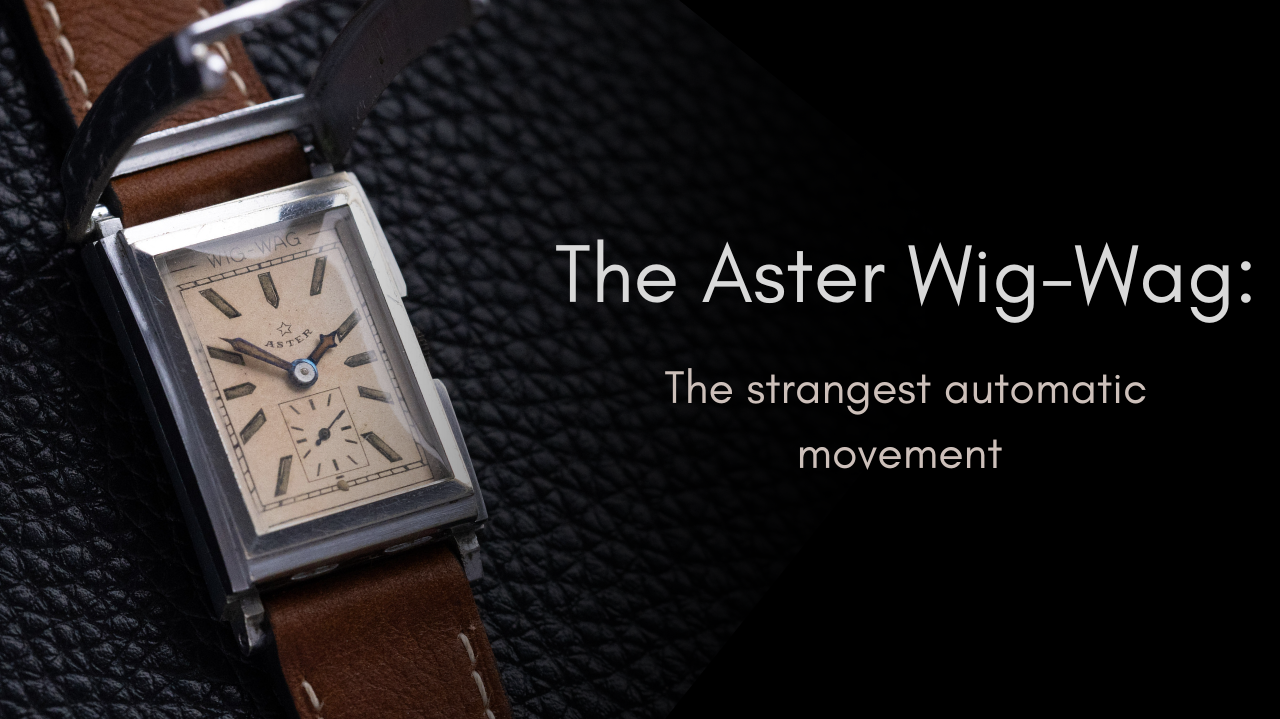

For a few inventive years around 1930, the Swiss industry had not yet decided how a watch should wind itself — and into that uncertainty stepped one of the strangest answers ever patented. The Aster Wig-Wag did not use a rotor or a hammer. Its entire movement slid back and forth inside the case, and that motion alone wound the mainspring.
It is a true self-winding wristwatch from the very first generation of the complication, and a genuine technological dead end — which is exactly what makes it interesting now. This guide covers why it exists, how it works, who made it, and what a collector should know before buying one of the few that survive.

At a Glance: The Wig-Wag in Brief
Before the detail, here are the four facts that define this watch — and explain why it occupies such a specific niche in the history of automatic winding.
Registered by Louis Müller & Cie of Bienne — the same year Rolex unveiled the perpetual rotor that would eventually render every rival approach obsolete.
No rotor, no bumper hammer. The entire caliber slides back and forth on side levers inside the case, winding the mainspring as it travels.
A 15-jewel, lever-escapement movement beating at 18,000 vph, built around an 8.75-ligne base and wound directly at the ratchet wheel.
Never licensed out, never mass-produced, and superseded within a decade — leaving a small surviving population with no later successors.
Why Anyone Wanted a Self-Winding Watch
The self-winding principle is older than the wristwatch itself. A self-winding pocket watch is generally credited to Abraham-Louis Perrelet around 1777 — a weighted oscillating mass set in motion by the wearer — though, like many horological firsts of that era, the precise attribution is open to debate. Either way, the idea then stayed largely dormant for nearly 150 years. A pocket watch sat upright and still in a waistcoat; there simply wasn't enough motion to make automatic winding worthwhile, and the hand-wound crown worked perfectly well.
The First World War changed everything. Soldiers found pocket watches impractical in the trenches and migrated to wrist-worn timepieces, and after the war the wristwatch became a permanent civilian fixture. Worn on a constantly moving wrist, a watch finally had a reliable source of motion to harness.
There was a second, subtler motivation: sealing. The most vulnerable point on any watch is the hole through which the winding stem passes — the entry point for dust, moisture and dirt. Eliminate the need to wind by hand, and you could eliminate the crown and its hole entirely, dramatically improving resistance to the elements. That single insight drove the first commercially successful automatics and shaped the whole experimental era that followed.
The Experimental Decade: 1922–1931
The roughly ten years bracketing 1930 were the wild frontier of the automatic watch. No standard existed yet, and watchmakers attacked the problem from radically different directions. Placing the Wig-Wag among its rivals is the fastest way to understand both what it was and why it lost.
| System / Maker | Year | How It Wound | Why It Mattered |
|---|---|---|---|
| Léon Leroy | 1922 (claimed) | Side-weight oscillator | An early — and debated — side-weight wristwatch, reportedly in tiny numbers |
| John Harwood | 1923–24 | Pivoting "bumper" hammer | First automatic wristwatch in real production; no crown at all |
| Léon Hatot "Rolls" | 1930 | Whole movement slides on bearings | The Wig-Wag's closest cousin in concept |
| Glycine (Meylan) | 1930 | Modular oscillating-weight unit | Among the first widely produced automatics |
| Bulova | early 1930s | Sliding case / side bumper | A separate sliding experiment — often confused with the Wig-Wag |
| Louis Müller "Wig-Wag" | 1931 | Whole movement slides in a carriage | The subject of this guide |
| Rolex (Aegler / Borer) | 1931 | Full 360° perpetual rotor | The design that made all the others obsolete |
Harwood is the one to understand first. His "bumper" system used a centrally pivoted weight that swung through an arc and struck buffer springs at each end — and crucially, his watches had no crown at all, the hands set by rotating the bezel. Built with A. Schild movements and Fortis cases, presented at Basel in 1926 and sold from 1928, around 30,000 were made before the company collapsed in the Depression in 1931. Léon Hatot's "Rolls," branded variously as Blancpain or "ATO," is the Wig-Wag's spiritual sibling: there too, the whole movement served as the oscillating weight, sliding sideways on ball-bearing runners. Into this crowded moment stepped Louis Müller & Cie.
The Maker: Louis Müller & La Champagne
The Wig-Wag was not the work of an obscure backstreet workshop. It came from one of Bienne's established houses, the Fabrique d'Horlogerie La Champagne, run by Louis Müller & Cie — later Louis Müller SA.
Louis Müller (1864–1943) was a substantial figure in the Swiss industry. He led the La Champagne factory in Bienne, served for three decades — from 1894 to 1924 — as president of the Society of Watch Manufacturers of Bienne, and was a longtime advocate for consolidation in an industry threatened by fragmentation and crisis. In 1931, the very year the Wig-Wag was patented, Müller sat as a founding board member of ASUAG, the giant holding company created to rationalise Swiss movement and component production. ASUAG would, decades later, become a core ancestor of today's Swatch Group.
Sources differ on the factory's exact origins. Some date La Champagne to 1854 and credit Müller with taking it over around 1890; others name him as its founder outright. What is not in dispute is that by the 1930s it was a well-regarded Bienne manufacturer operating under his name — and that it marketed watches under a family of in-house brands, several of which carried the Wig-Wag.
How the Wig-Wag Actually Works
The Wig-Wag belongs to the same conceptual family as Hatot's Rolls: the whole movement is the oscillating mass. A complete, conventional round hand-wound caliber is installed from the front into a carriage — a "rolling weight mass" — that also carries the automatic drive. This carriage is mounted on side levers within a rectangular case frame. As the wearer moves, the entire assembly slides back and forth, the playful repetitive motion that gives the watch its name. That sliding is transmitted directly to the movement's ratchet wheel, winding the mainspring. Like several automatics of the period, it wound in one swing direction only.

A characteristic detail follows from this architecture. Because the movement itself moves, the winding and setting crown is concealed beneath a hinged bezel. Lift or swing the case open and the crown is revealed — an unmistakable Wig-Wag signature, and one of the first things a knowledgeable collector looks for. It was a clever solution, and a charming one to handle. It was also, by the standards that would soon prevail, inefficient: the sliding mass had a limited range of travel and wound in only one direction, delivering far less to the mainspring than a freely rotating rotor.

The Caliber: Aster 19-4
The automatic itself is documented as the Aster caliber 19-4, introduced in 1931. It is a self-winding, movement-as-oscillating-mass design built on an 8.75-ligne (≈19.4 mm) conventional base, wound directly at the ratchet wheel by the automatic carriage. Specifications run to 15 jewels, a lever escapement, and a frequency of 18,000 vibrations per hour. The automatic device measures roughly 21.7 × 30.0 mm, with an overall height of approximately 4.10 mm including that device. The protecting patent is German D.R.P. 529785, registered in 1931.

Louis Müller & Cie also produced a manual-wind caliber numbered 28-20 — the "Champagne" caliber — which served as the basis for the Bulova 13AP used briefly in Bulova's "Champ" model around 1936.
The 28-20 is a different, hand-wound movement and should not be confused with the self-winding Wig-Wag 19-4. The two are sometimes conflated online; they are not the same thing. If a listing cites the 28-20, it is not describing the automatic Wig-Wag.
Which Brands Used the Wig-Wag?
This is where the Wig-Wag differs sharply from its better-known rivals — and the answer tells you something about how it was made and sold. The Wig-Wag stayed in-house. Unlike Harwood's system, which was licensed out and built by Fortis, or Hatot's Rolls, which appeared under Blancpain and "ATO," the Wig-Wag was never licensed to independent third-party makers. It remained proprietary to Louis Müller & Cie and appeared only under that firm's own stable of house brands. "Wig-Wag" itself was registered as a Müller trademark in 1931, alongside the company's other marks.

The names you'll actually see
By far the most commonly seen name on a surviving Wig-Wag dial is Aster — the firm's star trademark, in use from around 1902. Mars was the second name under which the automatic was launched. The company's other house marks — Champ (1921), Dido, and Champagne / La Champagne (1906) — round out the family, but in practice "which brands used it" really means "which of Müller's own brands carried it," and the realistic answer is principally Aster and Mars. A genuine example will typically show one of those names, sometimes accompanied by the "Wig-Wag" designation itself.
The "Bulova Wig-Wag." An example occasionally circulates described this way, but the best-known case had a refinished dial bearing an incorrect name, and even the collectors discussing it doubted any Bulova marking was originally present. Bulova ran its own, separate sliding experiment — the upper case moving over a lower chassis — which is a different construction entirely. Bulova was a parallel experimenter of the era, not a Wig-Wag licensee.
The generic "wig-wag gear." You will find parts listed as a "wig-wag gear" for unrelated calibers — the Universal Genève 72 chronograph, for instance. Here "wig-wag" is simply a generic horological term for a reciprocating, back-and-forth winding pawl. It has nothing to do with the Aster Wig-Wag watch.
Why the Wig-Wag Disappeared
The Wig-Wag's fate was sealed not by any flaw in its making but by the arrival of a better idea. The Rolex-style perpetual rotor, sweeping a full circle and — in later refinements — winding in both directions, was simply more efficient at putting energy into the mainspring. Patent protection around the rotor also constrained how freely other makers could follow. Collectors building around that lineage will recognise the architecture from any modern automatic in the vintage Rolex world; it became the template the whole industry adopted.

The improvements came quickly. Felsa's Bidynator (1942) brought the first widely used bidirectional central rotor. Eterna's ball-bearing rotor mounting, introduced at the end of the 1940s, solved the durability problem of supporting a heavy rotor, and the rotor architecture became universal. The sliding-movement and bumper systems — the Wig-Wag, the Rolls, the early Bulova designs — were quietly abandoned.
That obsolescence is exactly what makes the Wig-Wag collectible today. It was never made in the volumes of the rotor automatics that replaced it, and as a technological dead end it had no successors. What survives is a small population of watches representing a genuine, dated chapter in the evolution of the self-winding wristwatch.
Collecting the Wig-Wag Today
For anyone considering one of these watches, the unusual architecture changes what matters at the point of purchase. The defining features are not cosmetic — they are the evidence that you are looking at a real roller-winding Wig-Wag rather than a conventional rectangular dress watch dressed up as one.
The hinged bezel and concealed crown: These are the defining features. They confirm the roller-winding architecture. If the crown sits in the usual place on the case band, it is not a Wig-Wag.
Dial name vs movement: Genuine examples carry Aster or Mars, sometimes with the "Wig-Wag" designation. Be wary of refinished dials bearing other names — misattributed Wig-Wags do circulate, and an incorrect refinished signature is a known pitfall.
Original dials over refinished: Dials are typically silvered and, after ninety-odd years, usually show honest age — light foxing, warm patina, softened printing. On pieces of this rarity, original untouched dials are generally preferred to refinished ones, even with imperfections.
Case material by hallmark: Cases are frequently rectangular and Art Deco in feel. Confirm the material by hallmark where possible rather than assuming it. Our guide to Swiss watch hallmarks explains how to read those marks.
Mechanical condition: Because the winding architecture is unusual and parts are not interchangeable with later standard calibers, servicing a Wig-Wag is specialist work. A piece confirmed running and recently serviced carries a meaningful premium over one of uncertain state — our vintage watch servicing guide sets out what a proper service involves.
Is It a Watch Worth Owning?
The Aster Wig-Wag is not a watch that announces itself. It is small, restrained, and on the wrist it looks like any number of period rectangular watches — until you discover the crown hidden beneath the bezel and feel the whole movement shift as you move. Whether that appeals depends entirely on what you want from a vintage piece. Here is how it maps to different kinds of buyer.
Anyone documenting the pre-rotor era needs a representative of the sliding-movement branch. The Wig-Wag is that branch, with a patent and a year attached.
Rectangular cases, silvered dials, and the geometric calm of early-1930s taste. It wears as a dress watch first and reveals its secret second.
Few watches do anything you can feel in the hand. The shifting movement and concealed crown are a real, physical novelty — not a marketing one.
Attention sits elsewhere for now. For a buyer willing to accept specialist servicing, the supply is small and the story is unusually complete.
History chose the rotor. But the Wig-Wag remains one of the most characterful answers to a question that, for a few years around 1930, genuinely had no settled answer — a serious manufacturer staking a patent on the idea that a movement might simply rock itself awake. As with any watch of this age and rarity, individual examples should be authenticated and assessed on their own merits before purchase.
The pre-rotor era produced some of the most inventive watchmaking ever attempted. Browse our curated selection of vintage Swiss pieces — from established names to genuine horological oddities.
View Swiss Watches →Your Questions Answered
Frequently Asked Questions