
There is a phrase that follows Jaeger-LeCoultre everywhere in collecting circles: the watchmaker's watchmaker. It is often repeated and rarely examined. What it means, in practice, is that JLC occupied a position in the Swiss watch industry that no other manufacture has ever quite matched — simultaneously designing and building some of the most technically ambitious watches ever made, while quietly supplying the movements that made the most celebrated timepieces of other brands possible.
This guide covers everything a collector needs: the key models and what distinguishes the most desirable references, the movements to look for, how to navigate the "Jaeger-LeCoultre" versus "LeCoultre" dial signature question, authentication red flags specific to vintage JLC, servicing considerations, and the current market for each model family.
A Brief History of the Manufacture
1833–1937: LeCoultre & Cie
The story begins in 1833 when Antoine LeCoultre established a small workshop in Le Sentier, a remote village deep in the Vallée de Joux in the Swiss Jura mountains. From the start, LeCoultre's ambition distinguished his operation from the hundreds of small ateliers scattered across the valley — he wanted to produce complete movements, and he wanted to do so with a precision that surpassed anything then possible by hand.
By 1844 Antoine had invented the Millionomètre, the first instrument in history capable of measuring the micron — a development that transformed the precision of watch part manufacture and was used as a closely guarded trade secret for over 50 years. By 1866, he and his son Elie had established the Vallée de Joux's first full-fledged manufacture, pooling workshops under one roof and employing 500 people. By the turn of the 20th century, the catalogue had grown to over 350 distinct calibres — 128 chronographs, 99 minute repeaters — and the firm was supplying nearly all of Patek Philippe's movement blanks.
In 1903, Paris-based watchmaker Edmond Jaeger entered the picture. A specialist in ultra-thin movements who supplied the French Navy, Jaeger challenged Swiss manufacturers to produce the extremely thin calibres he had developed. Jacques-David LeCoultre accepted, and the two firms began a collaboration that would produce, among other things, the world's thinnest pocket watch in 1907. The formal merger arrived in 1937, when the house officially became Jaeger-LeCoultre.
1931–1970: The Golden Era
The golden age of JLC watchmaking spans roughly four decades, from the launch of the Reverso in 1931 through the late 1960s. Each decade brought at least one landmark innovation. The 1930s gave the world the Reverso. The 1940s saw rugged tool-watch calibres developed for wartime and post-war professional use. The 1950s brought the Futurematic, the Memovox, and the Calibre 101 — still the world's smallest mechanical movement. The Geophysic arrived in 1958; the Polaris in 1968. It is from this period that virtually all of the most sought-after vintage JLC pieces come.
The LeCoultre vs. Jaeger-LeCoultre Dial Question
One of the most common sources of confusion for new vintage JLC collectors is the appearance of the name "LeCoultre" — without the Jaeger prefix — on dial signatures. This is neither a red flag nor an indicator of a lesser watch. It is a product of US import regulations.
Between roughly the 1930s and the mid-1970s, US customs duties on fully assembled Swiss watches were significantly higher than duties on components. To keep their watches competitively priced in the American market, JLC exported movements, dials (signed "LeCoultre"), and hands to the US, where local distributors — primarily through a relationship with Longines-Wittnauer — assembled the watches into US-made cases.
A LeCoultre-signed vintage watch uses the same JLC calibres, the same quality standards, and the same dial printing conventions as its European-market counterpart. The movement inside will typically be signed "LeCoultre & Co." or bear the JL rotor engraving. The one meaningful difference is the case: US-market cases were often made by Star Watch Case Company and may not carry Swiss hallmarks. A LeCoultre-signed dial is not a fake — it is the American edition of the same watch.
A related variant is the "Jaeger" signature found on certain chronograph models sold in France. These were marketed under the Jaeger name alone for the French domestic market and use Universal Genève-based chronograph movements rather than JLC calibres. They are fascinating pieces, but technically a different product category from what most collectors consider vintage JLC.
The Reverso (1931–present)
The Reverso is the most famous watch Jaeger-LeCoultre ever made, and among vintage collectors, the most complex to navigate. The model's near-century of continuous production, its enormous variety of references, case materials, and dial variations, and the existence of sophisticated fakes all combine to make it a fascinating but demanding category.
The first Reverso watches were designed in response to a request from British officers stationed in India who needed a watch that could survive polo. The ingenious swiveling case — which allowed the dial to be slid and rotated to expose a blank steel back for protection — was immediately recognised as a design triumph. Critically for collectors, the first-generation Reverso watches (1931–1935) were not powered by JLC movements — they used Tavannes calibres (Cal. 064/063 for men, Cal. 050/051 for ladies). JLC's own Calibre 410 arrived in 1936. A 1937 Reverso bearing the unified Jaeger-LeCoultre name and Calibre 413 marks the formal merger — an important historical document.
Production slowed dramatically during and after the Second World War and essentially ceased as a mainstream product for several decades before the model was revived in the 1980s. Mid-century Reverso pieces (1940s–1960s) are rare and command significant premiums when they surface in European collections.
What to Look For — Reverso Authentication
- The caseback of authentic pieces has a separate movement holder — never integrated into the case
- Case serial number and movement serial should not match — if they do, something is wrong
- A flat caseback on a men's vintage Reverso is an immediate red flag — originals have a slight curve
- The interior of the cradle (where the case swivels) should show perlage decoration on original examples — aftermarket cases skip this
- Request interior caseback photographs showing the cradle and movement holder as a separate piece
The Memovox (1950–present)
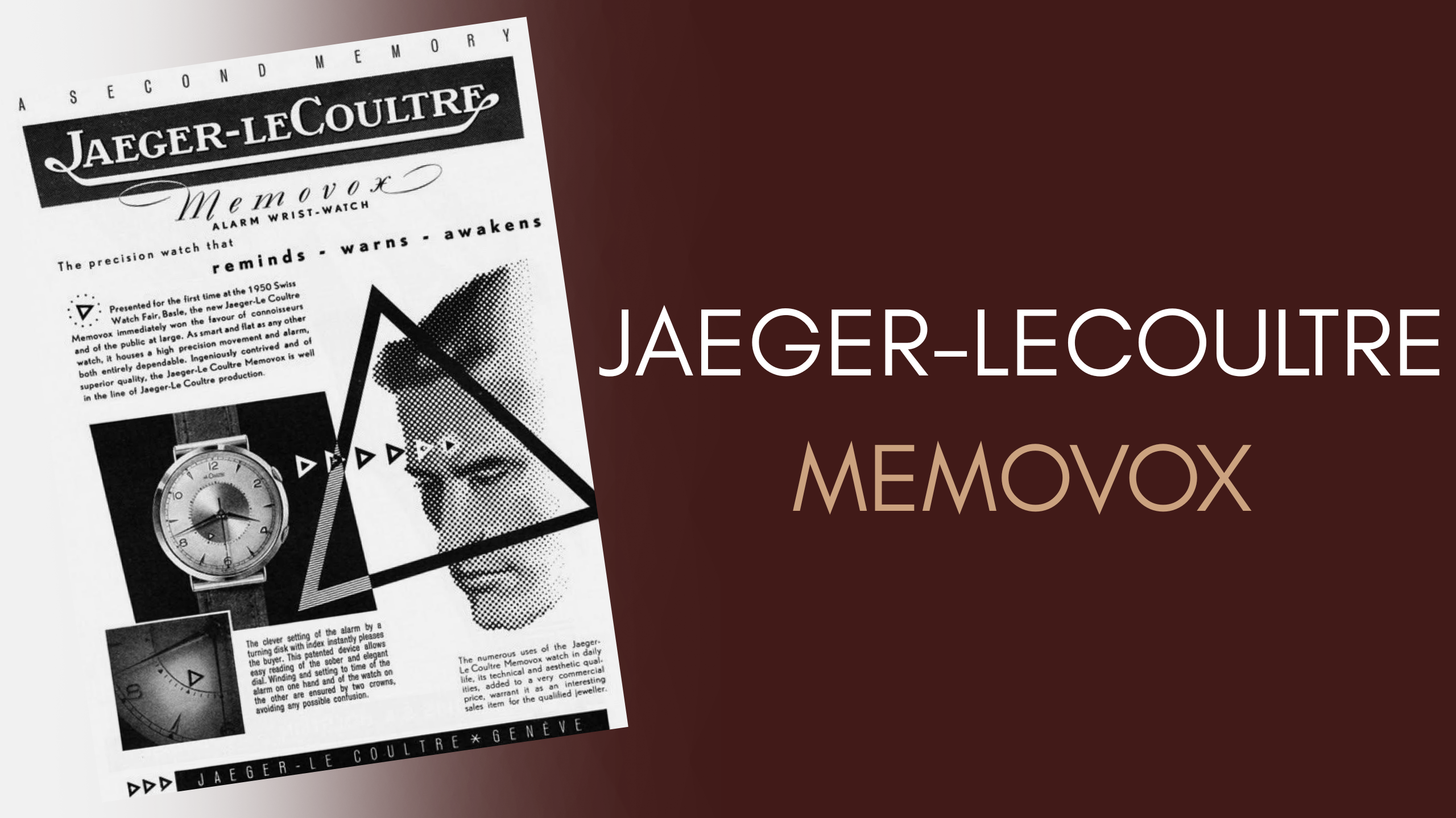
If the Reverso is JLC's most famous watch, the Memovox is its most beloved among hardcore collectors. Introduced at the Basel Watch Fair in 1950, the Memovox was the world's first mechanical alarm wristwatch, and it has been in continuous production in one form or another for over 75 years — the longest production run of any JLC model.
The Memovox uses a separately wound movement for the alarm function — a second mainspring dedicated purely to powering the alarm. Setting the alarm requires winding this secondary spring using the dedicated alarm crown. When the alarm disc (or hand, depending on the reference) reaches the set hour, a small hammer strikes a gong. The sound is louder when the watch rests on a surface — which amplifies vibration — and softer when worn on the wrist. This dual-spring architecture is one reason experienced collectors test vintage Memovox pieces carefully before purchase.
| Reference | Era | Movement | Notes |
|---|---|---|---|
| E 853 | 1950s | Cal. 489 | First-generation Memovox; manual wind, alarm only |
| E 855 | 1960–1974 | Cal. 815 | Most widely collected early Memovox; two crowns, round case. Lapis lazuli dial variant is among the most coveted in all of vintage JLC. |
| E 857 / 875 | 1970s | Cal. 916 | Transitional era; first with date; sold on strap with signed buckle |
| Deep Sea Alarm | 1959–1967 | Cal. 814/815 | Forerunner of the Polaris; first automatic diver's alarm |
| Memovox Parking | 1960s | Cal. 815 | Alarm used as parking meter timer; rare and charming |
| Memovox International | 1959 | Cal. 817 | World time alarm with UTC ring; exceptional rarity — $8,000–$15,000+ |
Finding a truly original, unpolished E 855 in honest condition is harder than it sounds. The model's accessibility has meant many examples have been poorly serviced, over-polished, or had hands and dials replaced. A well-preserved E 855 with original dial and unpolished case commands a meaningful premium over a technically functional but cosmetically tired example.
The Polaris (1968–1976, revived 2018)
Among all vintage JLC pieces, the Polaris occupies the most celebrated position. Launched in 1968 as the successor to the Deep Sea Alarm, the Polaris was an ambitious technical statement: a 42mm stainless steel sports watch with three crowns (one for time, one for alarm, one for an internally rotating timing bezel), a case engineered to amplify the alarm sound underwater, and water resistance far beyond typical dress-watch specifications.
The Polaris was designed around the premise that a diver needed to be warned to ascend. The alarm would be set before a dive and would ring when it was time to return to the surface. The two-piece case back created a resonating chamber that amplified the alarm when submerged. The internal rotating bezel — operated from the third crown, a rare feature for any era — allowed elapsed time tracking without relying on an external bezel.
The first-series Polaris (Ref. E 859) is among the most collectible vintage JLC pieces of any category. Complete sets — with the correct strap, buckle, and especially the additional bezels that early examples were sold with — are extraordinarily rare. Most examples that surface are watch-only, often on incorrect straps. JLC's own Collectibles programme valued a restored Polaris Memovox at €55,000.
The Futurematic (1951–1959)
The Futurematic is perhaps the most technically eccentric piece in the JLC vintage catalogue. Launched in 1951, it was marketed as the world's first automatic watch with no crown on the side of the case — because it had no side crown at all. The crown used to set the time was positioned on the rear of the case, requiring the watch to be removed from the wrist to make adjustments.
The movement, Cal. 497, was automatic but — unlike conventional automatics — could not be hand-wound at all. JLC solved the "first wear" problem by incorporating a six-hour power reserve that allowed the movement to start functioning immediately when put on. A power reserve indicator at the 9 o'clock position showed remaining reserve; small seconds appeared at the unusual position of 3 o'clock. The movement also featured a locking mechanism that held the rotor in place when the mainspring was fully wound.
The Futurematic is a technically demanding watch to service. Budget for a service when purchasing, and insist on evidence of recent servicing before buying at meaningful price points.
The Geophysic (1958–1962)
The Geophysic is one of the most historically significant watches JLC ever produced, and it remains underappreciated even among collectors who should know better. Created in 1958 to celebrate the International Geophysical Year — a global scientific collaboration involving 67 nations — the Geophysic was designed as a precision instrument capable of surviving the most hostile environments on Earth.
The Calibre 478BWS was engineered for three specific threats: magnetic fields (via antimagnetic shielding), water (sealed case), and shock (multiple systems). The movement featured a Breguet overcoil hairspring, a Glucydur balance wheel, and a regulating spring on the balance cock — specifications that would not look out of place on a modern observatory chronometer. In the year of its launch, JLC presented a Geophysic to William Anderson, commander of the USS Nautilus — the first nuclear submarine to travel from the Pacific to the Atlantic via the North Pole.
Military Watches and the P-Calibre Family
Jaeger-LeCoultre supplied watches to military contracts from the 1930s through the 1960s, primarily for UK, Australian, and US government clients. Genuine military-issued JLC pieces carry specific government markings: British pieces show a broad arrow mark and service designation; Australian pieces similar stamps; US-issued examples often carry contract numbers.
The term "military watch" is heavily over-used in the vintage market. A black-dialed JLC with Arabic numerals and radium lume from the 1940s may have a military character but is not a genuine military-issued piece unless it carries the relevant government stamps. Both are valid collecting categories — but they should be priced and described differently.
A significant category of JLC military-adjacent pieces were designed with military character: radium-dialed watches with black dials, Arabic numerals, and high legibility, powered by the P-prefix calibre family. The "P" designates Parachoc — JLC's proprietary shock protection system. The P469 family is the most frequently encountered: a robust, reliable manual-wind movement with excellent service longevity. These watches from the 1940s represent exceptional value, offering genuine JLC engineering in a tool-watch aesthetic at accessible price points. For more on how to read the hallmarks and case marks on these pieces, our Guide to Swiss Watch Hallmarks covers the essential stamps.
Dress Watches and the Calibre 800/900 Series
The vast majority of vintage JLC watches that come to market are elegant dress watches: round or rectangular cases in gold or steel, clean dials with applied indices or batons, and movements from the Calibre 800 and 900 series. These are the bread-and-butter of vintage JLC collecting — not the most dramatic pieces, but often the most beautifully made.
The Calibre 800 series covers bumper automatics from the late 1940s and early 1950s, where the rotor swings in arcs rather than rotating fully — producing a characteristic clicking sound when the wrist moves sharply, which many collectors find charming. The Calibre 900 series — including the widely used 880, 881, and 899 — represents the classic JLC automatic from the 1950s through the 1970s. Well-regulated examples of the 880 and 881 keep excellent time and are straightforward to service.
Triple-date calendar variants from this era — showing day, date, and month simultaneously — are particularly compelling: technically complex, visually rich, and available at prices far below equivalent complication pieces from Patek or Vacheron. Understanding case metals — whether gold-filled, gold-capped, or solid gold — is important for pricing; our guide on gold, gold-plated, and gold-filled watches explains the differences clearly.
Key Vintage Calibres at a Glance
JLC used a rough but consistent calibre numbering system: smaller calibres (lower numbers) generally correspond to smaller movements; higher numbers typically indicate more elaborate or recently designed movements. The prefix letter indicates shock protection: "P" for Parachoc, "K" for Kif, no prefix for earlier unprotected movements.
| Calibre | Type | Era | Found In | Collector Notes |
|---|---|---|---|---|
| Cal. 101 | Manual, micro | 1929+ | Ladies' dress, jewelry | World's smallest mechanical movement; worn by Queen Elizabeth II at her 1953 coronation |
| Cal. 410/413 | Manual | 1936–1940s | Reverso (1st JLC-made) | First in-house Reverso movement; Cal. 413 carries full JLC name post-merger |
| Cal. 476/481 | Bumper auto | Late 1940s | Round dress watches | Early bumper automatic; gentle clicking sound; reliable with correct service |
| Cal. 497 | Bumper auto + P/R | 1951–1959 | Futurematic | No hand-wind; rear crown; power reserve indicator; 6-hour reserve on first run |
| P469 / P469c | Manual | 1940s–1950s | Dress & tool watches | Parachoc shock protection; ultra-reliable; military associations; excellent value |
| Cal. 478/P478 | Manual, central seconds | 1940s | Military-style tool watches | Based on Cal. 449; sweep seconds; rugged; Geophysic-adjacent specification |
| Cal. 489 | Manual, alarm | 1950s | First Memovox (E 853) | Original alarm calibre; foundation of the entire Memovox line |
| Cal. 814/815 | Auto, alarm | 1950s–1960s | Memovox E 855, Deep Sea Alarm | Automatic alarm; signature JLC dual-spring architecture; must test alarm function before buying |
| Cal. 880/881 | Automatic | 1950s–1970s | Dress watches, Master Mariner | Workhorse calibre; excellent reliability; straightforward to service; best value entry point |
| Cal. 916 / 916SC | Auto, alarm | 1968–1970s | Polaris, later Memovox | Three-crown architecture; hacking seconds in SC version; underpins the Polaris identity |
| Cal. 920 | Ultra-thin auto | 1967+ | Sold to AP, Patek, Vacheron only | Never used in JLC's own watches; powers Royal Oak, Nautilus, Vacheron 222 |
| Cal. 889/889/2 | Thin automatic | 1984+ | Master Control, IWC, AP, Vacheron | Versatile workhorse; supplied to many brands; still in production as 889/2 |
Authentication — What to Check Before Buying
Vintage JLC authentication is less about spotting crude fakes and more about identifying genuine but problematic pieces: marriages (correct movement in wrong case), redials (original movement and case, refinished dial), and re-cased pieces. These issues affect value significantly, and some sellers — even in good faith — may not know what they have.
The Case
- Serial number relationship: Case and movement serial numbers should not match. If they do, something is wrong. The case carries its own number inside the caseback; the movement number is engraved on the movement itself.
- Swiss hallmarks: Swiss-cased JLC pieces should carry Swiss gold or silver hallmarks on the lugs and case. US-cased LeCoultre pieces will not — this is expected. A Swiss-market JLC presented without hallmarks warrants scrutiny.
- Reverso caseback: Vintage Reverso casebacks are not flat — they have a slight curve. A flat Reverso caseback is an immediate red flag.
- Reverso cradle interior: The interior channel should show perlage (circular brushing) decoration. Aftermarket cases skip this finishing.
The Dial
- Typography quality: Original JLC dials feature sharp, clean serif typography with consistent letter spacing. Reprinted examples show thicker letterforms or inconsistent colour.
- Minute track alignment: A common redial tell — the minute track falls unusually far inside the edge, or is slightly misaligned. On originals, it aligns precisely with the case edge through the crystal.
- Lume aging consistency: Original lume ages uniformly — all indices and hands show similar patina. If hands are bright white and dial lume is deep cream, at least one element has been replaced.
- Sunken subdials: Authentic JLC dials of the golden era typically feature slightly recessed subdials for small seconds. Flat subdials on a watch that should have sunken ones are worth investigating.
The Movement
- Movement signature: Genuine JLC movements will be signed "Jaeger-LeCoultre" or "LeCoultre & Co." on the top plate. The rotor carries the JL monogram.
- Calibre vs. case and dial: Cross-reference the calibre number against known pairings for the reference. A JLC movement may be genuine but swapped from another case — a marriage.
- Movement condition: Look for original screws (no screw-head damage), undamaged jewels, and consistent surface finishing. Signs of heavy amateur servicing are meaningful quality concerns.
The Alarm Function (Memovox / Polaris)
- Wind the alarm spring separately via the alarm crown and set it to trigger within minutes — the alarm must engage cleanly and produce a clear bell tone. A weak or non-firing alarm requires service.
- Count the crowns — Memovox models have two; Polaris models have three. A single-crown Memovox has likely had the alarm function removed or damaged.
JLC's Heritage Archive service can provide archive extracts for most vintage pieces, confirming production year, original configuration, and case/movement pairing. The service charges a fee but is worth the cost for significant purchases — it is essentially factory documentation and provides strong authentication support. Contact JLC directly or through an authorised service centre to request an extract.
What to Buy at Each Budget
Honest vintage JLC dress watches from the 1950s–1970s powered by the Cal. 880 or 881 — round, gold-filled or steel cases, clean dials, reliable automatics. LeCoultre-signed US-market pieces in 14k gold are frequently excellent value here. Do not expect pristine condition; budget for service.
Opens up the Memovox E 855, solid Futurematic examples, triple-date calendar dress watches, and military-adjacent 1940s pieces with original radium dials. Pieces at this level should be mechanically sound with original dials. Budget $300–$600 for service if not recently done.
Reaches the Geophysic, Deep Sea Alarm, early Memovox gold references, and beginning-quality Polaris examples. Also the lower end of genuinely original post-war Reverso pieces. At this level, condition begins to matter significantly for future value — a fine example at $5,000 is a better purchase than a tired one at $3,000.
Exceptional Polaris first-series pieces, early gold Reverso examples, Memovox International, and rarer complications from the 1950s–1960s. First-series Reverso (1931–1937) expects $25,000–$55,000+ at reputable dealers. Buy with documentation and provenance wherever possible.
Market Overview (2025–2026)
The following is a general guide to current pricing through specialist dealers. Auction prices may differ significantly based on condition, provenance, and market timing. All figures approximate.
| Model / Reference | Condition | Approx. Price Range | Key Value Drivers |
|---|---|---|---|
| Reverso (1931–1937, early) | Good–Excellent | $25,000–$55,000+ | Tavannes vs. JLC movement; gold vs. steel; dial colour |
| Reverso (1940s–1960s, mid-century) | Good | $8,000–$18,000 | Originality; rarity of this production period |
| Memovox E 855 (steel) | Good | $1,200–$2,500 | Dial condition; alarm function; case finish |
| Memovox E 855 (gold) | Good | $2,500–$5,000 | Karat, case condition, original dial |
| Memovox Deep Sea Alarm | Good | $3,000–$6,500 | Dial colour; case sharpness; alarm function |
| Memovox International | Good | $8,000–$15,000 | Rarity; working world-time function |
| Polaris E 859 (1st series) | Good–Very Good | $5,000–$12,000+ | Dial condition; additional bezels; completeness of set |
| Futurematic (steel) | Good | $1,500–$3,500 | Working rear crown; power reserve accuracy |
| Geophysic E 168 (steel) | Good | $2,500–$6,000 | Dial originality; historical documentation |
| Military-adjacent 1940s (P469) | Good | $1,000–$3,000 | Dial patina; radium lume; originality |
| Triple Date Dress Watch | Good | $2,000–$5,000 | Calendar function; dial condition |
| Dress watch, Cal. 880/881 (steel) | Good | $600–$1,800 | Case quality; dial printing; recent service |
| LeCoultre US-market (14k, dress) | Good | $800–$2,000 | Case metal; dial; movement condition |
Owning and Servicing Vintage JLC
A fully serviced vintage JLC mechanical watch should be serviced every 5–7 years under regular use. Watches that have sat unworn for extended periods often need immediate service before being wound and set, regardless of the last service date — lubricants dry and can damage movement surfaces if a watch is run after a long dormant period.
The Futurematic, the Memovox, and the Polaris all require a watchmaker specifically familiar with these movements. JLC's official service network can service vintage pieces, though wait times and costs are typically higher than independent specialists. For collecting-grade pieces — where maintaining original parts and finishes is paramount — an independent watchmaker with demonstrated JLC vintage experience is often preferable. Official servicing can involve case polishing and part replacement that reduces collector value.
- Alarm movements benefit from regular use — letting a Memovox sit inactive for long periods can cause alarm setting gears to seize
- Calendar mechanisms should be advanced correctly — never manually change the date between approximately 9pm and 2am, when the date change mechanism is engaged
- Bumper automatics should be gently jostled if sitting, to allow the bumper spring to fully engage before aggressive winding
- JLC's Heritage programme maintains blueprints and original tools for every piece ever made — allowing missing components to be recreated from scratch, though at significant cost
A Collector's Strategy
Start With One Category
The vintage JLC catalogue is enormous — over 1,300 calibres across nearly two centuries of production. Trying to collect broadly across all models produces a scattered, unfocused collection. The most experienced JLC collectors specialise: some collect only Memovox references; others focus exclusively on Geophysic and scientific-instrument pieces; others on the Reverso across its evolution. Starting with a specific category — even as broadly as "alarm watches" or "1950s JLC dress complications" — allows you to develop genuine expertise and understand value nuances that only emerge from direct experience with many examples.
Condition Above Everything
An unpolished case with crisp lug edges and original surface finishing is worth significantly more than the same reference buffed smooth. An original dial — even with honest patina, minor age spots, and worn lume — is vastly preferable to a clean but refinished one. Developing the eye for condition takes time. Handling examples in person at watch fairs and shows, building relationships with specialist dealers, and studying reference communities online are all worth the investment.
Where to Buy
For serious vintage JLC collecting, the most reliable sources are specialist vintage dealers with demonstrable JLC expertise, established auction houses with dedicated watch departments, and vetted private sales through watch forum communities such as WatchProSite and Hodinkee forums. eBay and generalist marketplaces present high risk at anything beyond entry-level prices — authentication requires hands-on expertise that listing photographs alone cannot provide.
JLC's own Collectibles programme offers factory-authenticated and restored vintage pieces with archive documentation — an excellent source for significant purchases, though prices reflect the full restoration and certification cost.
Jaeger-LeCoultre is like wearing a beautiful cashmere coat with no visible label. You feel confident wearing it without having to signal or wave around your status. — Hodinkee
There is a reason experienced collectors — people who have owned Patek Philippe, Vacheron, and Audemars Piguet — often arrive eventually at Jaeger-LeCoultre. The Reverso is an Art Deco masterpiece that has never been convincingly copied. The Memovox is the founding document of mechanical alarm watchmaking. The Futurematic solved problems no one else thought to solve in the way they were solved. The Geophysic went to the ends of the Earth. And behind all of these, quietly powering the Royal Oak and the Nautilus and the Vacheron 222, was the same manufacture in the same valley — producing movements good enough that the most prestigious names in Swiss watchmaking were happy to put their own names on them.
Collector's Questions
Frequently Asked Questions