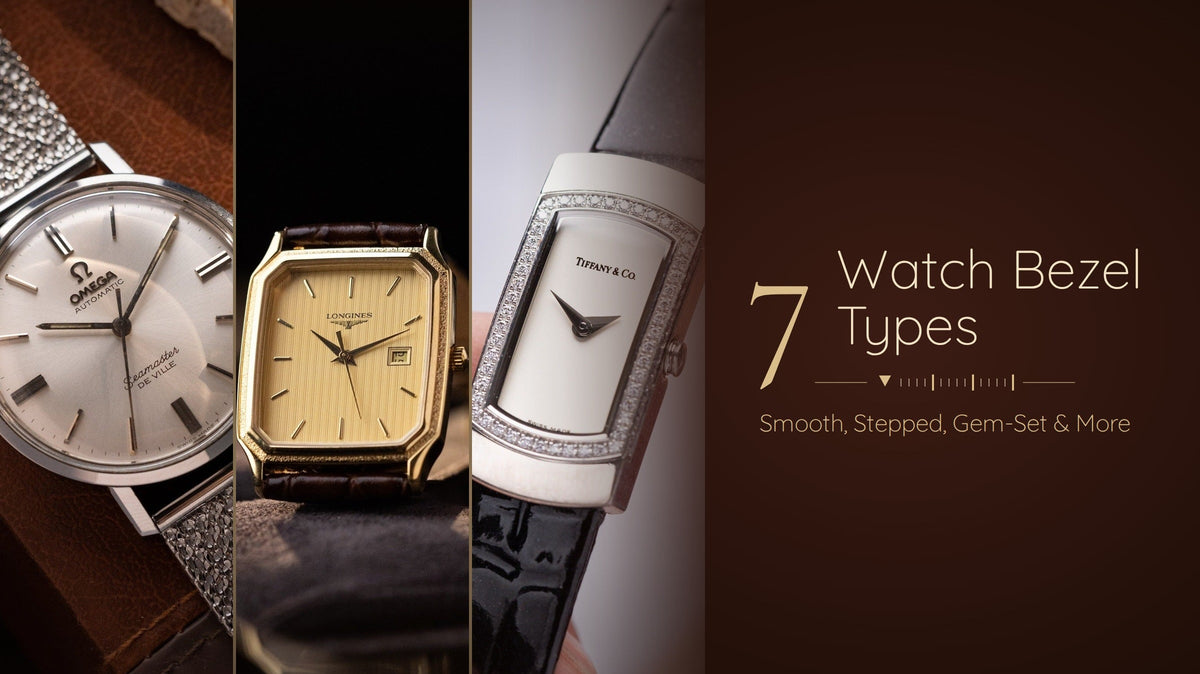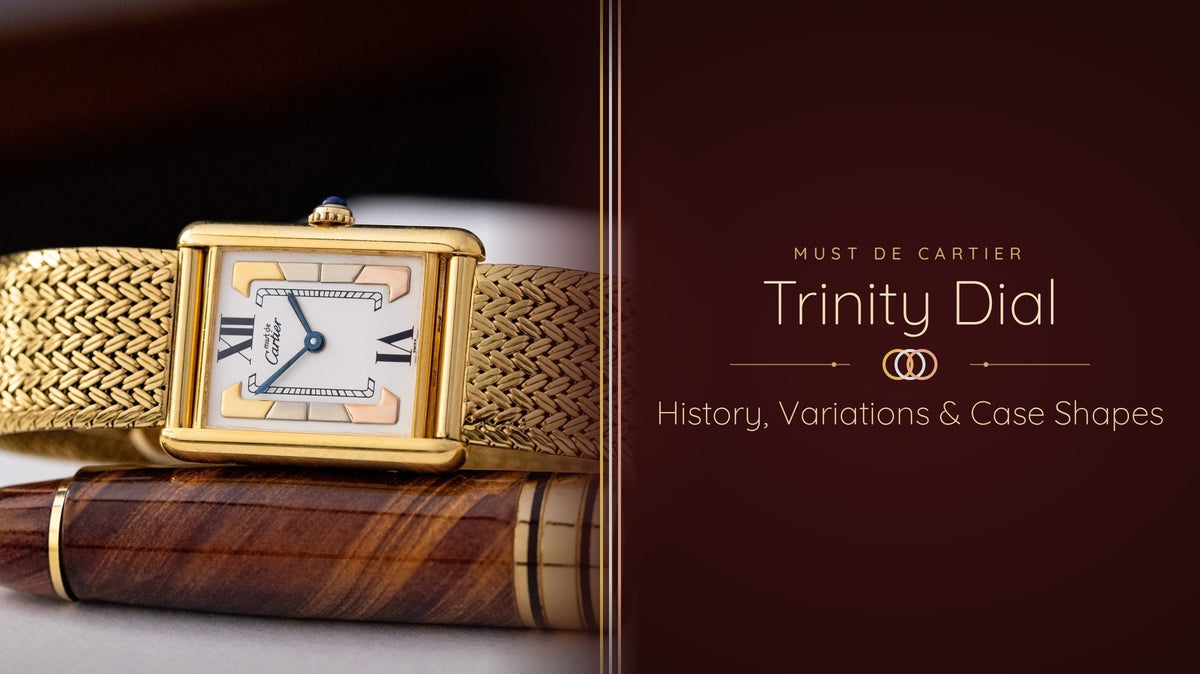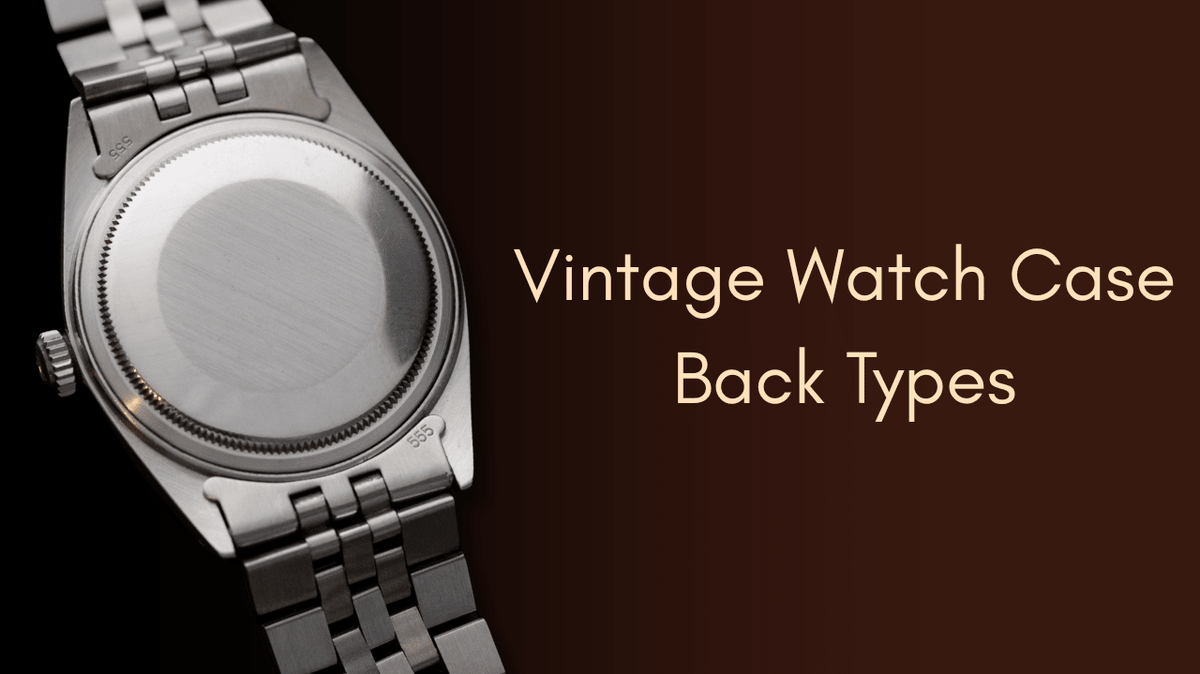

Watch dial markers are the shapes that show the hours on a watch face: numerals, batons, daggers, arrows, dots and more. Collectors also call them hour markers, indices or indexes. This guide names every type, shows them on real vintage dials and explains what they tell you about a watch's age.
Dial markers fall into two families. Numerals show the hour as a number, in Roman, Arabic or Breguet style. Indices replace the number with a shape, such as a baton, a dagger, an arrow, a lozenge, a square or a dot.
The baton is the most common index today. Daggers and arrows belong to the 1950s, and square markers point to the late Art Deco years around 1950.
When a watch comes to us, I look at the markers under a loupe before anything else. A missing foot, a trace of glue or a marker that sits a fraction off line tells me someone has had the dial out, and that changes how we describe the watch.


What Are Watch Dial Markers?
A dial marker sits at each hour position and tells you where the hands point. Watchmakers use several names for the same thing: hour markers, dial markers, indices and indexes all mean the markers around the dial. "Indices" and "indexes" are both correct plurals of index, and you'll see both in auction catalogs.
Markers do more than show the time. Their shape sets the character of the dial, from the formal look of Roman numerals to the bold, lume-filled batons of a tool watch. Our classification follows two catalogs of applied hour markers from the Swiss dial maker Stern Frères, published in the 1950s and around 1965.
Markers work together with the hands, and a watchmaker picks the two to match each other. Our guide to types of watch hands covers the other half of the dial.
Hour Markers at a Glance
The table lists every marker type in this guide, with the shape to look for and the era it belongs to.
| Marker | What it looks like | Peak era | Seen on |
|---|---|---|---|
| Roman numerals | I, II, III… in classical letters | All eras | Dress watches, Cartier Tank |
| Arabic numerals | 1, 2, 3… in plain figures | 1930s–1960s | Military, pilot and field watches |
| Breguet numerals | Curved Arabic figures with serifs | From the 1780s | High-end dress watches |
| Baton | Straight bar with blunt ends | 1950s–1970s | Dress, dive and racing watches |
| Dagger | Thin triangle pointing to the center | 1950s | Mid-century dress watches |
| Double-pointed | Long diamond, pointed at both ends | 1950s–1960s | Dress watches |
| Arrow | Wide triangle or arrowhead | 1950s | Omega Constellation "pie pan" |
| Lozenge | Wide diamond or rhombus | 1950s–1960s | Accents at 12, 3, 6 and 9 |
| Square | Small square, polished or lumed | Around 1950 | Late Art Deco and dive watches |
| Cabochon or dot | Round, domed or flat dot | 1950s onward | Cocktail and sports watches |
| None (blank) | No markers at all | 1970s–1980s | Must de Cartier, Omega De Ville |
Numeral Markers: Roman, Arabic and Breguet
Numeral markers show the hour as a figure. On better dials the numerals stand raised above the surface as applied pieces, and some dials add decorative symbols, such as zodiac signs, in place of numbers.

Roman Numerals
Roman numerals give a dial a classical, formal look borrowed from old clocks and pocket watches. The Cartier Tank made black Roman numerals on a white dial its signature, and Rolex fits gold Roman numerals to some Datejust models. You'll find them on dress watches far more than on tool watches.


Arabic Numerals
Arabic numerals put readability first, which is why military, pilot and field watches use them. Mid-century field watches carried a full set of twelve, and the Rolex Explorer uses only a bold 3, 6 and 9. A full Arabic dial reads as practical and honest.

Breguet Numerals
Breguet numerals are Arabic figures drawn with soft curves and fine serifs, close to handwriting. Abraham-Louis Breguet introduced them in the late 18th century. Breguet still uses them, and Patek Philippe has fitted them to some Calatrava dress watches, where they give a modern watch an early 19th-century look.

Index Markers: Baton, Dagger, Arrow and More
An index first meant a flat, stick-shaped marker fixed to the dial at each hour. Today the word covers almost any hour marker that isn't a number. These are the seven main types of watch indices:
- Baton: a straight bar with blunt ends.
- Dagger: a thin triangle with one point.
- Double-pointed: a long diamond with two points.
- Arrow: a wide triangle or arrowhead.
- Lozenge: a wide diamond or rhombus.
- Square: a small square, polished or lumed.
- Cabochon: a round dot or domed jewel.

Baton Markers
Baton indices are flat, rectangular bars with blunt ends and parallel sides. They range from thin sticks to wide blocks, and none of them tapers to a point. Collectors also call them baton indexes or stick markers.
Batons spread through the 1950s on dress watches, where thin sticks gave the clean "stick dial" look of the period. In the 1960s, wider batons filled with lume became standard on dive watches and racing chronographs. They're still the most common hour marker today, because they read well and suit any style.

Dagger Markers
A dagger marker is a slim triangle that narrows to a point facing the center of the dial. Watchmakers facet them so they catch the light as the wrist moves. They're a signature of 1950s design, when buyers wanted clean lines and a little sparkle.
Early Rolex Oyster Perpetuals and some vintage Omega Seamaster dress models wear dagger markers. Collectors pay more for daggers that keep their original facets intact.

Double-Pointed Markers
Double-pointed markers taper at both ends, which turns them into long, thin diamonds. Unlike a dagger, they're symmetrical, with a point toward the center and another toward the edge. On a dial they read as refined and decorative rather than sporty.

Arrow Markers
An arrow marker is a wide triangle or arrowhead that points to the center. The wide base and sharp tip make it stand out, so some watches use arrows only at 12, 3, 6 and 9. Watchmakers faceted them or filled them with lume.
The best-known example is the late-1950s Omega Constellation with a "pie pan" dial, where faceted arrowheads run all the way round. Vintage Longines dress watches used arrow markers in the same years.

Lozenge Markers
A lozenge marker is a wider diamond or rhombus with four sides of close to equal length. Seen from the front, it looks like a small four-pointed star. Watchmakers use lozenges at 12, 3, 6 and 9 to give those hours more weight, and a faceted lozenge catches the light like a cut stone.

Square Markers
Square markers do two jobs. Filled with lume, a small square gives a dive watch more glowing surface than a dot of the same width. Polished, a row of squares gives a dress watch a geometric, instrument-like face.
Square markers peaked around 1950, at the tail end of Art Deco. Dress watches of the late 1940s and early 1950s used them alone or alternated them with other shapes, like the Jaeger-LeCoultre tank below.

Cabochon and Dot Markers
A cabochon is a small, round, domed marker, the dot of the marker world. In jewelry, a cabochon is a polished stone with a smooth dome, and on a dial the word means a round, convex appliqué. Some are solid metal, some are real gemstones, and flat printed dots belong to the same family.
Collectors separate applied cabochons from painted dots. Tiny gold cabochons appear on 1950s Piaget and Jaeger-LeCoultre cocktail watches, and early Rolex Submariners carry applied dots whose lume has aged to a warm patina.

No Markers (Blank Dials)
Some dials have no markers at all. You lose a little legibility, and the dial gains a clean, uninterrupted surface. Designers took this route in the late 1970s and 1980s. Some Must de Cartier Tanks show only the hands and a small logo, and some Omega De Ville models of the period have completely blank dials.

Applied vs Printed Markers
Every marker on this page comes in one of two forms. An applied marker is a separate piece of metal with small feet that pass through holes in the dial. A printed marker is ink or lume laid directly on the dial surface.
Applied markers cost more to make and give the dial depth, so you'll see them on better watches. Printed markers keep the dial flat and thin, and they suit tool watches and slim dress pieces. Tilt the watch under a light: an applied marker throws a small shadow, and a printed one doesn't.
How Markers Help Date a Watch
Markers are one of the quickest ways to place a dial in its decade. Daggers and arrows point to the 1950s, wide lumed batons to the 1960s, and square markers to the years around 1950. A marker style that doesn't fit the movement's date is a reason to look closer.
Look at the condition as well as the shape. Applied markers should all sit level and line up with the minute track. Lume on the markers should age in step with the lume on the hands. Glue marks, a missing marker or bright new lume next to old hands point to a refinished dial. Markers are one of ten checks in our guide on how to identify a vintage watch.
The markers we see damaged most are the faceted daggers and arrows of the 1950s, because their thin points bend when a dial comes out during a careless service. We describe any bent or reset marker in the listing.
Buyers ask us about Roman numeral dials more than any other style, and Cartier Tanks and gilt-numeral Pobedas are the ones they ask about first.
Choosing a Watch by Its Markers
Pick the markers that match how you'll wear the watch. Roman and Breguet numerals suit a dress watch, Arabic numerals and wide batons suit a watch you'll wear every day, and daggers, arrows and lozenges give a 1950s look. The dial finish around the markers matters too, and our guide to watch dial types covers finishes and textures.
You can compare marker styles on real watches in our vintage Swiss watches collection.
Your Questions Answered
Frequently Asked Questions
What are the markers on a watch called?
What are watch indices?
What are baton indices?
What are dagger hour markers?
What is the difference between Arabic, Roman and Breguet numerals?
What is the difference between applied and printed markers?
Which watches have arrow markers?
How can I tell if the markers on a vintage dial are original?