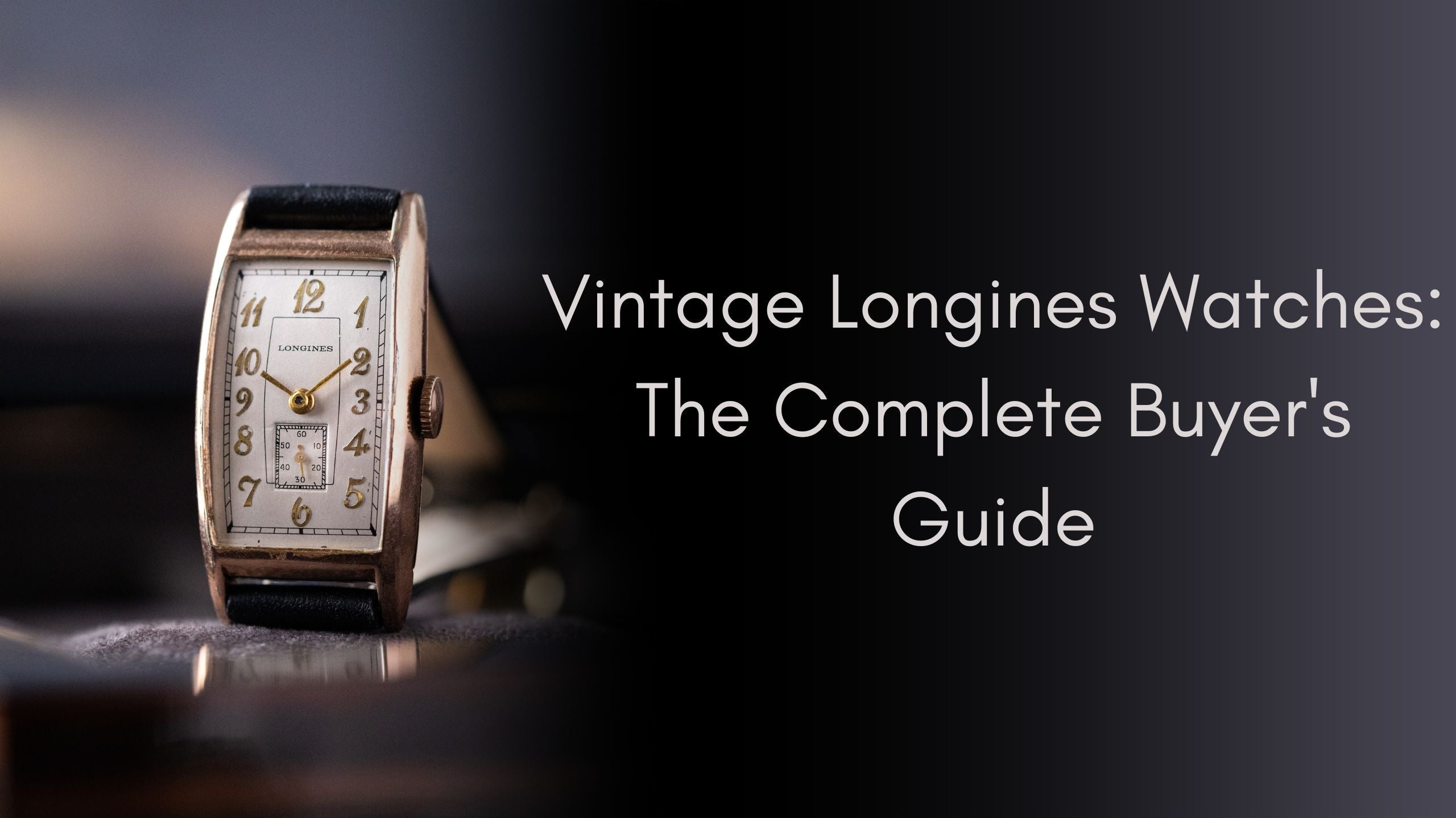

The Cartier Tank established rectangular watch design as an art form. But it was never alone — across the same decades, Omega, Longines, and other Swiss makers produced rectangular watches of equal elegance and far greater rarity.
The Cartier Tank is widely regarded as one of the most influential wristwatch designs ever created. Introduced in 1917 and inspired by the top-down silhouette of military tanks used during the First World War, the Tank established a new design language for wristwatches. Instead of adapting round pocket-watch movements into round cases, Cartier introduced a watch built around architectural geometry: rectangular case, elongated Roman numerals, railway minute track, and cabochon crown.

Over the following decades the Tank became a cultural icon worn by figures such as Andy Warhol, Jackie Kennedy, and Princess Diana. Yet Cartier was far from the only manufacturer producing rectangular watches. Today, the vintage watch market reveals an important insight for collectors: some of the most interesting alternatives are vintage rectangular watches produced between the 1930s and 1960s.

The Art Deco Origins of Rectangular Watches
Rectangular watches became fashionable during the Art Deco period of the 1920s and 1930s, when design across architecture, fashion, and industrial objects embraced geometric forms and modern materials. These ideas translated naturally into watch design — instead of traditional round cases, manufacturers began experimenting with rectangular, tonneau, and stepped Art Deco cases.
Art Deco emphasized geometric symmetry, architectural proportions, stylized typography, and modern industrial elegance. The rectangular wristwatch quickly became associated with elegance, modernity, and urban sophistication.
- Geometric symmetry over organic curves
- Architectural proportions and stepped case forms
- Stylized typography — elongated numerals, bold baton indices
- Modern industrial materials — chrome, gilt, black enamel
- Dramatic contrast — black dials with gold lettering
Why Collectors Love Vintage Rectangular Watches
A rectangular watch is not simply a different shape. It is an entirely different philosophy of design — one that prizes architecture over convention. — The collector’s perspective
- Distinctive design — Case designs and dial layouts from the 1930s–1960s are almost never replicated in modern watchmaking. Each piece carries a visual identity that cannot be purchased new.
- Small production numbers — Watchmakers historically produced far more round watches than rectangular ones, making genuine scarcity — not manufactured rarity — a real factor.
- Mechanical craftsmanship — Most vintage rectangular watches use manual-winding movements, often developed specifically for shaped cases. Engineering a caliber to fit a rectangular outline is a far greater challenge than designing for a round case.
- Historical authenticity — For collectors who value provenance, a 1939 Longines or a 1930s Omega offers something no new watch can: a direct material connection to the era that produced it. The design is not inspired by Art Deco — it is Art Deco.
The Golden Era of Rectangular Design
The most important period for rectangular watch design occurred between the 1930s and early 1950s. During this time manufacturers such as Omega and Longines produced elegant rectangular dress watches with distinctive Art Deco styling. Many were produced for specific retailers or national markets, which adds another layer of historical interest.
Cartier Tank introduced — the benchmark rectangular watch design that would define the category.
Art Deco movement peaks. Swiss manufacturers begin producing rectangular dress watches in earnest, with stepped cases and bold dial typography.
Omega develops the Cal. T17 shaped movement. Longines produces black gilt dial rectangular models. The golden era of the form begins in earnest.
Production slows during wartime but resumes with post-war refinement. Cases become slimmer and more architecturally resolved.
Modernist minimalism replaces Art Deco ornament. Dials become cleaner. The Omega Cal. 620 era exemplifies this quieter, more restrained approach.
The quartz crisis redirects production. Rectangular mechanical watches become increasingly rare, and their collector appeal begins to grow.
Typical characteristics of watches from this golden era include elongated rectangular cases, small seconds subdials, stylized Arabic numerals or baton indices, slim mechanical movements, and narrow lug widths designed for leather straps.
Vintage Omega Rectangular Watches
Among Swiss watchmakers, Omega produced some of the most interesting rectangular watches during the Art Deco era. Many used specialized movements designed specifically for rectangular cases, rather than adapted round movements. One of the most notable examples is the Omega Caliber T17, a shaped movement developed during the 1930s.

This watch illustrates several defining characteristics of early rectangular watches: small seconds at six o’clock, slim rectangular case, and Art Deco dial typography. Omega continued producing rectangular watches into the mid-twentieth century — later examples featured slimmer cases and more minimalist dial layouts, as seen in the Cal. 620 period.

Vintage Longines Rectangular Watches
Longines also produced numerous elegant rectangular watches during the mid-twentieth century, combining refined case proportions with distinctive dial designs and high-quality mechanical movements. Black gilt dials from the 1930s are especially attractive because of their dramatic contrast and strong Art Deco character.

Longines continued producing rectangular watches throughout the twentieth century. Later interpretations sometimes featured textured cases or two-tone dial designs, demonstrating how rectangular watch design evolved well beyond the Art Deco period.

Movements in Vintage Rectangular Watches
Rectangular watches presented a unique challenge for watchmakers. Most mechanical movements are round, which naturally fits circular cases. To produce rectangular watches, manufacturers used one of two approaches.
- Adapted round movements — a round caliber placed inside a rectangular case, with the case shaped around the movement
- Shaped movements — calibers engineered specifically to match the rectangular case outline; technically more complex and far less common
Many vintage Swiss watches were also not produced entirely in-house. Case manufacturing was often performed by specialized companies — including Favre-Perret, François Borgel, Taubert & Fils, and Spillmann — that supplied cases to multiple watch brands. As a result, collectors sometimes encounter watches from different brands sharing similar case designs.
Typical Sizes & How They Wear
Vintage rectangular watches are often smaller than modern watches. Typical case widths range between 20 mm and 25 mm, while case lengths often range between 30 mm and 38 mm. Because of their elongated shape, they can wear larger than their measurements suggest.
The Vintage Market for Rectangular Watches
The market for vintage rectangular watches has grown steadily in recent years, driven by three converging trends: a shift toward smaller, more elegant watches; renewed interest in Art Deco design; and the genuine scarcity of rectangular models relative to round ones.
| Brand | Era | Movement | Typical Width |
|---|---|---|---|
| Omega | 1930s–1960s | Mechanical | 20–24 mm |
| Longines | 1930s–1960s | Mechanical | 20–24 mm |
| Tissot | 1970s–1990s | Quartz / Mechanical | 22–26 mm |
Finding authentic vintage watches requires careful sourcing. Collectors should consider the originality of dial and hands, the condition of the movement, servicing history, and authenticity of the case. At Dumarko, each watch is inspected, serviced when necessary, and verified for authenticity before being offered to collectors.
For enthusiasts willing to explore beyond the most famous references, vintage rectangular watches can be some of the most rewarding discoveries in watch collecting. — Dumarko