
There is a moment, watching a moonphase watch, when the boundary between timekeeping and poetry dissolves entirely. A small disc rotates beneath a cut-out aperture, carrying a painted or guilloché moon through its celestial cycle — and in that slow, barely perceptible movement, centuries of astronomical observation are compressed into a mechanism no larger than a thumbnail. The moonphase complication is one of watchmaking's oldest, most beautiful, and most misunderstood achievements.
This guide traces the full arc of the moonphase watch — from its origins in 16th-century astronomical clocks to the golden age of Swiss production in the 1940s and 1950s, through the key houses that made it iconic, and into the present, where these complications command extraordinary prices at auction and on the collector's market. We focus particularly on the vintage moonphase wristwatch: Omega's Cosmic and triple-calendar references, Jaeger-LeCoultre's extraordinary complications, Universal Genève's Tri-Compax, and the rarefied world of Patek Philippe and Vacheron Constantin.
Origins: From Astronomy to the Wrist
The moonphase display is one of the oldest complications in horology, predating the wristwatch by several centuries. Its roots lie in medieval astronomical clocks — large, cathedral-housed mechanisms that tracked not just the hours but the movements of the heavens. The famous Prague Orloj (1410) displayed the lunar cycle alongside solar time and the positions of the zodiac. These clocks were instruments of genuine scientific observation, built at a time when knowledge of lunar cycles was essential for agriculture, navigation, religious calendars, and medicine.
By the 16th and 17th centuries, the complication had migrated into pocket watches. The great English and Swiss makers — Thomas Mudge, Abraham-Louis Breguet, and later Patek Philippe — incorporated moonphase displays into their most prestigious timepieces. In the pocket watch era, the complication was often paired with a perpetual calendar, creating an instrument of extraordinary mechanical ambition.

The critical transition came in the 1920s and 1930s, as the wristwatch overtook the pocket watch entirely. Reducing a triple-calendar moonphase complication — which had comfortably occupied the generous case diameter of a pocket watch — into a movement small enough to fit on the wrist was a formidable engineering challenge. The houses that solved it most elegantly would define the golden age of the complication.
Prague Orloj installed — one of the earliest surviving public astronomical clocks displaying the lunar cycle.
Abraham-Louis Breguet incorporates moonphase displays into high-complication pocket watches for European aristocracy.
Patek Philippe produces early wristwatch moonphase references — among the first to adapt the complication to a wrist format.
Universal Genève, Longines, and Movado develop triple-calendar moonphase wristwatch movements. The golden age begins.
The peak of production. Omega, JLC, Universal Genève, Longines, and Vacheron release iconic moonphase references. Civilian demand drives volume; craftsmanship remains exceptional.
The Quartz Crisis begins. Production of mechanical complications collapses. Surviving moonphase watches from the previous two decades become immediately more precious.
The mechanical revival. Patek Philippe's ref. 3448 and later ref. 5496 lead a renaissance. Vintage moonphase watches from the golden age begin their ascent to trophy status.
How a Moonphase Complication Works
At its simplest, a moonphase display tracks the lunar cycle of approximately 29 days, 12 hours, 44 minutes, and 3 seconds. The mechanism uses a toothed wheel — typically with 59 teeth — that advances one step every 24 hours, completing two full rotations in 59 days (representing two lunar cycles of approximately 29.5 days each).
The heart of the mechanism. Advances one tooth per day, completing two rotations every 59 days — corresponding to two approximate lunar cycles. Driven by a finger or lever connected to the date mechanism.
A rotating disc carrying two painted or engraved moons on a deep blue or black ground. As the disc turns, one moon rises through the aperture from new moon to full moon and back again.
Most golden-age moonphase watches pair the display with a triple calendar: day, date, and month indicated via subsidiary dials or apertures. This combination defines the classic "triple calendar moonphase" form.
The standard 59-tooth moonphase wheel is not astronomically precise. The true lunar cycle is 29 days, 12 hours, 44 minutes, and 3 seconds — meaning the standard mechanism accumulates an error of approximately one day every 2 years and 7 months. Most vintage moonphase watches require a small manual correction every few years to stay accurate.
High-precision moonphase mechanisms — such as those used in Patek Philippe's perpetual calendar references — use 135-tooth wheels or more complex gear trains to reduce this error to one day in approximately 122 years. These ultra-precise mechanisms are significantly more expensive to produce and are a major contributor to the value differential between a standard moonphase and a perpetual calendar moonphase.
The Golden Age: 1930s–1960s
The three decades between approximately 1935 and 1965 represent the undisputed golden age of the moonphase wristwatch. Several converging forces made this era extraordinary: the mechanical ingenuity of Swiss ebauche houses had finally solved the miniaturisation problem; the postwar economic recovery created a market of prosperous buyers willing to pay for complication; and the aesthetic traditions of Art Deco gave moonphase dials some of their most beautiful and enduring designs.
The defining format of the era was the triple calendar moonphase: day and month displayed via subsidiary dials or apertures at 10 o'clock and 2 o'clock, a date subdial at 6 o'clock, and the moonphase aperture — typically at 12 o'clock, directly below the 12 hour marker. This arrangement, with minor variations, was shared across nearly every major Swiss house of the period, because most of them sourced their movements from the same small number of ébauche suppliers.
The great moonphase watches of the 1940s and 1950s were not made for astronomers. They were made for men who understood that wearing one was a statement — not of wealth alone, but of appreciation for the highest reaches of the craft. — Horological tradition
Omega: The Cosmic and the Triple Calendar
Among the major Swiss houses, Omega produced some of the most technically sophisticated and visually remarkable moonphase watches of the golden age. The key references cluster in the late 1940s and early 1950s — a period when Omega's technical ambition was at its peak and the brand had not yet pivoted toward the sports and space narrative that would define it in the 1960s.

The Omega Cosmic — introduced in 1947 and produced until approximately 1956 — was Omega's most prestigious and technically complex wristwatch of the period. Available in multiple case materials including 18k solid gold, the Cosmic featured a triple calendar with moonphase display, powered by Omega's calibre 381 (a modified Lemania base). The Cosmic is now one of the most sought-after vintage Omega references, commanding prices that reflect both its mechanical ambition and its extraordinary rarity in fine condition.
The closely related reference 2471 and 2474 are triple calendar moonphase watches that share the Cosmic's mechanical DNA. Reference 2471 features subsidiary dials for day and month at the upper flanks, date at 6 o'clock, and the moonphase aperture just above — on an ivory or champagne dial that has become one of the most recognisable faces in vintage collecting. The 2474 variant adapts the same configuration with minor dial differences.
Critically, these are not to be confused with later Omega sports references. The moonphase Omegas of this era are dress watches: relatively slim, refined, with exquisitely printed dials and — in the finest examples — solid gold cases that have developed a warm patina over seven decades. Production numbers were small. Surviving examples in original, unrestored condition are genuinely scarce.
Jaeger-LeCoultre: The Grand Complication House
Jaeger-LeCoultre occupies a position in the moonphase story that is both central and paradoxical. As one of the great ébauche suppliers of the 20th century — making movements for Patek Philippe, Vacheron, and dozens of other houses — JLC's mechanical fingerprints are on more moonphase watches than any other manufacturer. Yet the brand's own signed moonphase watches, produced under the Jaeger-LeCoultre name, represent some of the rarest and most coveted in existence.
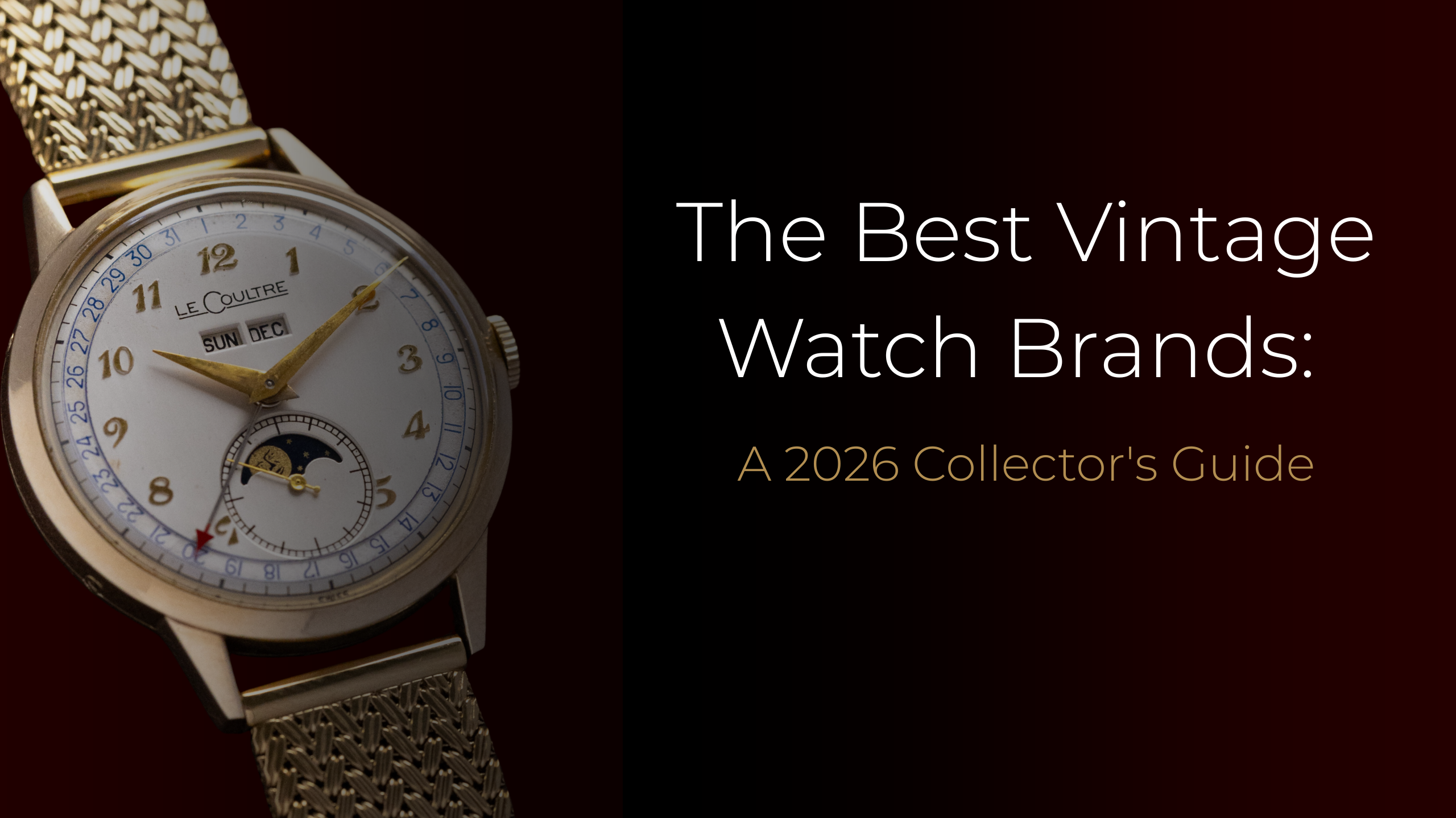
JLC's most celebrated vintage moonphase references are the Triple Date Calendar Moonphase watches of 1943–1949, powered by the in-house Calibre 486/486AW. These were produced in a run of approximately 5,000 pieces: 500 cased in 14ct gold for the European market (signed "Jaeger-LeCoultre"), and 4,500 exported to the US in gold-filled cases (signed "LeCoultre" on the dial). The design — featuring teardrop lugs, applied indices, and a moonphase aperture typically positioned below the hands — is widely considered among the most beautiful dial architectures JLC ever produced. The watch was so well regarded that JLC re-released it in 1983 as a limited 150th anniversary edition. Surviving examples in original, unrestored condition are now genuinely rare.

Into the 1950s, JLC continued producing triple-calendar references under the combined Jaeger-LeCoultre name — typically in 18k gold with restrained, beautifully balanced dials — in very limited numbers and cased in-house to a standard that even major rivals rarely matched. A later and highly collectible footnote to the JLC moonphase story is the Tank Moonphase, Ref. 400.6.20 — a 1990s quartz-powered piece housed in a rectangular stainless steel case with gold-plated groove accents (approx. 24×38mm). Its dial architecture is distinctive: a round layout set within the tank case, with a moonphase aperture at 6 o'clock and a pointer date hand. The dial is double-signed — JLC at the top, LC at the bottom — a direct visual reference to the brand's American-market heritage. Described as ultra-rare even by specialist dealers, it represents an unusual chapter in JLC's moonphase story: a quartz movement in a classically proportioned case, consciously echoing the 1940s aesthetic it descends from.
JLC's position as a movement supplier also means that many moonphase watches carrying other brands' names — including some Patek Philippe references of the period — contain JLC-derived or JLC-manufactured ebauches. Understanding this relationship is essential for advanced collectors navigating the vintage market.
Universal Genève: The Tri-Compax
If any single watch defines the aesthetic ideal of the golden-age triple calendar moonphase, it may be the Universal Genève Tri-Compax. Universal Genève — a Geneva-based manufacture that operated from 1894 and peaked in prestige and production during the 1940s and 1950s — produced moonphase watches of remarkable quality and visual elegance at a price point slightly below the elite tier of Patek and Vacheron.
The Tri-Compax (reference 22270 and related references) is powered by Universal's own calibre 287, a manually wound movement of excellent quality that incorporates the triple calendar and moonphase complication with unusual elegance. The name "Tri-Compax" refers to its three complications: calendar, moonphase, and chronograph — making it not merely a moonphase watch but a horological statement of remarkable ambition for its era.
The dials of Tri-Compax watches are among the most beautiful of the period: sector layouts, applied gold indices, and moonphase apertures of unusual depth and colour. Cases were produced in pink gold, yellow gold, and stainless steel — the steel versions representing extraordinary value on today's collector market, as stainless triple calendar moonphases are far rarer than gold examples.
Universal Genève's subsequent decline — the brand was acquired, sold, and ultimately reduced to a minor player — has given its golden-age production a poignant finality that collectors find deeply compelling. The Tri-Compax is the product of a house at its absolute peak, producing at the very limit of what it could achieve.
Longines: Calibre 878 and the Flagship
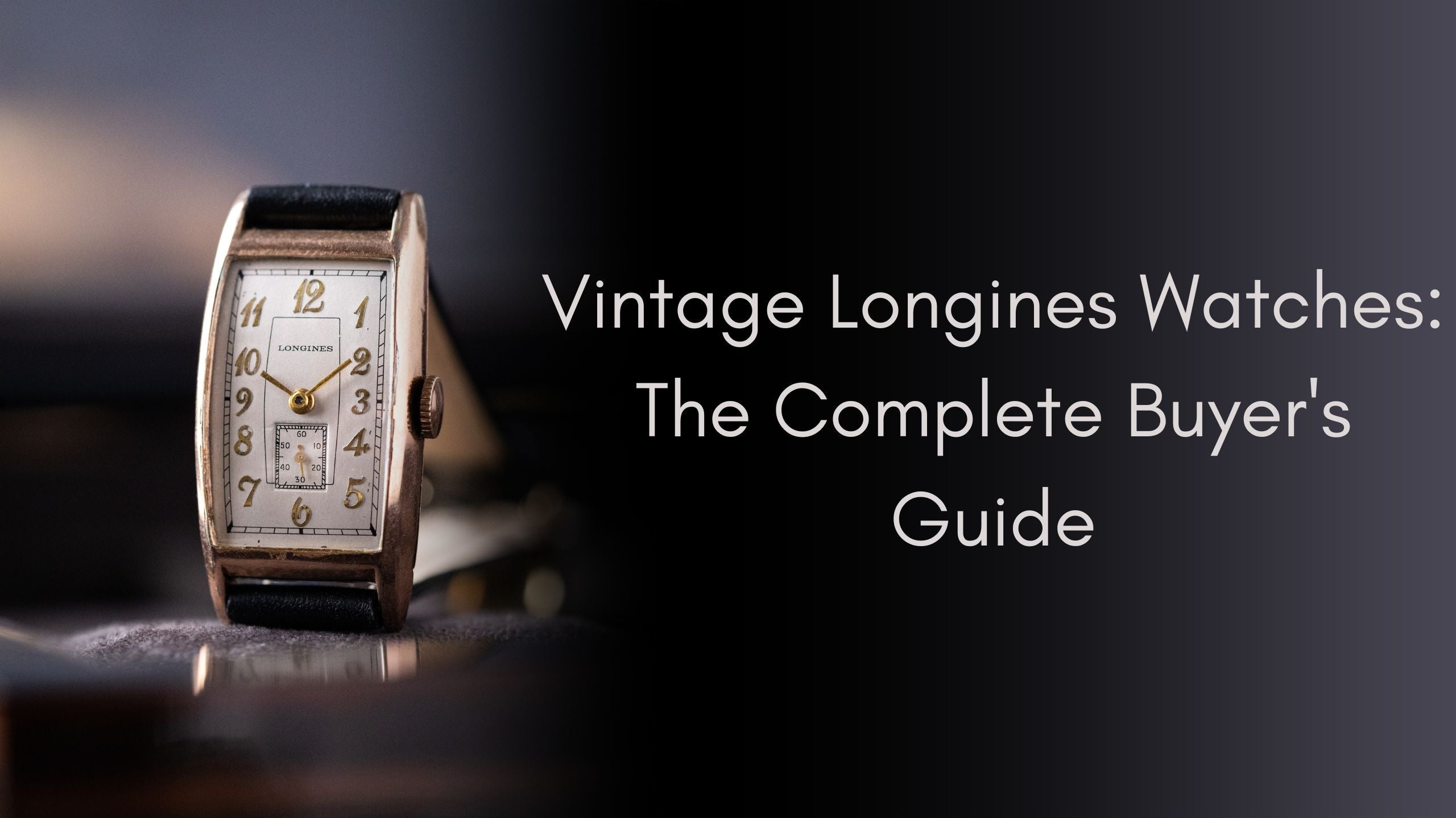
Longines approached the moonphase complication with the same systematic precision it brought to chronographs and observatory-certified movements. The brand's triple calendar moonphase references, produced in the 1940s and early 1950s, are powered by calibre 878 — a movement widely regarded as one of the finest triple-calendar ebauches of the era, notable for its extremely clean layout and reliable calendar mechanism.
The Longines triple calendar moonphase watches of this period are distinguished by their exceptional dial quality and movement finishing. Calibre 878 — also used by some other houses under licence or rebadged — drives a triple calendar with moonphase display that is among the most mechanically reliable of the genre. Unlike some competitors' designs, the Longines calendar advances with a clean snap rather than a slow drift, which collectors prize for legibility and aesthetic satisfaction.
Longines produced its moonphase references in both gold and steel, in both large and more modest case sizes. The brand's position as a volume manufacturer of high quality meant that production numbers were somewhat higher than at Patek or Universal — but golden-age triple calendar moonphase Longines in original condition are still genuinely rare, because most examples have been polished, serviced with non-original parts, or simply worn to exhaustion over the intervening decades.
The Longines moonphase represents perhaps the best entry point into serious golden-age triple calendar collecting — excellent mechanical quality, beautiful dials, a prestigious name, and prices that remain more accessible than the elite tier.
Patek Philippe: The Pinnacle
Any serious discussion of moonphase watches must acknowledge Patek Philippe's position at the absolute apex of the form. Patek has produced moonphase complications continuously since the 1920s, and its perpetual calendar moonphase references represent the rarest and most valuable vintage watches of any kind regularly appearing at auction.
The defining Patek moonphase references of the golden age are ref. 1526 (the first perpetual calendar wristwatch with moonphase, produced from 1941) and ref. 2499 (produced from 1950 to 1985 in only approximately 349 pieces). These are not simply moonphase watches — they are perpetual calendars, meaning the calendar advances automatically to account for months of different lengths and even leap years, without any manual correction required.
The distinction between a triple calendar moonphase and a perpetual calendar moonphase is critical for understanding Patek's premium. A triple calendar must be corrected at the end of short months; a perpetual calendar requires no intervention for 100 years or more. The mechanism required to achieve this adds many additional components and demands a level of adjustment and finishing that places these watches in an entirely different category of craft.
Reference 2499 has sold at auction for sums exceeding CHF 5 million in exceptional examples. Reference 1526 regularly fetches six figures. Even Patek's standard triple calendar moonphase references — such as ref. 1526 variants — represent investment-grade horology of the highest order. These are watches that major auction houses dedicate catalogue essays to, that serious collectors pursue for decades.
Vacheron Constantin & Audemars Piguet
Vacheron Constantin and Audemars Piguet — alongside Patek, the two other members of the informal "Holy Trinity" of Swiss watchmaking — each produced moonphase complications of exceptional quality, though in considerably smaller numbers than the mid-tier producers.
Vacheron's golden-age moonphase references include a series of triple-calendar and perpetual-calendar watches produced in the 1940s and 1950s that are among the most architecturally beautiful of the period. The brand's dial artisans — working in Geneva's traditional enamel and guilloche tradition — produced moonphase apertures of extraordinary depth and colour, with moons that seem almost three-dimensional against their midnight-blue grounds.
Vacheron moonphase watches are rarer at auction than their Patek equivalents — not because they are less desirable, but because surviving examples appear less frequently. The brand's output was small, its clientele was discreet, and many pieces have remained in family ownership for generations. When a fine Vacheron triple calendar moonphase does appear, it commands immediate and intense attention.
Audemars Piguet produced triple calendar moonphase watches in the 1940s and 1950s of remarkable quality — housed in cases of unusual elegance and powered by AP's own or ébauche-based movements finished to the highest standard. Like Vacheron, AP's golden-age moonphase output was small in absolute terms, and surviving examples in excellent original condition are exceptionally rare.
The modern legacy of AP's moonphase work is best seen in the Royal Oak Perpetual Calendar and the Royal Oak Offshore Grande Complication — contemporary pieces that trace a direct lineage back to the house's mid-century complications. These modern references, like their vintage predecessors, command six-figure prices and waiting lists at boutiques worldwide.
Other Notable Producers: Movado, IWC, and Zenith
Movado produced triple calendar moonphase watches in the 1940s and 1950s that are often overlooked but mechanically superb — the brand's in-house movement quality was exceptional, and its dials display the same understated elegance as its celebrated Museum dial. IWC produced the cal. 83 and its relatives — a triple calendar moonphase ebauche that powered a series of watches later known as the "Da Vinci" ancestors. Zenith fitted its triple calendar moonphase references with movements of excellent quality, and its surviving examples — often in pink gold — are increasingly recognised by a new generation of collectors. All three represent meaningful alternatives for collectors who want genuine golden-age quality at prices more accessible than the elite tier.
Why Moonphase Watches Are Rare and Valuable
The rarity and value of vintage moonphase watches is the product of several distinct and compounding factors. Understanding them is essential for anyone approaching this segment of the market seriously.
| Factor | Significance | Collector Impact |
|---|---|---|
| Low original production | Triple calendar moonphase movements were complex and expensive. Even major houses produced only hundreds — not thousands — of examples per year. | |
| Mechanical fragility | The calendar and moonphase mechanisms are delicate. Many examples have been damaged by incorrect pushing of corrector buttons or amateur service. | |
| Dial survival rate | Moonphase dials — especially those with printed day/month text and coloured moonphase apertures — are extremely susceptible to moisture, UV damage, and incorrect cleaning. | |
| Case polishing | Over-polishing removes original case finishing and chamfering. Original "skin" on a 1950s case is rare; most examples have been polished flat at some point. | High |
| Quartz Crisis attrition | Many golden-age moonphase watches were discarded, cannibalised for parts, or "modernised" during the 1970s–80s when mechanical watches were out of fashion. | High |
| Originality of parts | Crown, crystal, hands, and bracelet replacements — even with period-correct parts — reduce value significantly. All-original examples command enormous premiums. | High |
| Growing collector demand | The intersection of vintage watch collecting and astronomical complication enthusiasm has created a global demand that far outpaces surviving supply. | Moderate |
| Provenance and documentation | Original box, papers, and purchase receipts add significant value. Documented single-family ownership is increasingly rare and premium-commanding. | Moderate |
The convergence of these factors explains why a fine Omega Cosmic in original condition can command ten times the price of a similar-era Omega dress watch, and why a Patek Philippe ref. 2499 with original dial and documented provenance occupies a tier shared only with a handful of other objects in all of collecting.
Collector's Guide: What to Look For
Approaching the vintage moonphase market requires specific knowledge that goes beyond general vintage watch collecting. The complication introduces a unique set of condition concerns and authenticity questions that buyers must understand before committing.
Dial Condition Is Everything
On a moonphase watch, the dial carries extraordinary information density: day and month names, date numerals, subsidiary dial chapter rings, and the moonphase aperture itself. Any damage to this surface — fading, moisture staining, cracking lacquer, or repainted sections — is both aesthetically devastating and significantly value-destructive. Examine the dial under multiple light sources and pay particular attention to the area around corrector pushers, which is often where moisture has entered.
The Moonphase Disc
The moonphase disc itself — the rotating element carrying the moon imagery — is often a silent tell of a watch's history. Original discs show a specific depth of blue, a particular painting or engraving style, and often a patina consistent with the watch's age. Replaced discs are common, and while period-correct replacements exist, they are still considered non-original. Ask sellers specifically about disc originality and examine it carefully under magnification.
Corrector Pushers
Triple calendar moonphase watches have between two and four corrector pushers — typically recessed into the case band — for advancing the day, date, month, and moonphase independently. These pushers must be operated with a fine stylus or dedicated tool; using a pen tip or finger can bend or break the delicate calendar fingers beneath. Ask whether the calendar mechanism has been tested and whether the correctors operate smoothly without resistance.
- Examine the dial under UV and raking light — look for repainted sections, moisture rings, and hairline cracks
- Verify moonphase disc originality — ask the seller directly and compare against reference images
- Test all corrector pushers for smooth operation — resistance indicates potential damage
- Check case originality — examine hallmarks, case back serial numbers, and lug profile for signs of replacement
- Confirm hands are original — shape, finish, and lume plots (if present) should match known references
- Request movement images — look for damage around the calendar mechanism and evidence of amateur service
- Verify crown and crown tube originality — these are often replaced and are an easy tell of non-original condition
- Ask about service history and which parts, if any, were replaced during previous servicing
- Cross-reference case and movement serial numbers against known production data
- Where possible, purchase from specialist dealers or established auction houses with condition guarantees
Conclusion
The moonphase watch is one of the few complications in horology where the practical and the poetic are held in genuine equilibrium. It tells you something genuinely useful — the phase of the moon — through a mechanism that is both astronomically grounded and visually enchanting. And it does so in a form small enough to wear on the wrist, through mechanisms that were developed at a specific moment in watchmaking history that will never quite be repeated.
The great vintage moonphase watches — the Omega Cosmic, the Universal Genève Tri-Compax, the JLC triple calendars, the Longines calibre 878 references, and above all the Patek and Vacheron perpetual calendars — are the product of a golden age defined by extraordinary mechanical ambition, exceptional aesthetic sensibility, and a market that rewarded both. They survived the Quartz Crisis, the decade of disposable fashion, and the long indifference of the 1980s. The fact that they are now among the most coveted objects in all of collecting is not an accident of market fashion. It is a recognition, delayed but emphatic, of just how exceptional they always were.
Collector's Questions
Frequently Asked Questions