If you're looking for a vintage watch with real history, honest engineering and a price that won't make you wince, you're in the right place. Vintage Vostok watches tick all three boxes. They were built in a small Tatar town for soldiers, sailors and divers, and they've quietly become one of the best-loved corners of watch collecting.
This guide pulls together what we've learned handling Vostok watches at DuMarko. We'll cover where they came from and what makes the Komandirskie and Amphibia special. We'll also look at the movements worth knowing and how to buy well in 2026. Along the way, we've corrected a few myths that keep getting copied from site to site. If you'd rather browse first, our Soviet watch collection holds the pieces we still have.
Why Vintage Vostok Watches Still Matter in 2026
Let's be honest. Nobody buys Vostok watches to impress a room full of bankers. You buy one because it's the real deal. These are tool watches made by a genuine manufacture, built to survive conditions most luxury pieces never see. That's exactly why collectors keep coming back to Vostok watches.
There's also a simple supply story at play. Soviet-era production ended over three decades ago. Every year, more of the good examples get worn out, modified or tucked away in private collections. Meanwhile, interest keeps growing, helped along by forums, YouTube channels and even television. The result? Clean, original vintage Vostok watches are harder to find than they were ten years ago.
At DuMarko, we've made a related decision of our own. We're no longer sourcing new Soviet pieces, so what's in our Soviet collection now is the stock we have left. When those watches go, they won't be replaced.
The Four Families Worth Knowing
Over the decades, Vostok watches came in hundreds of dial and case variations. Still, most collectors start with one of four broad families. Here's a quick look before we dig into each one.
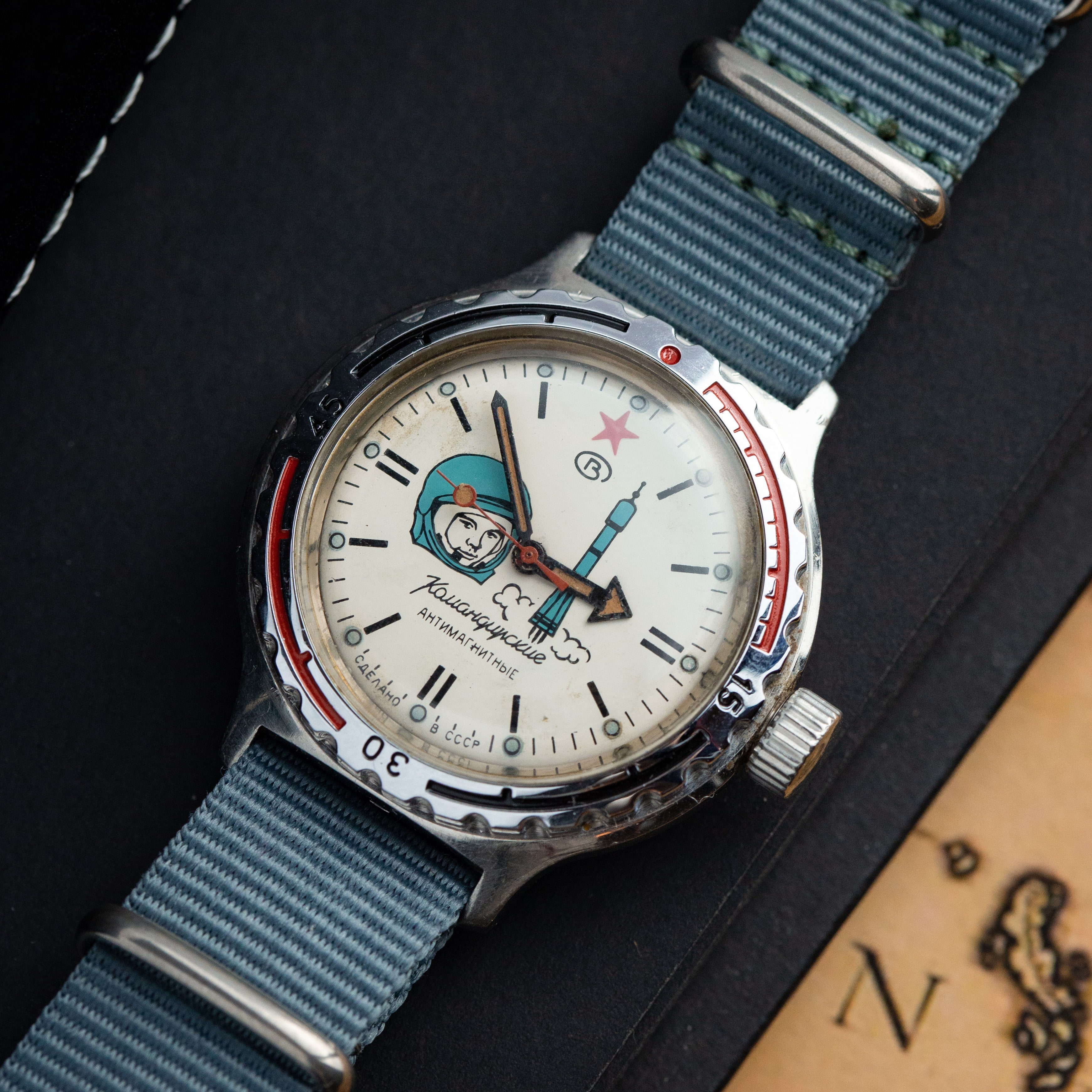
The "Commander's" watch. Launched alongside the 1965 Ministry of Defence contract, it's rugged, readable and packed with military character.
The 1967 dive watch rated to 20 atmospheres. Clever, low-cost engineering made it a cult favourite with divers and designers alike.
Watches marked "ЗАКАЗ МО СССР" were ordered by the Soviet Ministry of Defence. They're the ones serious military collectors chase.
Thin, elegant pieces powered by the calibre 2209. They show a quieter side of Vostok that many buyers overlook.
| Family | Introduced | Typical Calibre | Collector Interest | Best For |
|---|---|---|---|---|
| Komandirskie | 1965 | 2414 / 2414A (manual) | ★★★★☆ | First Soviet watch |
| Amphibia (early) | 1967 | 2209, later 2409 (manual) | ★★★★★ | Dive watch fans |
| Amphibia (automatic) | 1980s | 2416B (automatic) | ★★★★☆ | Daily wear |
| Ministry-issue | From 1965 | Varies by model | ★★★★★ | Military history buffs |
| Slim dress | 1960s–70s | 2209 (manual) | ★★★☆☆ | Understated style |
From Evacuation Train to Ministry Contract: The Origins of Vostok
Vostok's story starts with a crisis. In the autumn of 1941, German forces were closing in on Moscow. Soviet planners moved vital industries east, far from the front. One of them was the Second Moscow Watch Factory.
Late 1941: A Factory on the Move
Machinery, materials and hundreds of workers travelled east by rail. The factory settled in Chistopol, a quiet town on the Kama River in Tatarstan. Moscow staff trained local people to run the equipment, including the tooling for the Type-1 (K-43) pocket watch movement. By 1942, the Chistopol plant was making watches for the military. That's why most sources, including DuMarko, give 1942 as the brand's founding year.
It's worth pausing on that. The factory wasn't built in a planned industrial zone. It grew out of wartime improvisation, with skills passed hand to hand. That scrappy, practical spirit never really left.
Kirovskie, Kama and the Post-War Years
Production broadened once the war ended. The factory turned out Kirovskie wristwatches from 1943. Then, in 1952, it launched the Kama, a shock-resistant, dust-proof and water-resistant model. In hindsight, the Kama reads like a rehearsal for everything that came later. Toughness was already the house speciality.
1965: The Ministry of Defence Contract
The big turning point came in 1965. That year, the Chistopol factory became the official watch supplier to the USSR Ministry of Defence. The same year saw the launch of the Komandirskie. From then on, Vostok's reputation was tied to the armed forces, and its design choices reflected that brief.
So Where Does the Name "Vostok" Come From?
"Vostok" simply means "East" in Russian. The factory used several brand names for years, including Kama, Sputnik and others. Around 1969, it consolidated its output under the Vostok name. Many collectors link the name to Yuri Gagarin's Vostok 1 flight of 1961, and it's a lovely story. However, other accounts tie it to an earlier Chistopol precision watch model. We'd treat the space connection as collector lore rather than documented fact.
"The name came from Vostok 1." Possible, but unproven. The documented timeline only shows the factory adopting the brand in the late 1960s.
"The 2416B hacks." It doesn't. The seconds hand keeps running when you pull the crown to set the time. That's normal for this calibre and not a fault.
"A named engineer duo co-designed the Amphibia." Some websites credit two specific designers. We couldn't verify the second name, so we've left it out. Factory lore does credit designer Mikhail Novikov with recalling that the "Amphibia" name came from a staff naming contest.
The Komandirskie: The Commander's Watch
"Komandirskie" translates as "Commander's." The name tells you who it was meant for. These were watches for officers, and they had to work in mud, cold and chaos. Cases were steel or chromed brass, with luminous hands and bold, legible dials. Many later versions added a rotating bezel, which is handy for timing short intervals.
What makes the Komandirskie so appealing today is its range. You'll find red stars, tanks, parachutes, submarines and anchors. Some dials are stern and plain. Others feel almost like propaganda posters. There's a Komandirskie for nearly every taste, and that variety keeps collectors hunting.
What "ЗАКАЗ МО СССР" Means
Look closely at some dials and you'll see "ЗАКАЗ МО СССР." It means "Ordered by the Ministry of Defence of the USSR." Watches with this marking were made for the military itself, not the shop counter. As a result, they're among the most sought-after Komandirskie variants. Naturally, that also makes them a target for redials, so originality checks matter even more here.
The Workhorse Calibre 2414
Most vintage Komandirskie run on the manual-wind calibre 2414 or its date version, the 2414A. They use 17 jewels and beat at 19,800 vibrations per hour. That's not exotic by Swiss standards. However, it's tough, simple and easy for a good watchmaker to service. For a watch built to take a beating, that's exactly what you want.

Tanks, Subs and Paratroopers: The Late-1980s Dials
Here's a twist many buyers don't know. In the late 1980s, Soviet military budgets were cut hard, and the Ministry bought far fewer watches. Vostok responded by selling more Komandirskie to civilians. These versions came in fresher cases with bold military themes like tanks and U-boats. Because they weren't government orders, they don't carry the Zakaz marking. They're still genuine Vostok watches, and many are great fun to wear.
A Surprise Pop-Culture Moment
Vostok has popped up on screen more than once. On Apple TV's Severance, the character Mark Scout wears a green-dial Komandirskie. Years earlier, Wes Anderson put an Amphibia on Steve Zissou's wrist in The Life Aquatic. Both moments sent new fans searching for Vostok watches. Pop culture rarely creates value on its own, but it does keep the conversation going.
The Amphibia: Engineering Without Excess
If the Komandirskie is Vostok's soldier, the Amphibia is its diver. It's also the model that earns Vostok the most respect from engineering-minded collectors. Why? Because it solved a hard problem cheaply and cleverly.
1967 and the 20-Atmosphere Promise
The first Amphibia watches left the factory line in 1967. They were rated to withstand 20 atmospheres of pressure, roughly 200 metres of water. At the time, Swiss brands reached similar ratings with precise, expensive machining. Soviet industry didn't have that luxury. So Vostok's engineers worked with physics instead of against it.
How the Pressure Seal Works
The trick is surprisingly simple. The Amphibia uses a thick acrylic crystal and a caseback held by a ring, both sitting on gaskets. As the watch goes deeper, water pressure pushes these parts harder onto their seals. In other words, the seal gets tighter the deeper you dive. It's an elegant answer that didn't demand ultra-precise tolerances.
The crown is just as clever. On many Amphibias it feels loose, almost wobbly, when screwed down. New owners often think something's broken. It isn't. That slight play is part of the design and helps the crown seal reliably without strain. Just make sure it's screwed down properly before any water contact.
Case Shapes Collectors Know by Number
Amphibia fans talk in case numbers, and it's useful to learn the basics. The 420 is the classic round case most people picture. The 470 is the hexagonal "hex" case. The 710 is often called the "ministry" case. Others include the 110, the 150, the curvy 060 and the modern 090 tonneau. Each has its own fan club, and matching the right bezel to the right case is part of the hobby.

The Komandirskie is a field watch first. It's light, readable and full of military symbolism. The Amphibia is a purpose-built diver with a pressure-assisted seal and a chunkier presence on the wrist.
Want a story-rich watch for everyday wear? Start with a Komandirskie. Want one of the most ingenious budget dive watches ever made? Go for an Amphibia.
Inside the Movements: What Makes Vostok Tick
Vostok watches have always run on in-house movements, and that matters. Back in 2003, trade magazine Europa Star described Vostok as a genuine manufacture that produced everything in-house, even balance springs. It also noted the factory had never made quartz watches. That's a rare boast for a mass-market brand.
| Calibre | Winding | Jewels | Beat (vph) | Functions | Found In |
|---|---|---|---|---|---|
| 2209 | Manual | 17 | 18,000 | Central seconds | First Amphibias, slim dress watches |
| 2409 | Manual | 17 | 19,800 | Central seconds | Amphibia |
| 2414A | Manual | 17 | 19,800 | Central seconds, date | Komandirskie |
| 2415 | Automatic | 31 | 19,800 | Central seconds | 1967 Amphibia reissue |
| 2416B | Automatic | 31 | 19,800 | Central seconds, date | Amphibia, Komandirskie |
The 2209: A Thin Surprise
The 2209 is the movement many people don't expect from a "tough" brand. It's slim, with an unusual layout for a central-seconds calibre. It powered the first Amphibia and many elegant dress watches. If you like quiet, flat watches with real history, 2209-powered Vostok watches are worth a look.

The 2416B: Simple, Sturdy, Not Fancy
Vostok added automatic winding to its 24-series movements in the 1980s. The best-known result is the 2416B, with 31 jewels, a date and roughly 31 hours of power reserve. You can wind it by hand, too. As we mentioned, it doesn't hack, so the seconds hand won't stop while you set the time. Is it refined? Not really. But it's famously forgiving, and that's why it's still everywhere.
Built for Repair, Not Just Display
Here's the practical upside. Vostok calibres were made in huge numbers, so spare parts are still around. Their simple construction means a competent watchmaker can keep them running for decades. That's a big part of why vintage Vostok watches make such good daily companions.
Vostok After the USSR: What's Changed
The Soviet Union ended in 1991, but the Chistopol factory carried on. Life wasn't easy, though. Like many former Soviet manufacturers, Vostok struggled through the 1990s and 2000s.

Bankruptcy and Rebirth
The original factory went bankrupt in 2010. It was then reorganised into several smaller companies under common ownership. In a 2016 interview, the company's CEO said it employed around 450 people. He also said it made roughly 15,000 to 18,000 watches a month. So production continues, though at a far smaller scale than in Soviet times.
Vostok Europe Isn't the Same Company
This one trips up a lot of buyers. Vostok Europe is a separate brand launched in Lithuania in the early 2000s. Some early Vostok Europe models used Chistopol-made calibres such as the 2426. However, it's a distinct business with its own designs and pricing. If you're shopping for Soviet-era history, a Vostok Europe piece isn't what you're after.
Why Vintage Still Wins for Collectors
Modern Vostok watches are fun and affordable. Still, they can't recreate the context of a Soviet-era piece. A 1970s Amphibia or a ministry-issue Komandirskie carries the weight of its time. That's something no reissue can manufacture, and it's why vintage examples hold collector interest.
How to Buy Vintage Vostok Watches in 2026
Chistopol made a huge number of Vostok watches, and that's both good news and bad news. It's good because there's plenty of choice. It's bad because mixed parts, repainted dials and tired movements are everywhere. A little knowledge goes a long way.
The Originality Checklist
Dial: Check for crisp, even printing and lume that has aged in step with the hands. Overly bright or perfect dials on "1970s" pieces deserve questions.
Calibre match: The movement should suit the model and era. A 2416B in a case meant for a manual 2409 is a red flag.
Case and bezel: On Amphibias especially, the bezel style should match the case number and period.
Caseback: Soviet-era backs often carry Cyrillic text and reference details. Compare them with known examples.
Honest wear: Light scratches and patina that fit the watch's age are good signs. Heavy polishing that softens the case edges isn't.
Watch Out for "Frankens" and Redials
A "Franken" is a watch built from mixed parts. Because Vostok used shared calibres and similar cases across many models, mixing is easy. Some sellers do it openly, while others don't mention it at all. Redials are another trap, particularly on Zakaz MO and themed dials. Ask for clear photos of the dial, movement and caseback before you buy.
What Should You Expect to Pay?
Prices swing widely. Unserviced Komandirskie can sell for well under €100 at online auctions. Clean, serviced, original examples from a specialist cost more, and early or rare references cost more again. Every watch in our own Soviet collection, for example, is serviced and checked before sale.
So what's the extra cost actually buying? It's a working movement, a verified set of parts and a warranty. For a decades-old mechanical watch, that peace of mind is worth a lot.
Buy the Seller First
It's the oldest advice in collecting, and it still holds. Choose sellers who describe condition honestly and answer questions quickly. A good dealer will happily send extra photos of the movement and caseback. If they won't, walk away.
Caring for Your Vostok
Good news: Vostok watches don't need fussy care. A few simple habits will keep yours ticking for years.
Winding and Daily Wear
- Wind manual pieces at roughly the same time each day, until you feel firm resistance.
- Don't force the crown past that point.
- For automatics, regular wear usually keeps them running. Give them a few winds if they've been sitting.
- Set the date away from midnight to protect the date mechanism.
Water: Respect the Age
A vintage Amphibia was rated to 200 metres when new. That doesn't mean a 40-year-old example still is. Gaskets age, and crystals pick up wear. Unless a watchmaker has recently replaced the seals and tested the watch, keep it away from swimming. A splash when washing your hands is fine. A dive isn't.
Servicing Intervals
Plan on a service every three to five years if you wear your watch often. That usually means a clean, fresh lubrication and new gaskets where needed. Because Vostok movements are simple, servicing tends to cost less than for comparable Swiss watches. Skipping service, though, is the quickest way to wear out the parts.
Which Vostok Is Right for You?
The honest answer depends on what you want the watch to do. Here's how each family suits a different kind of collector.
Easy to wear, full of character and widely available. It's the most natural first step into Soviet-era Vostok watches.
One of the cleverest budget dive watches ever made. Ideal if you love the "how" as much as the "what."
The most authentic link to Soviet armed forces. Expect to do more homework and pay a premium for originality.
Thin, understated and still undervalued. A smart pick if you prefer elegance over bulk.
Final Thoughts: A Soviet Classic Worth Wearing
Vintage Vostok watches prove that great design doesn't need a luxury price tag. They were born in wartime improvisation and shaped by military demands. Along the way, they produced some of the most inventive tool watches of the 20th century. The Komandirskie gives you history on the wrist. The Amphibia gives you engineering you can admire every time you check the time.
Most of all, Vostok watches are meant to be worn. Pick one that speaks to you, check its originality carefully and give it regular care. Do that, and it'll tell its story for years to come. Supply of clean Soviet-era examples won't last forever, so if one catches your eye, don't wait too long.
Last of Our Soviet Stock
Find Your Vintage Vostok
Every watch is serviced, checked and covered by our warranty. Once these pieces are gone, we won't be restocking them.
Browse Soviet WatchesBuilding a collection across countries? Explore our vintage Swiss watch collection for the other side of the Cold War story.
Your Questions Answered
Frequently Asked Questions