
An Omega tank watch is a vintage Omega with a rectangular or square case, the shape Cartier made famous with its Tank in 1917. Omega made these watches from the 1920s through the 1990s, and they cost a fraction of a vintage Cartier. We've listed 61 of them so far, and this guide uses their real prices.
Vintage Omega tanks fall into two groups. The Art Deco tanks of the 1920s to 1940s are small and run on hand-wound calibers such as the T17. The De Ville and Genève tanks of the 1960s to 1990s are larger and include quartz models.
The seven Omega tanks in our shop now cost between $1,477 and $3,845. Almost half of the 61 we've listed came from the 1930s and 1940s.
Below we go through Omega tanks decade by decade, with the models, calibers and sizes to expect. Then we compare them with the Cartier Tank and explain what to check before you buy one.
Our 1930s Omega tanks with sector dials are the ones customers ask about first. At 21 or 22mm across they look small in photos, but on the wrist the long case makes them read much larger.

What Is an Omega Tank Watch?
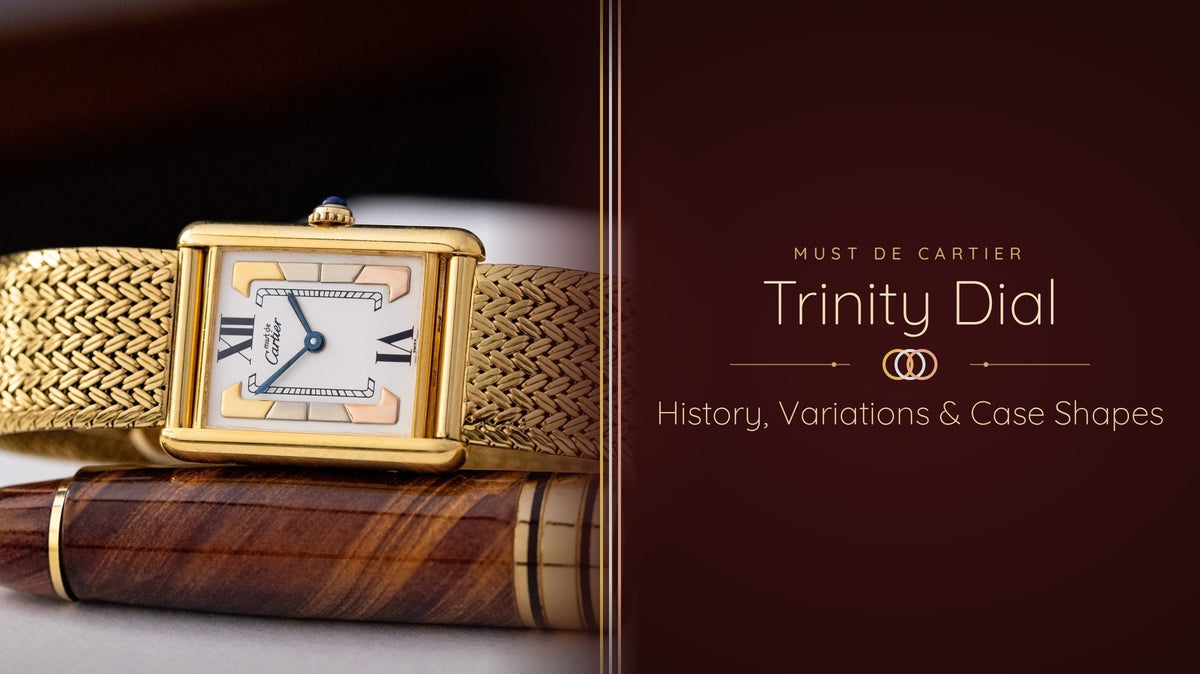
"Tank" describes the shape of the case: rectangular or square, with the lugs built into the sides. Louis Cartier designed the Cartier Tank in 1917, inspired by the Renault tanks on the Western Front, and full production began in 1919, according to Wikipedia's history of the Cartier Tank.
The name comes from Cartier. Collectors and dealers, ourselves included, use "tank" for any vintage Omega with that case shape. You'll find these watches under names such as De Ville and Genève, or with no model name on the dial at all on the earlier pieces. Omega was one of several Swiss brands to make tank style watches, and our guide to rectangular and square watches covers the others.
You'll read online that Omega made its first tank in the early 1950s. Our own listings show otherwise: we've had an Omega tank from the 1920s and 18 from the 1930s.
Omega Tank Models by Decade
The table sums up the models and references we've seen across the 61 Omega tank and square watches we've listed. Prices are in US dollars as of November 2026.
| Era | Models we've had | Calibers | Width | Our prices |
|---|---|---|---|---|
| 1920s | Art Deco tank in solid gold, no model name | 19.4S | About 25mm | $5,487 (solid gold) |
| 1930s | Sector-dial tanks, "Dedalos", tonneau Curvex, Marine Standard CK 3635 | T17, 20F | 21–23mm | About $1,300 – $3,750 |
| 1940s | Steel and gold-filled tanks | T17 and others | 21–23mm | About $1,550 – $2,150 |
| 1950s–1960s | Art Deco-style tanks, Ultra Thin, De Ville squares | 302, 620 | 22–28mm | About $2,000 – $2,200 |
| 1970s | Genève tonneau and cushion, De Ville tanks | 620, 625 | 21–28mm | About $1,600 – $3,300 |
| 1980s–1990s | De Ville Tank, De Ville quartz cushion | Quartz 1365, 1377 | 21–25mm | About $1,400 – $3,850 |
Solid gold pushes any decade to the top of its range. Steel and gold-filled tanks from the 1930s to the 1970s sit around $2,000 in our shop.
1920s–1940s: The Art Deco Tanks
The earliest Omega tanks are the most varied. Omega built them during the Art Deco years, when rectangular watches were fashionable, and the dials range from sector layouts to two-tone and Arabic-numeral designs. Our oldest, from around 1924, has a solid gold case and the caliber 19.4S, and it sold for $5,487.
These watches run on Omega's hand-wound form movements, which the factory shaped to fit a narrow case. The T17 appears again and again in our 1930s tanks, and we've had nine with the caliber 20F. Fratello's look at a 1939 Omega CK976 with the T17 shows the same movement in a steel tank.

These cases are small by today's standards. Our 1935 tank with a sector dial measures 21.5mm across, and our second 1935 tank measures 22.2 by 40mm and 8.6mm thick. The long case and the integrated lugs make them look bigger on the wrist than the width suggests.


The Marine Standard: A Tank Built for Water
Omega also put the T17 into a sportier rectangular watch, the Marine Standard. Our ref. CK 3635 from 1939 has a 23 × 37.5mm stainless steel case, 8.5mm thick, and a dial that has aged to a bronze tone. It's the toughest-looking tank we have, and it costs more than our other 1930s tanks.

1950s–1960s: Larger Cases and the De Ville
In our shop, the post-war tanks run a little bigger. Our 1957 Art Deco-style tank with the caliber 302 measures 28mm and sold for $2,035. In the 1960s the De Ville name arrived, first as part of the Seamaster range in 1960 and then as its own collection in 1967.
Square De Ville tanks from 1966 sold with us for $2,058, and a curved gold-filled tank, ref. 111.016, with the hand-wound caliber 620 sold for $2,161. These watches keep the Art Deco shape but add a cleaner dial with baton markers.
The most famous Omega tank of the period never reached a shop window. John F. Kennedy wore a rectangular 18K gold Omega Ultra Thin, ref. OT3980, at his inauguration in 1961.
1970s–1990s: Genève, De Ville and Quartz
The 1970s brought the widest choice of shapes. The Genève line included larger tonneau and cushion cases, such as the 27.5mm Genève ref. 111.0110 from 1971 that sold for $2,264. De Ville tanks of the decade use the small hand-wound calibers 620 and 625. Our 1975 tank in solid 14K gold with the caliber 625, ref. DD6850, sold for $3,316.

From the late 1970s Omega moved its slim tanks to quartz. Our 1982 De Ville Tank in 14K gold runs on the caliber 1377, built on the ETA 959.001, and the quartz caliber 1365 appears in other De Ville tanks we've had. Quartz makes these watches thin and easy to live with, since they only need a new battery every few years.


Rectangular, Square or Tonneau?
Collectors call all of these watches tanks, but the case shapes differ, and the shape decides how the watch sits on the wrist. Omega made four main shapes over the decades we cover.
The straight rectangular tank is the classic form, longer than it is wide, with flat sides. Our 1935 T17 tanks follow it. A square case has equal sides, and the De Ville squares of the 1960s are the ones we see the most. They wear wider and shorter than a rectangle, which suits a larger wrist.
A tonneau case has curved sides, like a barrel seen from above, and the Genève tonneau of 1971 shows the shape at its biggest. The Curvex cases of the 1930s bend along their length to follow the wrist. Our tonneau with a "pupitre" Curvex case, named after the sloping surface of a writing desk, sold for $2,858.
Cushion cases sit between a square and a circle, with rounded corners. Omega used them in the 1970s Genève line and in later De Ville quartz models such as our 21mm 1990s piece.
The Calibers Inside Omega Tanks
A round movement wastes space in a narrow case, so Omega built shaped movements for its early tanks and smaller calibers for the later ones. The table lists the calibers we've found in the Omega tanks we've listed.
| Caliber | Type | Era | Where we've seen it |
|---|---|---|---|
| 19.4S | Hand-wound | 1920s | Solid gold Art Deco tank, c. 1924 |
| 20F | Hand-wound | 1930s | "Dedalos" and nine other tanks |
| T17 | Hand-wound, shaped | 1934–1943 | Sector-dial tanks, Curvex tonneau, Marine Standard |
| 302 | Hand-wound | 1950s | 28mm Art Deco-style tank, 1957 |
| 620 | Hand-wound | 1960s–1970s | De Ville tanks, curved tank ref. 111.016 |
| 625 | Hand-wound | 1970s | Solid 14K gold tank ref. DD6850, 1975 |
| 1365 | Quartz | Late 1970s–1980s | De Ville tanks |
| 1377 | Quartz, ETA 959.001 base | 1980s | De Ville Tank in 14K gold, 1982 |
The Caliber T17
The T17 is the movement most collectors link with vintage Omega tanks, and it's the one we see most in our 1930s pieces. Omega introduced it in 1934 and made about 167,000 by 1943. The "T" stands for tonneau, the barrel shape of the movement, and the "17" gives its width in millimeters, which let Omega fit it into cases barely wider than the movement itself.
The T17 is hand-wound, beats at 18,000 vibrations per hour and comes with 15 or 17 jewels depending on its grade. You'll find it in straight tanks, stepped cases, curved Curvex cases and the Marine Standard. Our full guide to the Omega caliber T17 covers its history, the case shapes and how it compares with a Cartier Tank.
Dating a Tank by Its Caliber
The caliber gives you a quick first estimate of a tank's age. A T17 or 20F points to the 1930s or early 1940s, a 620 or 625 to the 1960s or 1970s, and a quartz 1365 or 1377 to the late 1970s or 1980s. For a closer date, check the serial number on the movement with our Omega serial number decoder.
Omega Tank Dials and Case Metals
On a tank, the dial carries a lot of the character, because the case is so plain. The 1930s Omegas we've had show how wide the choice was. Besides the sector dials on our 1935 tank and the "Dedalos," we've sold a T17 tank with a black gilt dial for $2,001 and one with a chocolate patinated copper dial for $2,275.
Later tanks moved to quieter dials. The De Ville tanks of the 1960s and 1970s use silver, grey or two-tone dials with baton markers, and our 1982 De Ville in gold has a striped two-tone dial with a gold center.
The case metal changes the price more than anything else. Of the 61 tanks we've listed, six had solid gold cases, and they sit at the top of every decade. The rest came in steel, gold-filled or gold-capped cases. Our two 1935 tanks with the T17 in stock now cost $1,831 and $1,923, while the solid gold tanks we've sold started at $3,316.
Omega Tanks for Women
The smaller tanks suit women's wrists well, and Omega also made tanks specifically for women. We sold a new-old-stock ladies' De Ville tank with a two-tone dial for $2,058. Our 1990s De Ville quartz in a 21mm cushion case is in stock now for $1,477. Our 1930s Omegas at 21 to 22mm also wear like a modern women's dress watch.
Omega Tank vs Cartier Tank
Cartier introduced the Tank first, and Omega's tanks take from it the idea of a rectangular case with integrated lugs. Each Omega tank has its own proportions and an Omega movement inside, so you won't mistake one for a Cartier.
Today the two also differ a lot in price. The Omega tanks in our shop now cost $1,477 to $3,845, while a vintage Cartier Tank in solid gold sits well above that. Our guide to the cheapest Cartier watches covers the Cartier side, including the Must de Cartier tanks in vermeil.
If you want the tank look with a Swiss mechanical movement and a famous name, a 1930s or 1940s Omega gets you there for the price of an entry-level vintage Cartier.
Manual, Automatic or Quartz?
Of the 61 Omega tanks we've listed, 52 were hand-wound, seven had quartz movements and two said automatic in the title. Small rectangular cases leave little room for a rotor, so the slim hand-wound calibers suited them best.
An automatic Omega tank takes longer to find. For everyday wear we'd point you to a quartz De Ville tank from the 1980s or 1990s, and if character matters more to you, we'd pick a hand-wound Art Deco tank. A hand-wound tank needs a few turns of the crown each morning, and that's the only daily care it asks for.
What to Check Before Buying
Tank watches need a few extra checks because of their shape. These are the points we look at first on every Omega tank that comes to us.
- The crystal. A rectangular or curved crystal is harder to replace than a round one. Check for cracks and make sure it sits flush in the case.
- The case material. Check whether the case is solid gold, gold-filled or gold-capped, because the corners of a plated case wear through first. Our guide to gold, gold-plated, gold-filled and gold-capped watches explains the difference.
- The dial. A refinished sector or two-tone dial lowers the value. Look for crisp printing and aging that matches the hands.
- The movement and the date. A 1930s tank should carry a period caliber such as the T17 or 20F. A modern movement in an Art Deco case means someone has swapped it.
- The lug width. Early tanks have narrow lugs, 16mm on our 1935 T17 tank. Check the strap width before you order a new strap.
- Water. Treat any vintage tank as not water resistant, the Marine Standard included, because old gaskets dry out over the decades.
Our 1930s tanks with sector dials sell fastest. We've noticed buyers care more about an original dial than about a perfect case, so a little wear on the corners of a 90-year-old tank doesn't put them off.
Before we list a tank, we check the crystal first. A good original or correctly fitted crystal saves the new owner a hunt for a rare part later.
Omega Tanks We've Sold
Every watch we list stays on our site after it's sold, so you can still see the photos and details. These are some of the Omega tanks that have found new owners, with the prices they sold for.
 Omega · Cal. 19.4S Art Deco Tank, Solid Gold, c. 1924 Sold for $5,487
 Omega · Cal. 625 Tank, Solid 14K Gold, Ref. DD6850, 1975 Sold for $3,316
 Omega · Cal. T17 Tonneau Pupitre Curvex Case, 1930s Sold for $2,858
 Omega · Genève Oversized Tonneau, Ref. 111.0110, 1971 Sold for $2,264
 Omega · De Ville Square Tank, 1966 Sold for $2,058
 Omega · Cal. 302 Art Deco-Style Tank, 28mm, 1957 Sold for $2,035
You can see every Omega we have now in our vintage Omega collection, with prices as of November 2026.
Your Questions Answered
Frequently Asked Questions
Did Omega make a Tank watch?
How much is a vintage Omega tank watch worth?
When did Omega make its first tank watch?
What movement is in a vintage Omega tank?
Is there an automatic Omega tank?
What size is a vintage Omega tank?
Did Omega make square watches?
Is an Omega tank cheaper than a Cartier Tank?
What is an Omega De Ville tank?
How do I find out how old my Omega tank is?
Are vintage square Omega watches good for men?