Poljot watches came from the First Moscow Watch Factory, the first watch factory of the Soviet Union, which put the name Poljot on its dials from 1964. The name covers everything from the Strela chronograph that went on the first spacewalk to slim De Luxe dress watches, and a vintage Poljot in good order starts at a few hundred dollars.
Poljot (Полёт) is Russian for "flight". The First Moscow Watch Factory adopted it as the single brand for its watches in 1964, and English listings also spell it Polyot or Poliot.
The best-known vintage watches from the factory are the Strela chronograph, the Sturmanskie, the ultra-thin De Luxe and the Signal alarm watch. In our shop, Poljot watches cost from $424 for a slim gold-plated dress watch to $4,563 for an original Strela, with prices as of November 2026.
The factory put the same dial designs on several different movements, so we read the caliber number before anything else. Once the movement and the dial agree, we know which decade and which kind of Poljot we're holding.

What Is a Poljot Watch?
Poljot (pah-LYOT) is the brand name of the First Moscow Watch Factory, known to Soviet watch collectors as 1MWF. The Russian word Полёт means "flight", and the factory chose it in the years when Soviet aviation and spaceflight filled the newspapers.
Before 1964 the same factory sold its watches under several names, including Kirovskie, Sturmanskie, Strela and Sputnik, and from 1964 Poljot became the main name on its dials. On watches made for Soviet buyers the name appears in Cyrillic as ПОЛЁТ, and export watches spell it "Poljot" in Latin letters. In English listings you'll also find it written as Polyot or Poliot, which is the same brand.
Poljot is one of the brands in our guide to Soviet watches and whether they're good, which compares the Moscow factory with Vostok, Raketa and the other Soviet makers.
Poljot History: From the First State Watch Factory to Poljot
The factory behind Poljot began with American equipment. In 1929 the Soviet trading company Amtorg bought the bankrupt Dueber-Hampden Watch Company of Canton, Ohio, and shipped its machinery to Moscow. The First State Watch Factory opened there in 1930, and its first products were pocket watches. Wikipedia's history of the factory covers the early years in detail.
After the war the factory grew quickly, and by 1951 it made more than a million wristwatches a year. By 1990 its yearly output of watches and clocks had reached five million. Poljot also exported watches, and buyers in Britain knew them under the Sekonda name.
Vintage Poljot Models Worth Knowing
The First Moscow Watch Factory made chronographs, alarm watches, slim dress watches and divers. These are the models collectors ask us about.
Strela
The Strela ("Arrow") is the most famous watch the factory ever made. It appeared in 1959 with the hand-wound column-wheel caliber 3017, and Alexei Leonov wore one outside Voskhod 2 in 1965. The watch kept the 3017 until 1979 and changed its dial name from Strela to Poljot along the way. Our Strela watch guide explains the Strela, Poljot and Sekonda versions in full.

Sturmanskie
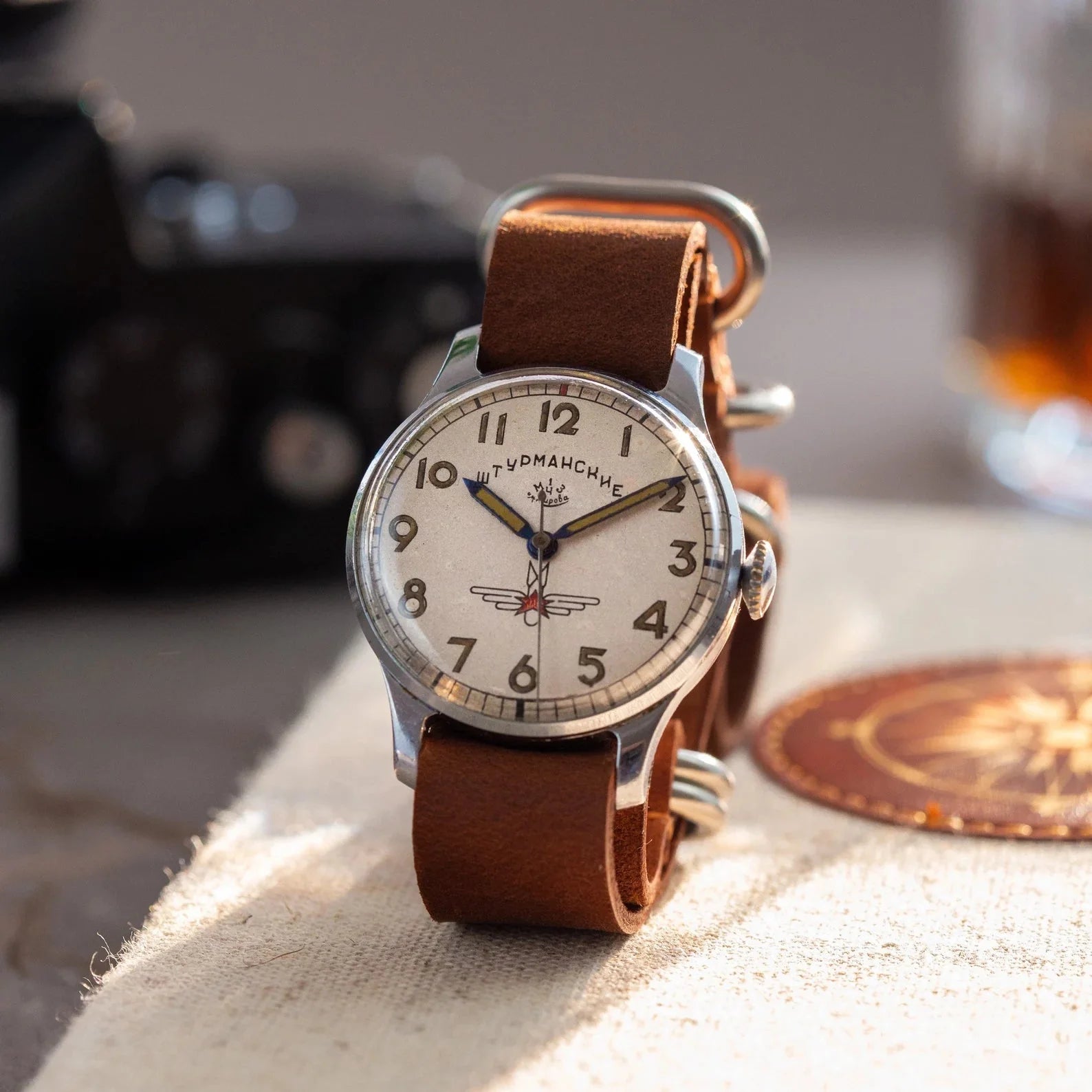
Sturmanskie means "navigator's", and the factory made it for Air Force pilots from 1949, before the Poljot name existed. Yuri Gagarin received one in 1957 and wore it on Vostok 1 in 1961. Our article on the first watch in space tells the story of his watch and the two Sturmanskie types.
De Luxe
The De Luxe is Poljot's dress watch, and its hand-wound caliber 2209 has 23 jewels and a very thin build, so the case sits low on the wrist under a shirt cuff. The factory made De Luxe watches from the mid-1960s into the late 1970s, with dials in Latin letters for export. Our review Is Poljot De Luxe a good watch? goes through the model in detail.


A gold-plated Poljot De Luxe from our archive
Signal Alarm Watches
Signal was the name the factory gave its mechanical alarm watches, and later examples carry the Poljot name with the caliber 2612. A second crown sets the alarm time, and a separate mainspring drives a small hammer that strikes the inside of the case. A Signal in working order is still loud enough to wake its owner.
Okean
In the 1970s the factory bought Swiss machinery for complex watches. From it came the 3133, a hand-wound chronograph with a date that collectors connect with the Swiss Valjoux 7734. The Okean, a chronograph for the Soviet Navy, used it first, and the 3133 then went into Poljot and Sturmanskie chronographs for decades.
Amphibian
Poljot made its own diver, the Amphibian, from 1972. The Chistopol factory's Vostok Amphibia is the better-known Soviet diver, so the Poljot version turns up less on the market. Ours is an automatic in a 38 mm case from the 1970s.

Poljot Calibers
On a Poljot, the caliber number on the movement is the surest guide, because the factory reused dial designs across movements. These are the calibers we find in Poljot watches.
| Caliber | Type | Found In |
|---|---|---|
| 3017 | Hand-wound column-wheel chronograph, 1959–1979 | Strela, Poljot and Sekonda chronographs |
| 3133 | Hand-wound chronograph with date, from the 1970s | Okean, later Poljot and Sturmanskie chronographs |
| 2209 | Ultra-thin hand-wound, 23 jewels | De Luxe and other slim dress watches |
| 2612 | Hand-wound with mechanical alarm | Signal and Poljot alarm watches |
| 2616 | Automatic | Poljot automatics, including the Aeroflot model |
The movement also carries the factory's logo, and Soviet movements for the home market mark it in Cyrillic. If a seller can't show the movement, you can't confirm which Poljot you're buying.
Poljot After the Soviet Union
After the USSR ended, the factory became a joint-stock company in 1992 and kept making watches for a few more years. Around the turn of the century production stopped, and smaller firms took over its equipment and leftover movements. Volmax, set up by former employees, sells watches under names that include Sturmanskie and Buran.
These firms fit Poljot-era movements into new cases and dials. If you want a vintage Poljot made before 1991, look for Soviet markings on the movement and the case, because the later watches don't carry them.
How to Date a Vintage Poljot
The name on the dial is the first thing to look at. A Kirovskie or Sputnik dial belongs to the years before 1964, and a dial that says Poljot or ПОЛЁТ comes from 1964 or later. If the dial uses Latin letters and says "Made in USSR", the factory made the watch for export.
For chronographs with the 3017, the serial number on the movement narrows the date further. Our guide How to Date a Strela by Serial Number has the full serial table. For other Poljot watches, the caliber number and the case style together place the watch within a decade.
What to Check Before Buying a Poljot
Before we list a Poljot, we compare the caliber with the model on the dial. A Strela needs a 3017 inside, and a Signal needs an alarm movement such as the 2612, so a famous dial on the wrong movement shows up at once. This mismatch is the problem we meet most with Poljot watches, and you can check it yourself if the seller sends a photo of the movement.
The dial deserves a close look too, since space and military designs attract repaints. Original printing is crisp, and the dial and hands age at the same pace. On gold-plated watches, a caseback stamped AU 20 means 20 microns of gold, and the lug edges and the rim of the caseback are where brass first shows through.
Original Poljot watches have acrylic crystals, and a scratched one polishes out for very little money. A sapphire crystal or a case without Soviet markings tells you that someone has replaced parts, or that the watch comes from the years after 1991.
When a Strela dial turns up on anything other than a 3017, we send the watch back to the seller. Some of the watches we've returned looked right from the front, and only the movement showed the problem.
On gold-plated De Luxe watches we check the plating at the lugs before we set a price, and a De Luxe with clean plating and an original dial sells within weeks in our shop.
Poljot Watches in Our Shop
These are the Poljot watches we have now, with prices as of November 2026. The Strela and the Amphibian above are also available.


Every watch we list stays on our site after it's sold, so you can still see the photos and details. These Poljot watches have found new owners.
 Strela · Cal. 3017 With 1960 Pilot's Certificate Sold for $2,500
 Poljot · Cal. 3017 Military Chronograph, 1960s Sold for $1,250
 Poljot · De Luxe Extra Slim Case, 1970s Sold for $378
 Poljot · De Luxe De Luxe "Space", 1970s Sold for $182
You can see every Soviet watch we have now in our vintage Soviet watch collection.
Your Questions Answered
Frequently Asked Questions